New calculations tighten how heavy elements form in stellar explosions
A new ab initio calculation sharpens the beta-decay “clock” at the r-process waiting points, improving heavy-element abundance models without rewriting the story of mergers or kilonovae.
A speck of gold on a ring, a trace of platinum in a lab sample, the heavy stuff that only appears when the universe gets violent enough to rebuild itself, all of it depends on nuclear clocks that are notoriously hard to read. This new study tightens one of the most important clocks in that chain: the beta-decay half-lives of neutron-rich nuclei sitting at the N=50 waiting point in the r-process.
The work, by Zhen Li, Takayuki Miyagi, and Achim Schwenk, brings a sharper nuclear-physics lens to the question of how matter climbs past the bottlenecks that slow rapid neutron capture in explosive astrophysical environments. The payoff is practical as much as cosmic: better half-life predictions mean better abundance calculations for the elements forged in neutron-star merger ejecta and other r-process sites.
The waiting point that holds up the line
The nucleus at the center of the story is 78Ni, with 28 protons and 50 neutrons. Technische Universität Darmstadt describes it as the most neutron-rich doubly magic nucleus discovered to date, and its spectroscopic study has already given direct evidence for doubly magic behavior, while hinting at competing spherical and deformed configurations. That makes it more than a curiosity. It is a benchmark for the shell structure that shapes how neutron-rich matter behaves near the N=50 closure.
In the r-process, these N=50 nuclei act like toll booths. They accumulate material because beta decay, not neutron capture, becomes the limiting step. When the half-lives are long or uncertain, the entire flow of nucleosynthesis shifts, and so do the predicted abundances of heavy nuclei downstream. That is why this region has stayed under intense scrutiny, especially around 78Ni.
What the new calculation adds
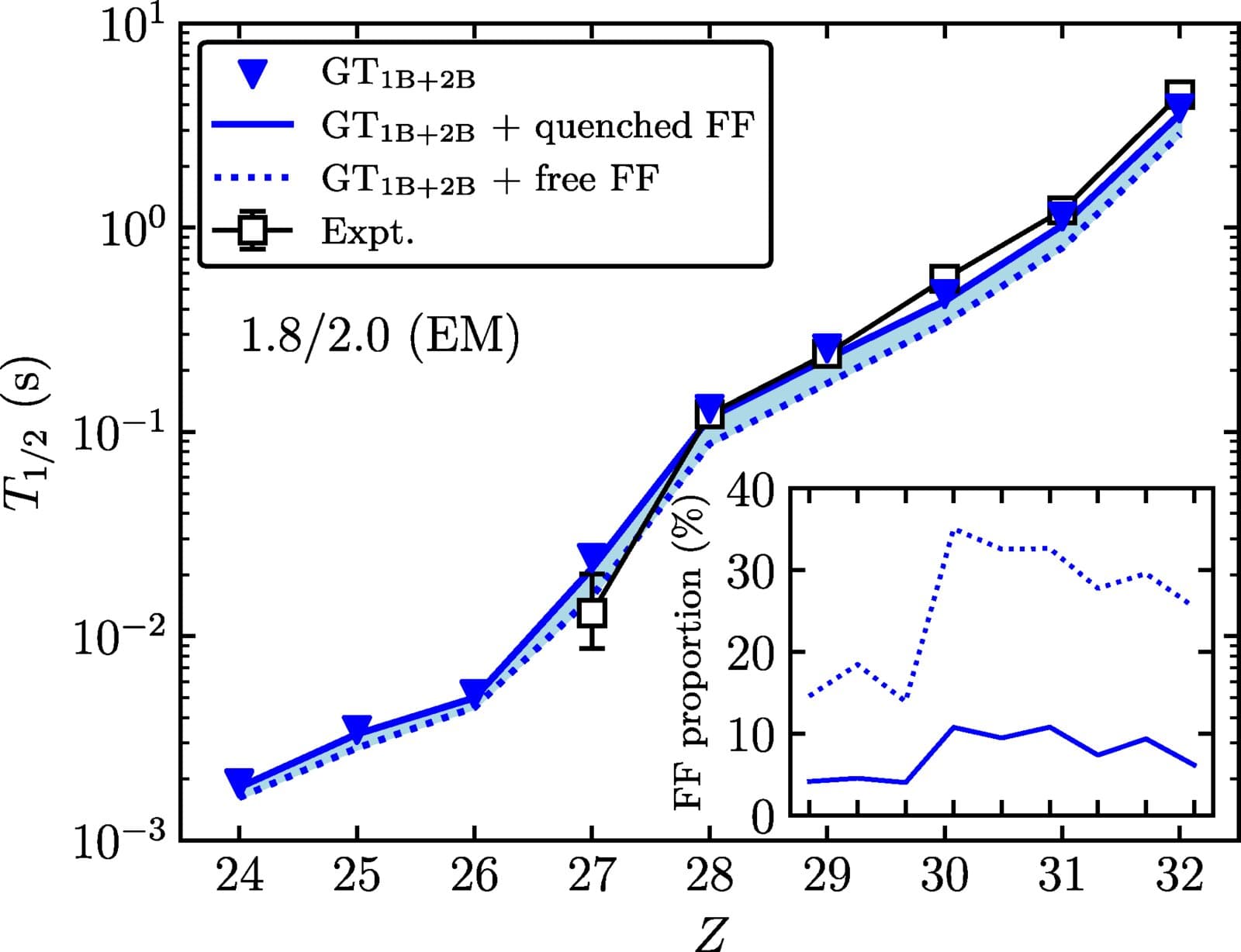
The new paper, Ab Initio Calculations of -Decay Half-Lives for N=50 Neutron-Rich Nuclei, was published in Physical Review Letters on 5 May 2026, with the arXiv version last revised on 7 May 2026. Its central move is to calculate beta-decay properties from the ground up, using chiral effective field theory inputs rather than tuning the theory to match known data.
The team then used the in-medium similarity renormalization group to derive valence-space Hamiltonians and weak operators. That matters because it turns a fundamental-interactions framework into something that can be applied in a realistic shell-model space. The model space is also larger than in previous beta-decay calculations in this region, with pf-shell protons and pf-sdg-shell neutrons, which gives the calculation more room to capture the structure that matters near the N=50 closure.
The result is not just a formal upgrade. The paper finds that including two-body currents increases the predicted total beta-decay half-lives and brings them into very good agreement with the experimental data already available. The study also looks at first-forbidden contributions, which become relevant when simple allowed decay channels do not tell the whole story.
Why experimental cross-checks still rule the game
The value of the calculation comes from how well it matches the data that already exist. That is the bridge between theory and the working nuclear-physics program at places like the RIKEN Radioactive Isotope Beam Factory, where the latest relevant experiments were carried out. In this part of the chart, direct measurements are difficult because the nuclei are so short-lived and so far from stability, which is exactly why a trustworthy ab initio method matters.
RIKEN has treated this region as a priority for years. In 2016, the BRIKEN Collaboration commissioned what it described as the world’s largest and most efficient beta-delayed neutron detector at RIBF, specifically to study exotic neutron-rich nuclei systematically, including the N=50 shell-closure region near 78Ni. That experimental backbone is important because the r-process does not depend on one observable alone. Beta-decay half-lives and beta-delayed neutron emission probabilities both feed abundance models, and the better those inputs are known, the less guesswork remains in the final heavy-element tally.
What model uncertainty gets reduced
The long-standing uncertainty this work helps reduce is the beta-decay input at the waiting points themselves. In practice, that means less ambiguity in how quickly material can flow through the N=50 bottleneck and into heavier nuclei. The study does not erase all uncertainty in heavy-element production, but it narrows a key piece of the nuclear-physics error budget that has repeatedly limited abundance calculations.
That fits with the broader direction of recent RIKEN-led work. A 2023 measurement of 20 neutron-rich nuclei improved agreement with solar-system abundance models and reduced nearly 30% of the inherent uncertainty in those models. This new calculation builds on the same logic: every better-measured or better-predicted waiting-point nucleus makes the global r-process picture more stable.
Does this change the story of kilonovae or gold?
Not in a dramatic, headline-rewriting way. The study does not overturn the idea that neutron-star mergers are a major r-process site, and it does not change the basic interpretation of kilonovae as the visible glow of freshly synthesized heavy material. What it does is make the modeling underneath those interpretations more reliable.
That distinction matters. Kilonova light curves and abundance patterns are only as good as the nuclear inputs that feed them. By tightening beta-decay half-lives near 78Ni and the N=50 waiting points, the new work improves the timing of the nuclear reaction chain that determines how much mass reaches the gold, platinum, and neighboring heavy-element region. In other words, it sharpens the detective work, even if the case itself still points toward the same cosmic crime scene.
A smaller technical step with a larger reach
The real significance of the paper is how it connects accelerator-based measurements, nuclear modeling, and astrophysical element formation in one continuous chain. It is a laboratory calculation with cosmic consequences, the kind of result that rarely makes a splash on its own but quietly redraws the confidence limits on a major piece of the universe’s heavy-element map. When the stopwatch at the waiting point gets more accurate, the whole trail of heavy elements becomes easier to follow.
This article was produced by Prism’s automated news system from verified source data, official records, and press releases, then run through automated quality and moderation checks before publishing. The system is built and supervised by the people who set the standards it runs under. Read our full AI policy.
Did this article answer your question?