NRC reviews Indiana bid to become 41st Agreement State
Indiana’s bid would shift licensing and inspections for about 200 radioactive material users from federal hands to state control, with comments open through June 15.
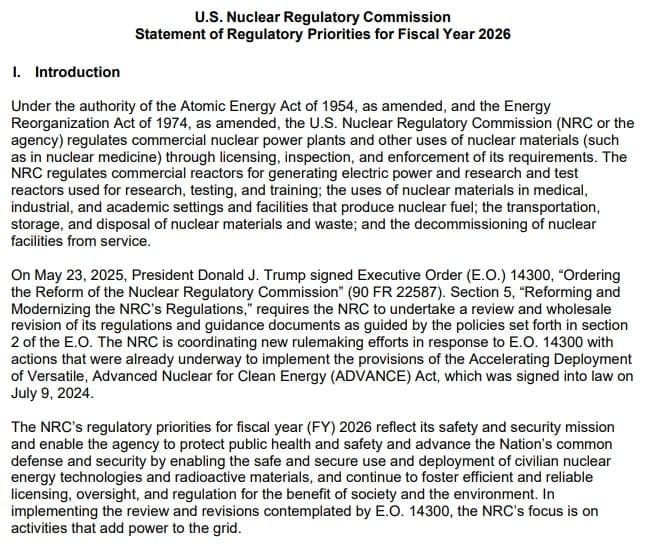
The Nuclear Regulatory Commission is weighing a shift that would be felt first by hospitals, universities and industrial facilities that handle radioactive material in Indiana. If the state wins approval to become an Agreement State, Indiana would take over licensing, inspection and enforcement for about 200 users, while the NRC would step back from direct control over those covered materials and keep authority over about 20 licenses and federal entities.
The commission published Indiana’s proposed agreement and draft staff assessment in the Federal Register on May 15 and opened a public comment period through June 15 under Docket ID NRC-2026-1387. NRC staff are asking for comments on the proposed agreement, its effect on public health and safety, the draft staff assessment, the adequacy of Indiana’s program, and whether the state has enough staffing to carry the load.
Indiana filed its request with the NRC on January 29, 2026, and Governor Mike Braun certified that the state has a program adequate to protect public health and safety for the materials covered. The application seeks authority over byproduct material, source material and special nuclear material not sufficient to form a critical mass. If approved, Indiana would become the 41st Agreement State, joining the 40 states already operating under the NRC’s state-agreement framework.
That framework matters because it is how the United States manages large numbers of radioactive material users in medicine, industry, research and academia without keeping every license at the federal level. Under the arrangement, a state must show legal authority, trained staff and a program that is compatible with NRC rules. The federal agency then continues to oversee the state program rather than each individual licensee, making the handoff a test of whether Indiana can absorb regulatory responsibility without weakening standards.

Indiana already has a radiological infrastructure in place. The state’s Radiation Program sits in the Indiana Department of Homeland Security, and a state memorandum of understanding says the Radiological Health Program moved from the Indiana State Department of Health to IDHS in 2013. IDHS says its Hazmat and Radiation Programs regulate the use of radioactive materials, register facilities that have radioactive materials and investigate radioactive materials found in the public in coordination with the Indiana Department of Environmental Management and others.
NRC staff told commissioners they were aiming to finalize and issue the agreement by September 30, 2026, although an April 7, 2025 letter said Indiana had originally expected a final agreement soon after January 1, 2026 and that the schedule slipped because of application delays. NRC staff and commissioners have also noted extensive engagement with Tribal governments during the review. For Indiana’s hospitals, labs and industrial users, the real change is not a title shift in Rockville or Washington, but who signs off, who inspects and who answers when radioactive material is on the line.
Know something we missed? Have a correction or additional information?
Submit a Tip