Pacific Fusion prototype delivers 440 gigawatts in 80 nanoseconds
Pacific Fusion’s subscale pulser hit 440 gigawatts in 80 nanoseconds, a hardware check that could unlock more funding and a full-size buildout.

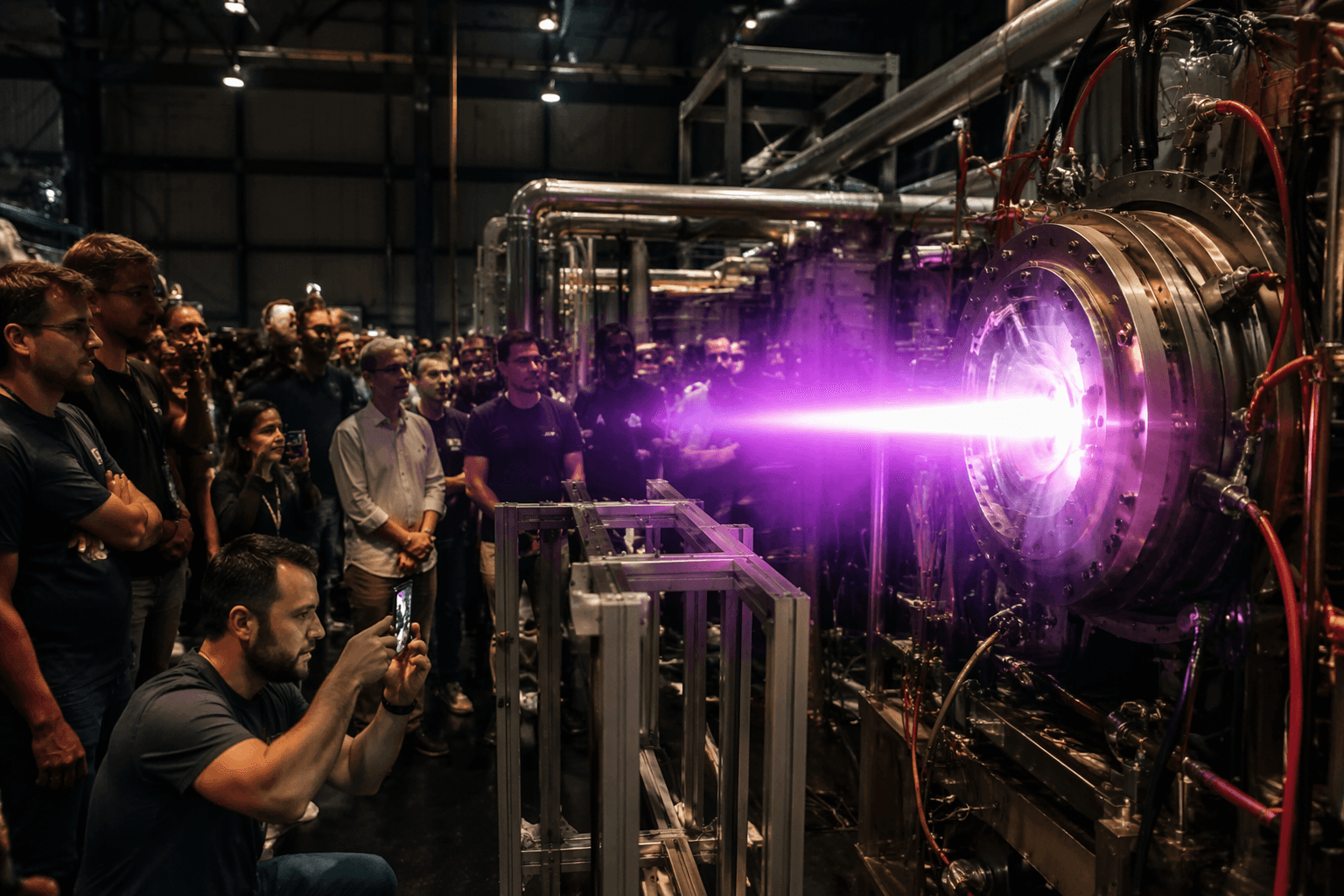
Pacific Fusion says its latest pulser test is more than a flashy power number. The company’s sub-scale module delivered 440 gigawatts of peak power in 80 nanoseconds, a result Pacific Fusion is treating as a key validation step on the path to its full demonstration system and the first major proof that its pulsed-power architecture can be built, timed and controlled at scale.
The prototype is about one-third the size of the full pulser module, the core energy driver in Pacific Fusion’s design. The tested unit reportedly included nine stages and 90 bricks, a layout meant to show that the company can stack and synchronize the hardware needed to compress a fuel pellet with an intense magnetic pulse. Pacific Fusion says each full module is intended to be shipping-container-sized and capable of delivering more than a terawatt in a pulse lasting about 100 nanoseconds, so the 440-gigawatt result is best read as an early subsystem milestone, not a finished reactor-performance claim.
That distinction matters. The test does not amount to ignition, net energy, or grid-ready electricity. What it does suggest is that Pacific Fusion has moved from architecture on paper toward repeatable hardware behavior inside the machine stack it will need for a future demonstration plant. The company said the result was strong enough to unlock another tranche of its Series A funding, a round that now exceeds $1 billion, though it did not disclose the size of the new release.
Pacific Fusion, founded in 2023 and led publicly by figures including Eric Lander, Will Regan, Keith LeChien, Carrie von Muench and Leland Ellison, emerged in October 2024 with more than $900 million in pledged Series A backing. General Catalyst led the round, with Breakthrough Energy Ventures also among the backers and coverage naming Bill Gates, Eric Schmidt and Ken Griffin as individual investors. The financing has always been tied to a build-it-like-industry pitch, not a lab-only science program, and this pulser result fits that strategy.
The company’s larger timetable is still aggressive. Pacific Fusion says its Demonstration System is aimed at net facility gain by 2030, meaning more fusion energy out than total stored energy in the system. It has also said the future machine should be capable of producing some of the most intense bursts of energy on Earth starting in 2028. The recent work at Sandia National Laboratories’ Z Pulsed Power Facility, where four shots at 22 million amps tested simplified target concepts, showed how Pacific Fusion is pushing on both sides of the problem: the pulser that drives the shot and the target that makes the shot useful.

There is also a physical plant taking shape around the hardware. In September 2025, New Mexico officials announced Pacific Fusion had selected Albuquerque’s Mesa del Sol for a $1 billion Research and Manufacturing Campus, with construction expected in 2026 and operations by mid-2027. Pacific Fusion also launched a Users Program in March 2026 for outside researchers from industry, academia and government. For a field where so much still lives in theory, the company’s 440-gigawatt burst is notable because it points to something much harder than a headline number: a machine architecture that can survive the jump from a one-third-scale pulser to the full-size system it needs next.
This article was produced by Prism’s automated news system from verified source data, official records, and press releases, then run through automated quality and moderation checks before publishing. The system is built and supervised by the people who set the standards it runs under. Read our full AI policy.
Did this article answer your question?