Paks II advances with concreting, excavation, and safety monitoring
Unit 5 is being concreted while Unit 6’s pit is already more than halfway excavated, marking Paks II’s shift from planning to heavy civil works.

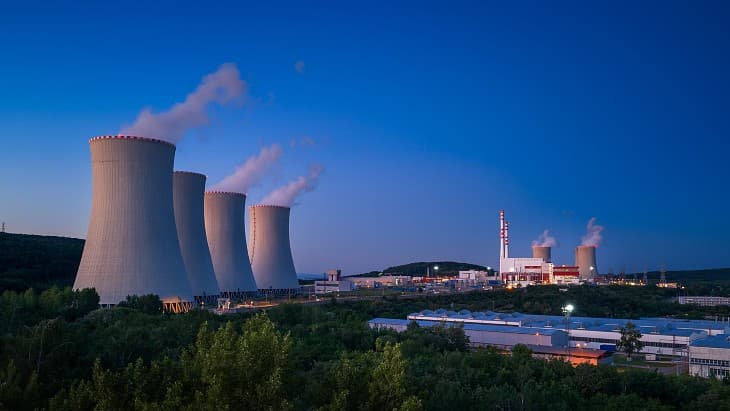
Concrete is going in on Unit 5 at Paks II while excavators keep cutting down Unit 6’s reactor pit, a visible sign that Hungary’s new-build has moved well beyond design work and into the hardest part of any nuclear project: the civil works that lock in the reactor island.
The June 25 update shows how far that sequence has advanced. The Unit 6 excavation measures about 150 metres by 190 metres and reaches roughly 23 metres in depth, and more than half of the estimated 500,000 cubic metres of soil has already been removed. Alongside the digging, secant pile wall anchoring and permanent fence construction are moving forward, while geodetic and geotechnical monitoring is in operation so changes in ground conditions can be detected early. The Hungarian Atomic Energy Authority is also carrying out regular inspections at the site.
That combination of excavation, reinforcement, and monitoring matters because it marks the point where a reactor project stops being a line on paper and becomes a controlled industrial site with measurable thresholds. Once a pit like Unit 6 is fully opened and prepared, the next visible milestone would be the first major foundation concreting in that footprint, followed by the below-grade structures that support the reactor building.

Paks II is also building out the workforce side of the project at the same time. A six-storey operator training centre with about 15,000 square metres of floor space is under construction, with space planned for control-room staff, field operators, refuelling-machine operators, and maintenance staff. The facility is expected to include both a full-scope simulator and an analytical simulator, turning operator qualification and emergency training into part of the physical build rather than a later add-on.
The construction update lands against a long and complicated project history. Hungary and Russia signed the Paks II intergovernmental agreement and contract in December 2014 for two Rosatom-supplied VVER-1200 reactors. The European Commission approved Hungary’s state-aid measure on 6 March 2017, then the Court of Justice of the European Union annulled that approval on 11 September 2025 in Case C-59/23 P over procurement-law issues tied to the direct award of the construction contract. Even with that legal backdrop, physical work has continued on site.
That continued pace is easier to read in the context of the existing plant next door. Hungary’s four operating Paks units are VVER-440 reactors, and the station generated 16,016.6 GWh in 2024, close to half of Hungary’s gross electricity production and about one-third of domestic consumption. For Paks II, the story today is not just that work is continuing, but that the most visible markers are now concrete, deep earthworks, and the machinery needed to keep both construction and future operation under control.
This article was produced by Prism’s automated news system from verified source data, official records, and press releases, then run through automated quality and moderation checks before publishing. The system is built and supervised by the people who set the standards it runs under. Read our full AI policy.
Did this article answer your question?