Ports, not reactors, may decide nuclear ships’ future
Nuclear shipping is moving from concept to port checklist. A new Rotterdam study shows the real hurdles are rules, liability, and emergency planning, not just reactor design.
Nuclear-powered ships are no longer being discussed only as a reactor problem. The harder question now is practical: what has to be in place before a nuclear vessel can legally and safely make a port call at Rotterdam? A new joint study from Core Power, Maersk, Lloyd’s Register and the Port of Rotterdam says the answer is less about core physics and more about whether ports, regulators and insurers can turn nuclear shipping into an operational routine.
What the Rotterdam study is really testing
The report, *Enabling Nuclear-Powered Feeder Ships - A Joint Development Project on Port Call Feasibility and Regulatory Pathways*, is designed as a desktop study, not a design study. Its purpose is to map the questions that need answers before a nuclear-powered feeder ship moves from conceptual acceptance to operational readiness. That makes it especially useful for a community that already understands the difference between a promising machine and a deployable system.
The report uses a hypothetical Maersk container ship calling at Rotterdam to make the issue concrete. Instead of treating nuclear propulsion as a distant shipping pitch, it asks what an actual port authority would need to see before it allowed the ship to enter, berth, operate and depart under controlled conditions. In other words, the real milestone is not a reactor on paper. It is a port call that can survive regulatory scrutiny, emergency planning and public acceptance.
Why the biggest barriers are not technical
The study’s central finding is blunt: the main obstacles are not technical. According to the report, the hardest problems are regulatory alignment, governance, risk-management integration and public acceptance. That matters because maritime nuclear projects are often discussed as though engineering performance alone will decide the outcome, when in practice the port ecosystem will be the gatekeeper.
Core Power chief executive Mikal Bøe has argued that civil maritime nuclear propulsion will depend on trust from port cities and the people who live in them. Port of Rotterdam harbour master René de Vries has framed the issue as one of future port operations and industrial systems. Lloyd’s Register’s Meg Albrecht has said maritime decarbonization will require the industry to examine a range of future fuel and propulsion pathways. Taken together, those views point to the same conclusion: the next phase of nuclear shipping is administrative as much as it is mechanical.
For readers used to following nuclear reactions in hardware, this is the key shift. The question is no longer only whether a reactor can run at sea. It is whether a port can write a safety case around it, coordinate response procedures, define responsibilities and convince everyone from shipowner to local authority that the system can be managed.
The regulatory scaffold already exists, but only in pieces
This is not a blank-slate issue. The International Maritime Organization’s SOLAS Chapter VIII already contains basic requirements for nuclear-powered ships, and the IMO Code of Safety for Nuclear Merchant Ships was adopted in 1981. That gives the industry a long-standing international reference point, even if it has not yet translated into commercial deployment at scale.
Liability is also not a new debate. The IMO Convention relating to Civil Liability in the Field of Maritime Carriage of Nuclear Material was adopted on 17 December 1971 and entered into force on 15 July 1975, with the International Atomic Energy Agency and the Organisation for Economic Co-operation and Development Nuclear Energy Agency involved in the framework. That history matters because any real port call would have to fit not just technical safety rules but also a liability and insurance structure that can withstand a serious incident.
The United Kingdom has already taken a more recent step. The Merchant Shipping (Nuclear Ships) Regulations 2022 implement SOLAS Chapter VIII and the Nuclear Code, and they state that nuclear ships are subject to special control before entering a UK port and while in port. That is the sort of detail that turns nuclear shipping from theory into procedure: who inspects, who clears, who monitors, and under what authority.
Why Rotterdam is the right test case
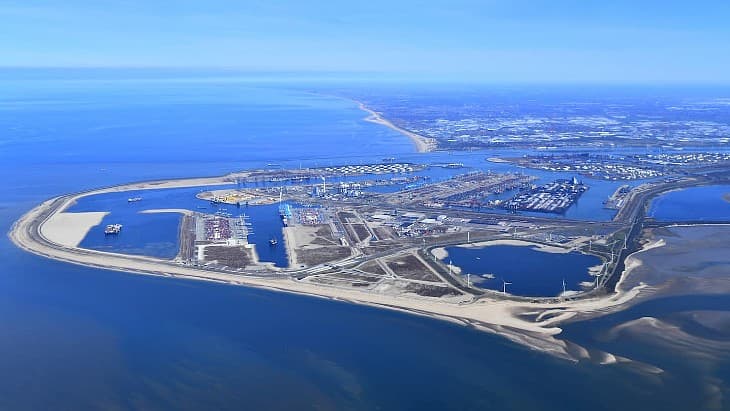
Rotterdam is not being used as a backdrop by accident. The Port of Rotterdam says its 2025 annual report covers a port that remains an essential engine for the Netherlands, Europe and global logistics chains. Its facts-and-figures material puts the scale at about 12,500 hectares of port area, more than 40 kilometres of port length, and roughly 428 million tonnes of cargo throughput.
That scale is part of the point. A port that large already lives in the world of complex sequencing, safety management and industrial coordination. It also has reason to think ahead: Rotterdam’s 2050 Port Vision, launched in 2026, says the port aims to be Europe’s most competitive, sustainable and resilient port by 2050. The nuclear-shipping study therefore lands in a place that is already actively planning for long-term propulsion and logistics changes.
The Port of Rotterdam Authority’s 2025 annual report also says revenues rose by 6.6% to €940.4 million. That financial strength underlines why the authority can treat future propulsion questions as strategic infrastructure planning rather than speculative curiosity.
What has to happen before docking becomes routine
If a nuclear-powered feeder ship were ever to call at Rotterdam, the report suggests a series of milestones would need to line up before the bow comes inside the breakwater. Those milestones are visible proof that the project has moved beyond design enthusiasm.
- Regulatory pathways would need to be clear enough for port-state control, licensing and shipboard requirements to work together.
- Governance would need defined roles across port authority, ship operator, regulator and emergency responders.
- Risk-management systems would need to cover normal operations, incident escalation and cross-border legal responsibility.
- Public acceptance would need to be strong enough that port cities see the ship as a managed industrial asset rather than an undefined hazard.
- Insurance and liability arrangements would need to be credible, because no commercial operator can berth without them.
That is why the report matters to the nuclear reactions community even though it is about shipping. It shows how a reactor stops being an isolated piece of hardware and becomes part of a broader operating system. The decisive work shifts to procedures, permissions and proof that every stakeholder knows what happens before, during and after the port call.
When a nuclear ship can finally dock at Rotterdam, the breakthrough will not be measured by a splashy headline about propulsion. It will be measured by whether the port can treat the vessel like a controlled, regulated and insurable part of everyday operations. That is the real checklist now, and it is the one that will decide whether nuclear shipping becomes a commercial reality or remains a concept waiting for its port clearance.
This article was produced by Prism’s automated news system from verified source data, official records, and press releases, then run through automated quality and moderation checks before publishing. The system is built and supervised by the people who set the standards it runs under. Read our full AI policy.
Did this article answer your question?