ST40 fusion reactor captures 100 million-degree plasma in color video
ST40’s new color footage turns a 100 million-degree blur into a diagnostic map, showing deuterium and lithium moving through the edge of the plasma.

Tokamak Energy has turned ST40’s plasma from an abstract heat record into something scientists can actually watch in motion. The compact spherical tokamak, which previously hit ion temperatures above 100 million degrees Kelvin, has now been captured in vivid color at 16,000 frames per second, giving researchers a rare look at how fuel and materials behave at the plasma edge.
The video matters because it is not showing the core directly. Tokamak Energy says the core is too hot to emit visible light, so the camera is reading the edge, where the action can still reveal a great deal about what is happening inside the machine. In the footage, deuterium plasma appears pink, neutral lithium glows crimson-red in cooler outer regions, and ionized lithium, or Li+, turns greenish-yellow as it moves deeper into the plasma and follows magnetic field lines. That makes the clip useful for tracking fuel injection, watching impurities spread, and checking whether the plasma is behaving the way the operators expect.
That is especially important for work on X-point radiator, or XPR, regimes, a mode Tokamak Energy is studying as a way to cool plasma before it reaches plasma-facing components. In plain terms, the goal is to reduce wear on the machine without giving up performance. The same camera is also helping validate spectroscopy measurements, so the new footage is not just a visual aid but a cross-check on the numbers coming from other diagnostics.
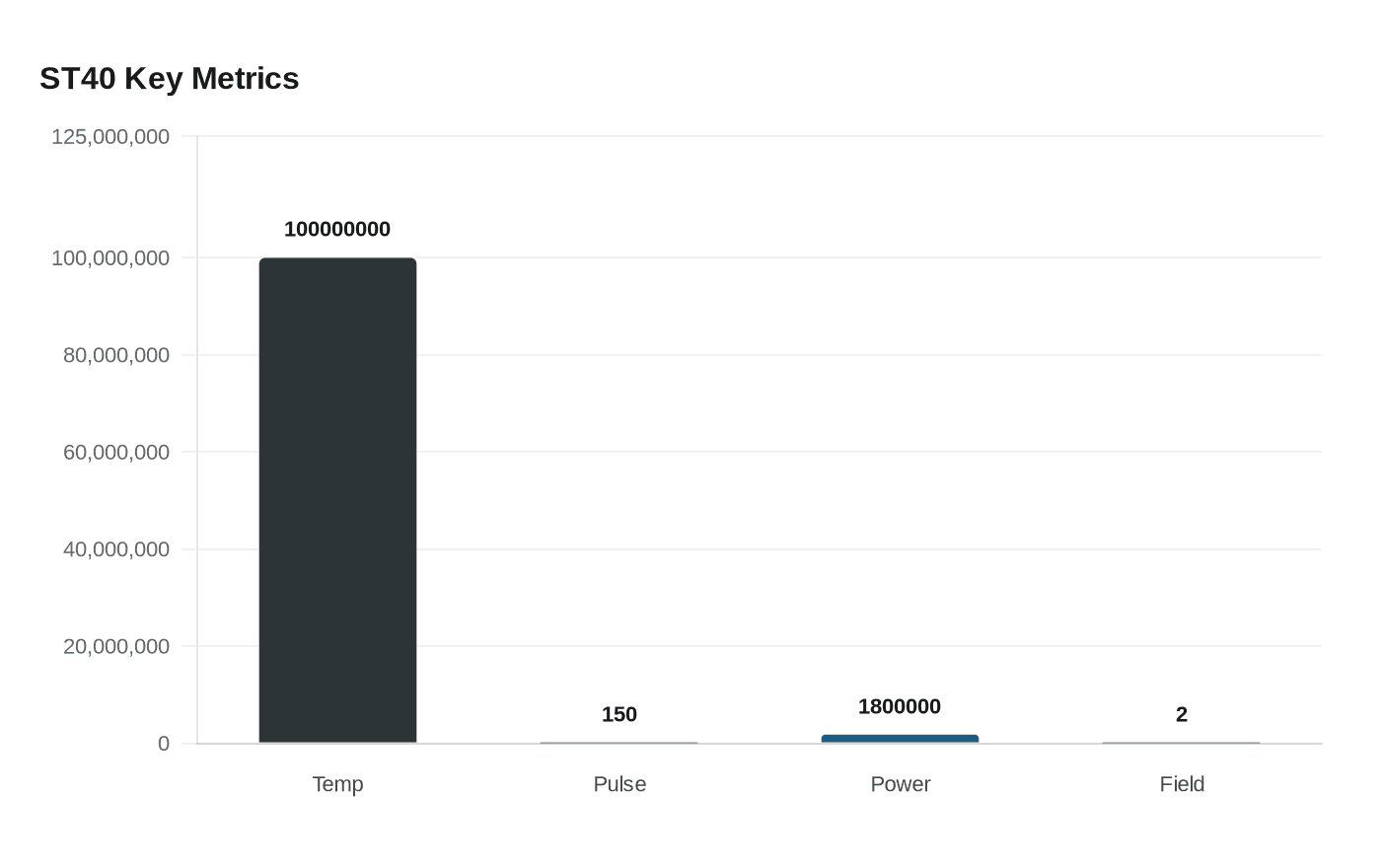
The interest around the video rests on a machine that already sits in a small club of notable fusion devices. ST40’s ion temperatures exceeded 100 million degrees Kelvin in discharges that lasted about 150 milliseconds, with the plasma heated by 1.8 million watts of high-energy neutral particles and confined at toroidal magnetic field values of just over 2 tesla. The published results reported a fusion triple product of about 6 ± 2 × 10^18 m^-3 keV s, a benchmark that keeps ST40 in the conversation as a compact, high-field path toward commercially relevant fusion.
Tokamak Energy’s broader LEAPS upgrade program, a $52 million effort backed with U.S. and U.K. support, is pushing that same logic forward with lithium coatings, molybdenum armor tiles, and new diagnostics. Princeton Plasma Physics Laboratory said its scientists worked with Tokamak Energy on ST40 experiments from 2019 to 2024, underscoring how fusion progress increasingly depends on shared hardware, shared measurements, and shared tools. The new color video does not just look impressive. It shows exactly where the next round of fusion troubleshooting begins.
This article was produced by Prism’s automated news system from verified source data, official records, and press releases, then run through automated quality and moderation checks before publishing. The system is built and supervised by the people who set the standards it runs under. Read our full AI policy.
Did this article answer your question?