Study calls for standard helium reporting in reactor materials
Helium predictions in reactor alloys swung by as much as 200%, raising the risk that durability comparisons are built on a bad baseline.
A reactor alloy can look tougher on paper than it really is if the helium trapped inside is miscounted. That is the warning coming from a University of Michigan-led study with Oak Ridge National Laboratory and UT-Battelle, which found helium generation predictions for fission and fusion materials could vary by as much as 200%, enough to skew how engineers judge swelling, embrittlement, and service life.
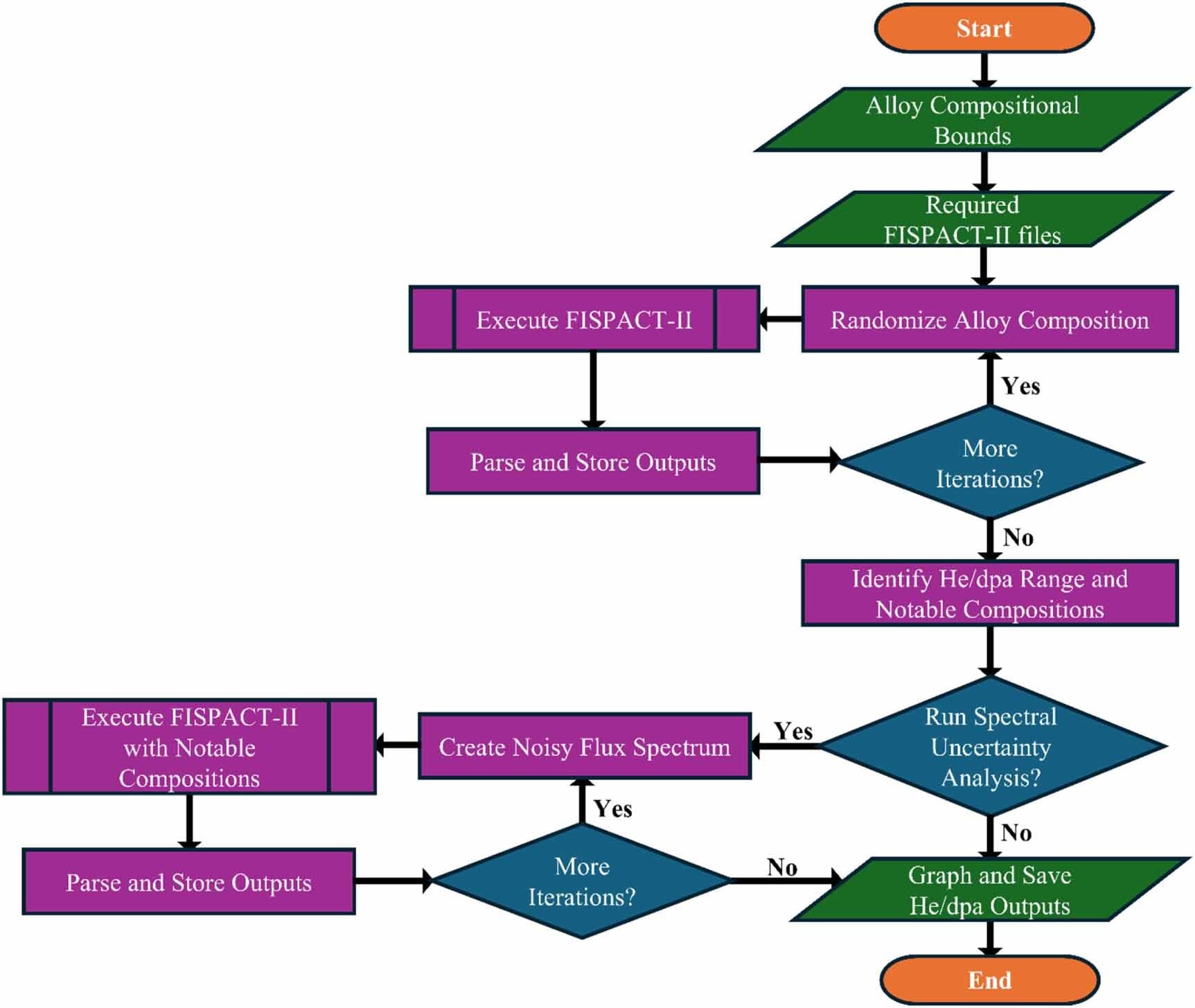
The paper, On the uncertainties in helium generation predictions for fission and fusion alloys, was received November 13, 2025, revised February 15, 2026, accepted March 10, 2026, and published March 27, 2026 in Journal of Physics: Energy. Its authors, Alexander J. Birmingham, Justin A. Hamil, Stephen Taller, and Kevin G. Field, used a Python wrapper called F-SCATTER around the FISPACT-II inventory code to systematically vary alloy composition, irradiating neutron flux spectrum, computational methodology, and nuclear data sources. The result was a clear message for the materials community: helium is not a side note in irradiation damage, it is one of the hidden variables that can decide whether a cladding or structural component keeps its shape or starts to fail early.

The study argues for standard reporting in He/dpa, helium produced per displacement per atom, so different experiments and databases can be compared on the same footing. That matters because current work often treats helium generation as a fixed constant, even though the simulations showed strong sensitivity to alloy makeup. Carbon, nitrogen, and nickel all significantly changed predicted helium output. Kevin G. Field said the method could improve the fidelity of experimental and modeling databases and help accelerate deployment of advanced nuclear systems. For reactor developers trying to qualify materials quickly, that kind of common yardstick could keep one lab’s numbers from being mistaken for another’s benchmark.
The backdrop for the work is the long-running pressure on reactor hardware. ORNL says its Fusion Materials Program, the largest of its kind in the United States, uses the High Flux Isotope Reactor to partially simulate the deuterium-tritium fusion environment while testing compatibility with liquid metals and molten salts. A 1990 review had already flagged helium effects as especially important during the swelling incubation period in fusion-relevant materials, and newer University of Michigan materials-qualification work has argued that ion-beam testing can be about 1,000 times faster and one one-thousandth the cost of conventional testing. Put together, the message is sharp: if helium is invisible in the reporting, it can quietly distort the race to build reactors that last.
This article was produced by Prism’s automated news system from verified source data, official records, and press releases, then run through automated quality and moderation checks before publishing. The system is built and supervised by the people who set the standards it runs under. Read our full AI policy.
Did this article answer your question?