Thorium-229 nuclear clocks achieve breakthrough precision in laser tests
Two teams independently locked 148 nm lasers to thorium-229, bringing a nucleus-based clock closer to a standard that could outstrip atomic timekeeping and probe new physics.
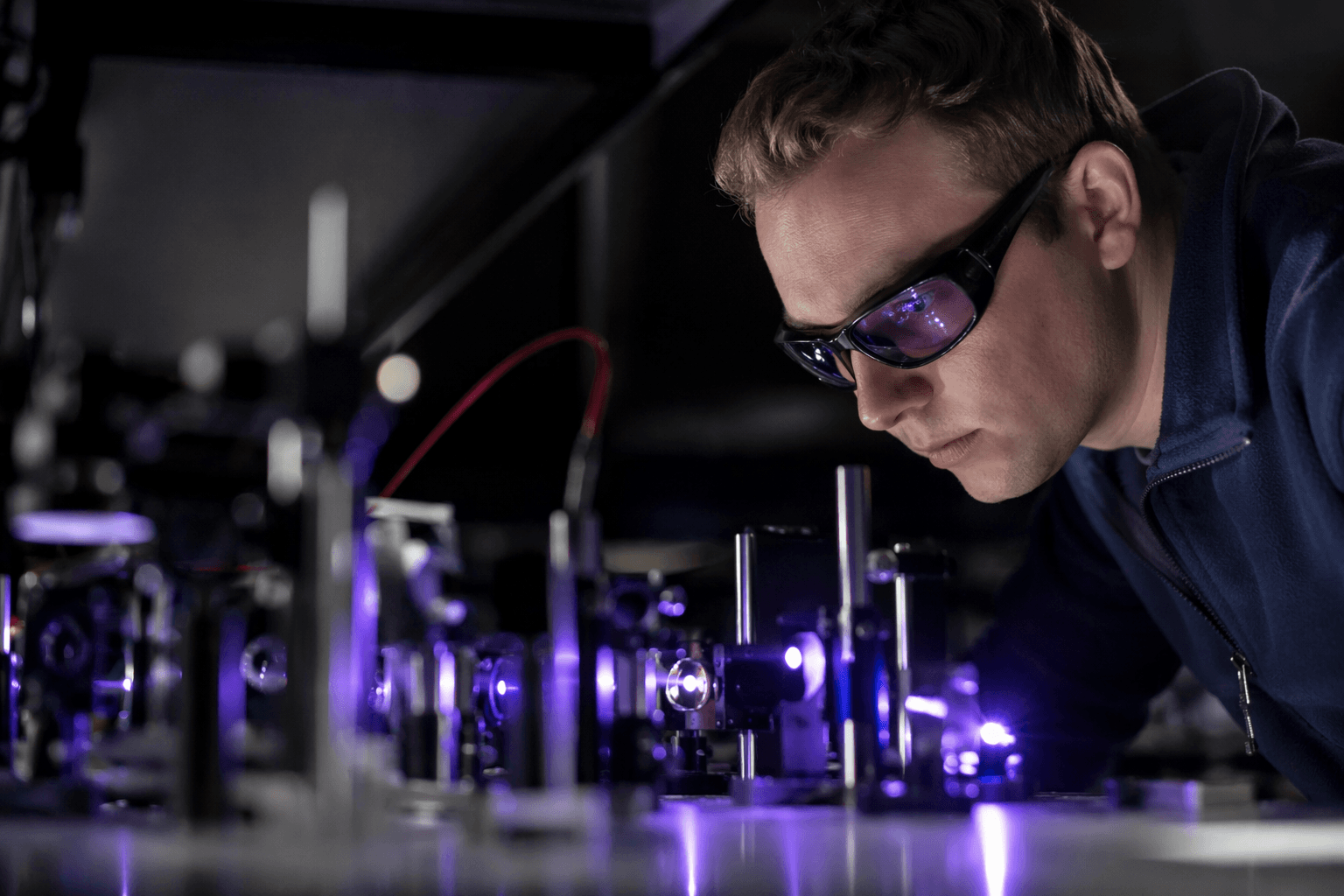
The race to build a nuclear clock has moved past proof-of-principle and into working hardware. Two independent teams, one led by Beichen Huang at Tsinghua University and one led by Luca Toscani De Col at the Vienna Center for Quantum Science and Technology, have separately built thorium-229 clock systems that use a nuclear transition rather than an electron transition to mark time.
That is the real break from atomic clocks. Atomic standards read out changes in electron energy levels, which are exquisitely useful but still exposed to the messiness of the surrounding atom. A nuclear clock, by contrast, aims at the nucleus itself, where the transition should be more isolated from stray electric and magnetic fields. Thorium-229 is the one known nucleus whose transition energy is low enough to reach with laser light, which is why the field has spent decades chasing it.
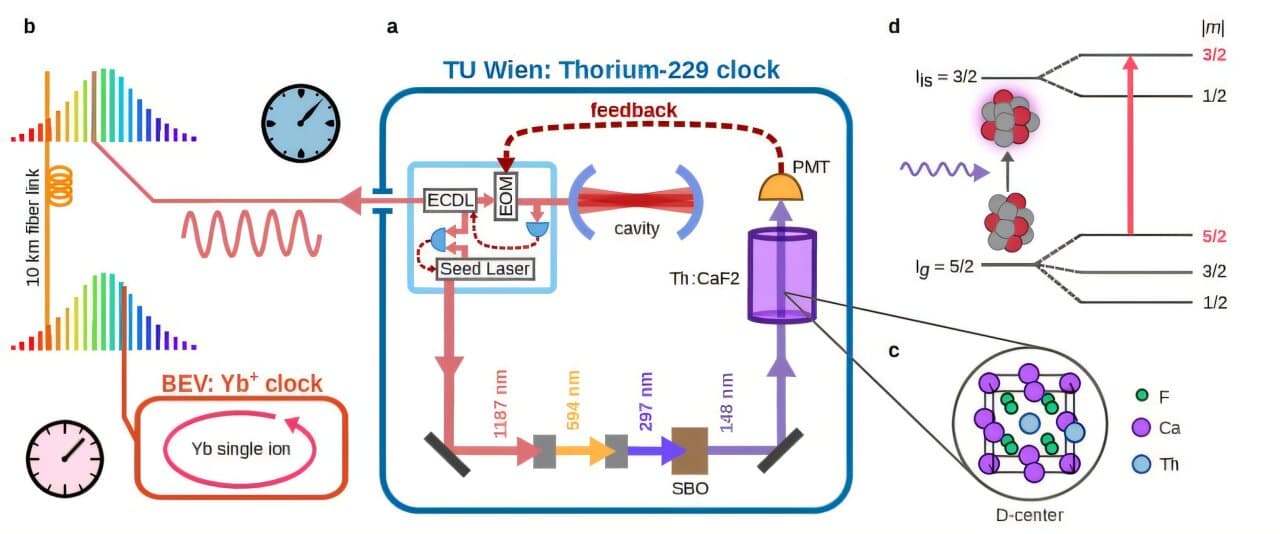
Both groups used thorium-229 embedded in calcium fluoride crystals and addressed it with a finely tuned continuous-wave laser at about 148 nanometers, deep in the vacuum-ultraviolet. The Chinese team reported stabilizing the laser frequency to the nuclear transition with fractional instability approaching one part in 10 trillion after a day. The Vienna group pursued the same nuclear target with a different crystal configuration and a different validation path, using rapid feedback and continuous absorption spectroscopy to show the clock transition could be controlled in solid state.
The technical challenge was never just finding the line. A Tsinghua-linked document puts the thorium-229 isomeric transition energy at 8.338 ± 0.024 eV, and a Nature Communications paper cited by NIST gave a transition frequency of 2,020,407,384,335(2) kHz, with a fine-structure-constant sensitivity coefficient of 5900(2300). Those numbers explain why nuclear clocks are attracting attention beyond metrology: a device this sensitive could register tiny shifts tied to the fine-structure constant, dark matter, or other signatures of physics beyond the Standard Model.
The road to this point has been long. A 2024 review traced the 229mTh idea from early conjecture to direct detection in 2016 over roughly 15 years, and NIST reported in September 2024 that scientists had already demonstrated key components of a nuclear clock and measured the thorium-229 jump with high precision. More recent solid-state work has focused on reproducibility, photonics, and nanofabrication, because a practical thorium clock will have to leave the optics table and survive as a stable platform.
The latest results do not make nuclear clocks routine yet. They do show that the clock can be tied directly to the nucleus, not just to the electron cloud around it, and that the laser control needed for that leap is now real in more than one lab. After years of chasing a nucleus that would talk to light, the field finally has two independent ways to make it tick.
This article was produced by Prism’s automated news system from verified source data, official records, and press releases, then run through automated quality and moderation checks before publishing. The system is built and supervised by the people who set the standards it runs under. Read our full AI policy.
Did this article answer your question?