Trinity College Dublin team sharpens key constant of the strong force
Trinity College Dublin cut the error on the strong coupling constant in half, giving quark-gluon physics a cleaner benchmark for LHC predictions.
A Trinity College Dublin team has produced the most precise determination yet of the strong coupling constant, the number that sets the strength of the force binding quarks and gluons inside nuclear matter. Led by Prof. Stefan Sint and joined by collaborators in Germany, Spain and Italy, the group said its new result halves the combined error of previous experimental measurements.
That matters because the strong interaction is the hardest of nature’s four forces to pin down cleanly. Unlike electromagnetism, it grows stronger with distance, a confinement effect that keeps quarks from ever being seen in isolation. Older determinations of the coupling leaned on models with larger systematic uncertainties, which left physicists with a fuzzier handle on quantum chromodynamics, the theory that describes how the strong force behaves from one energy scale to another.

The Trinity result aimed straight at that measurement race. Instead of leaning on looser model assumptions, the collaboration used advanced numerical simulations and large-scale computing to tighten the underlying calculation. The payoff is not a new machine or a new detector trick, but a cleaner constant, one that gives precision tests of the Standard Model a firmer footing and makes it easier to spot tiny deviations that could point to new physics.
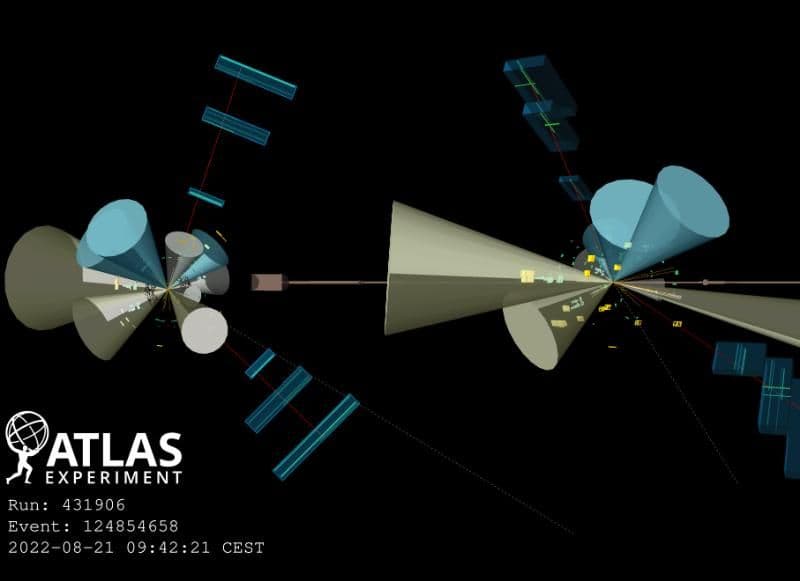
One immediate consequence is in the kind of theory predictions that feed into CERN’s Large Hadron Collider analyses. With a sharper strong coupling constant, physicists can make better predictions for collision processes where small discrepancies might otherwise be buried in the noise. The team also said the improved value will sharpen studies of the Higgs boson and its properties, where every reduction in theoretical uncertainty helps narrow the search for surprises.
For nuclear-physics readers, the milestone is real but bounded. This does not change hands-on nuclear tinkering, reactor operation, or anything visible in a lab flask or a home setup. It strengthens the numbers underneath the field, especially for the force that actually holds ordinary matter together, and that is exactly why shaving the error bar is worth tracking.
This article was produced by Prism’s automated news system from verified source data, official records, and press releases, then run through automated quality and moderation checks before publishing. The system is built and supervised by the people who set the standards it runs under. Read our full AI policy.
Did this article answer your question?