170 Rare Parrot Chicks Rescued From Smugglers on India Expressway
Crammed in containers and barely surviving, 170 rare parrot chicks were seized from smugglers on India's Eastern Peripheral Expressway. Three men arrested; forest department now stepping in.
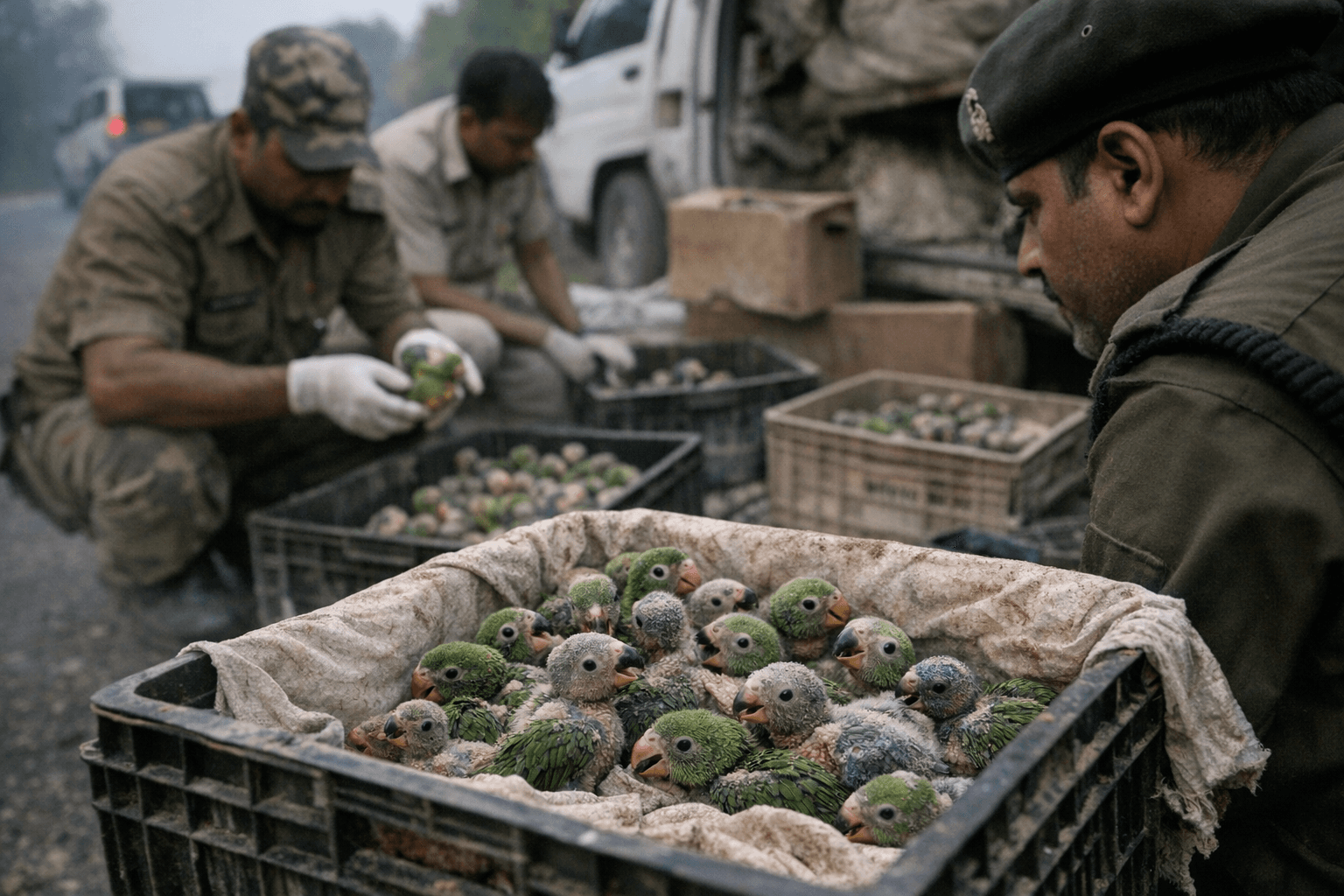
Wildlife enforcement agents in India intercepted smugglers carrying parrots concealed in cramped conditions, and this week's bust on the Eastern Peripheral Expressway was among the largest of its kind: 170 rare parrot chicks, packed into containers described by officials as cruel, were rescued by a joint team of police and animal welfare responders. Three smugglers were arrested. The birds had been transported from Rajasthan and were bound for Delhi and Ghaziabad before the operation cut the journey short.
The route is no accident. The Eastern Peripheral Expressway, a 135-kilometre, six-lane expressway passing through Haryana and Uttar Pradesh that forms part of the largest ring road around Delhi, connects Rajasthan's forested interiors to the capital's urban markets with brutal efficiency. Delhi ranks among the primary destinations in India's organized parrot trade, alongside Mumbai, Hyderabad, Patna, and Kolkata, with chicks collected from forested areas and transported to bird markets across these cities.
The demand that makes this trade profitable is something the parrot-keeping community needs to examine directly. "Rare" parrot species command premium prices precisely because buyers believe scarcity adds value. What sellers rarely disclose is that all native Indian parrots are protected species. Despite the fact that it is illegal to buy, sell, or keep parrots in captivity, these birds are still widely sold. The Alexandrine Parakeet is one of the most sought-after species in the Indian live bird trade and is traded in large volumes throughout the year. A chick labeled "captive-bred" at a street market is almost certainly wild-caught.
Knowing what paperwork to demand is the first line of defense against funding this chain. Exotic species legally sourced should carry CITES certificates; captive-bred birds require verifiable breeder documentation showing lineage and facility registration. Refuse any seller who cannot produce records, who will not allow a visit to a breeding premises, or whose pricing for a supposedly rare bird seems implausibly low. Suspicious sales can be reported to India's Wildlife Crime Control Bureau or to the nearest forest division office, both of which actively investigate trafficking networks.
The cruelty embedded in transit is the detail that should travel furthest. "When large consignments of birds are transported, the chances of them surviving are only 10 to 20 percent," according to wildlife enforcement research. Dark containers, no water, and bodies pressed together create conditions for dehydration, injury, and death before a single bird reaches a buyer. The 170 chicks intercepted on the expressway were already in critical condition; survival for many was not guaranteed at the moment of rescue.
Parrot chicks that hatch or are raised in smuggling conditions face severe developmental consequences. Early handling and transport stress during critical growth windows impairs immune function and disrupts the behavioral imprinting essential for species-normal social development. Birds subjected to crowding, dehydration, and darkness at this stage can carry those physiological deficits for life, making release to the wild a remote possibility rather than a routine outcome. Rehabilitation by the forest department involves temperature-controlled care, nutritional management, and carefully limited human contact to preserve whatever developmental capacity remains.
Three smugglers are in custody. The investigation is active. For the 170 chicks now in the forest department's hands, recovery is possible but far from certain, and the outcome will depend entirely on how thoroughly the damage from that expressway run can be reversed.
This article was produced by Prism’s automated news system from verified source data, official records, and press releases, then run through automated quality and moderation checks before publishing. The system is built and supervised by the people who set the standards it runs under. Read our full AI policy.
Did this article answer your question?