Cockatiel sweetly wakes newborn, showing strong flock bonds
Little Lady the cockatiel woke Sarah’s newborn with soft singing, turning a cute clip into a real lesson in flock bonds, supervision, and routine.
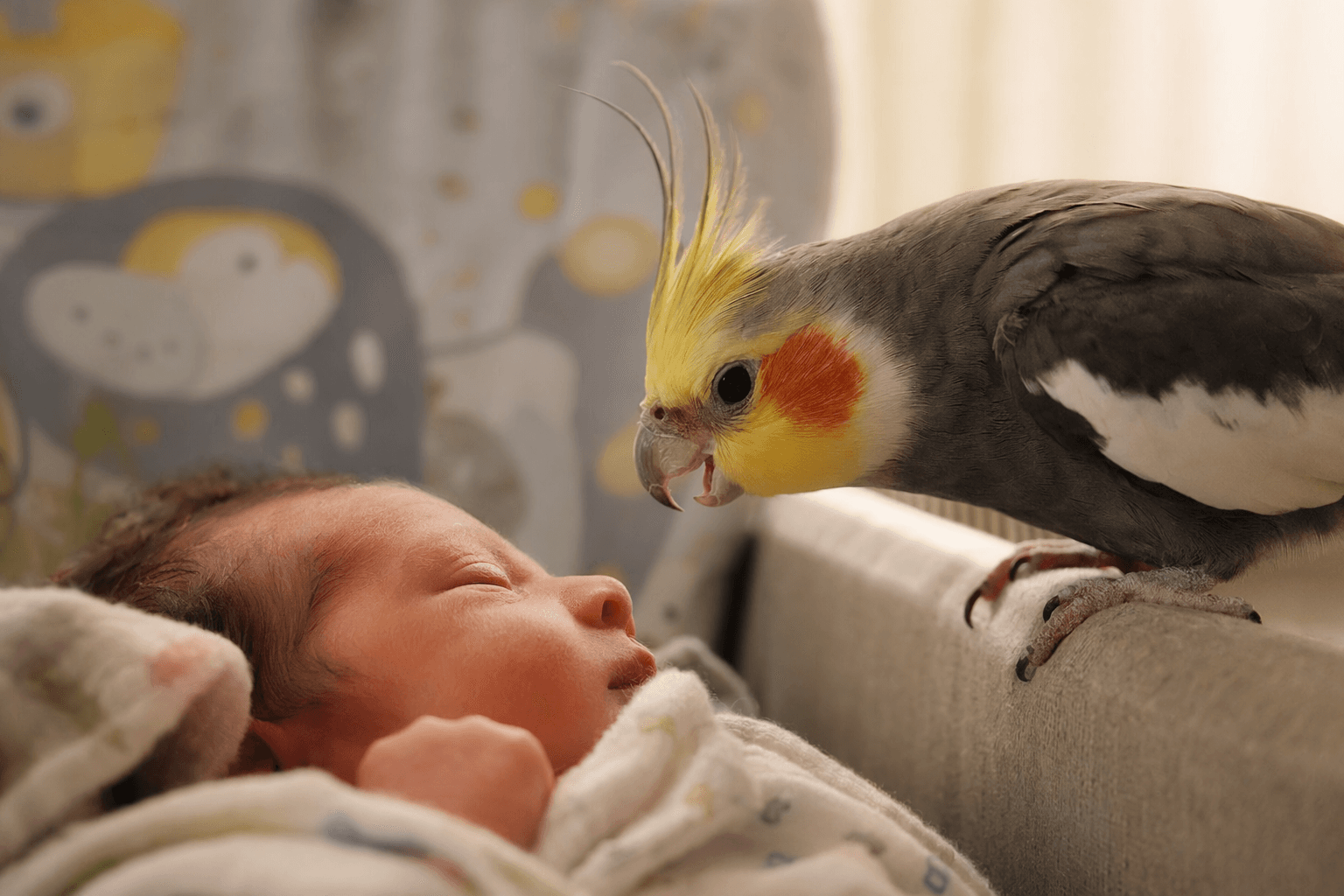
Little Lady did not burst into Sarah’s nursery. She perched beside Sarah’s newborn daughter, sang softly, chirped, and cooed, then seemed to wake the baby with the kind of quiet attention that felt more like a flock greeting than a viral stunt. Shared by Sarah at @sarahsgotbirds, the moment landed as both adorable and deeply personal: a cockatiel treating a newborn like part of the household from the start.
That reaction makes sense in a bird community that knows how social cockatiels can be. The American Veterinary Medical Association describes cockatiels as usually active and cheerful, and says keeping just one bird increases the odds it will bond with and respond to its owner. The broader human-avian bond is bigger than many people realize too. An IAABC Foundation Journal review cited American Pet Products Association data estimating 6.1 million U.S. households and about 14.3 million birds, making birds the fourth most common pet after dogs, cats, and fish. Little Lady’s behavior fit that picture exactly: not random noise, but a bird folding a new family member into her inner circle.
The care lesson matters just as much as the cute factor. The AVMA warns that most companion birds are not domesticated and are not adapted to continuous physical contact, which is why bird-and-baby time needs close supervision and clear limits. A cockatiel can be affectionate without being handled like a stuffed toy. In a home where a newborn changes the daily rhythm, the safest approach is to keep the bird’s routine as steady as possible, read body language carefully, and avoid turning every interaction into prolonged touching or shoulder time. The bond works best when the bird still has space, predictability, and a way to opt out.
The science behind the clip also checks out. A 2021 PLoS One study found that three hand-raised cockatiels learned a human whistled melody, and two of them spontaneously joined in so closely that their vocalizations lined up nearly perfectly with the melody. That kind of vocal timing makes Little Lady’s soft wake-up feel less like a one-off and more like classic cockatiel behavior. Even the health side of bird keeping points to the same conclusion: the CDC says psittacosis, caused by Chlamydia psittaci, is most commonly associated with pet birds like parrots and cockatiels, and prevention depends on wetting cage surfaces before cleaning, avoiding dry sweeping, and cleaning cages and food and water bowls daily. Little Lady’s gentle wake-up worked because it showed what a good flock bond looks like: affectionate, observant, and still guided by the boundaries that keep birds and babies safe together.
This article was produced by Prism’s automated news system from verified source data, official records, and press releases, then run through automated quality and moderation checks before publishing. The system is built and supervised by the people who set the standards it runs under. Read our full AI policy.
Did this article answer your question?