Free-flight training helps confiscated parrots prepare for release
A confiscated Amazon cannot be dumped back into the wild and hoped for the best. This study shows free-flight training can build flocking, feeder use, and return behavior that improves release odds.

When a confiscated parrot leaves the cage, the real test starts after the transport crate is closed. A new study on 18 fledging-aged Yellow-crowned Amazons in Colombia shows that free-flight training can give rescued parrots the one thing a rushed release usually lacks: a way to stay alive, stay together, and keep coming back to support.
Why this release problem is so hard
Parrots sit in one of the most pressured corners of wildlife conservation. Psittaciformes are among the most threatened avian orders, and the illegal wildlife trade remains a major driver of that pressure. That is why confiscated birds create such a difficult choice for sanctuaries and enforcement teams: holding them forever is not always realistic, but releasing them without preparation can be reckless.
That tension has been part of the parrot-rehab debate for years. A 2015 Oryx commentary warned that confiscated parrots should only be released in unusual circumstances, when disease history is known, the conservation need is real, and the team has the resources for a full release program. The new Amazon parrot study does not argue against that caution. It argues that when the stars do align, structured preparation can change the odds.
What the Colombia team actually tested
The team behind the study brought together Donald J. Brightsmith, Alejandro Rigatuso, Chris Biro, and David Geiszler, with institutional ties to Texas A&M University, Fundación Loros, Liberty Wings Freeflight Training, and CARDIQUE, the environmental authority for the Canal del Dique region in Colombia. Their test birds were 18 fledging-aged Yellow-crowned Amazons confiscated from the illegal wildlife trade in Colombia.
The method matters as much as the bird count. Free-flight training was originally developed by parrot owners who fly hand-raised birds outdoors, and this project takes that hobbyist practice and turns it into a conservation tool. That is the useful bridge here: the same skills that keep a pet parrot safe in open air, such as recall, flocking, and spatial confidence, can be shaped into a release strategy for birds that cannot simply be set free cold.
Fundación Loros, the sanctuary in Villanueva, Bolívar, outside Cartagena, sits right in the kind of landscape where that approach can be put to work. The sanctuary is specialized in parrots, and the wider Colombian project has already shown that the method can be scaled. A 2024 Texas A&M project note said the team had released 27 Amazon parrots over the prior year, with at least 22 still returning to feeders, and that Chris Biro had used free-flight training to prepare 23 young parrots for life outside the cage.
What success looked like in the field
The headline result is better than a simple survival count. All of the birds used project feeders after release, all showed good flock cohesion, and most demonstrated strong site fidelity. In plain English, they did not scatter into the landscape and disappear. They behaved like a flock that knew where home support lived.
The return numbers are the kind rescuers watch closely. At one month, 94% of the birds were still returning to feeders. At three months, that figure was 89%. At one year, 72% were still coming back. Two birds were recaptured, and the final fate of four was unknown, but the study also reports that predators were scarce and no direct predation events were witnessed.
Just as important, the birds appeared to keep the right instincts. The paper says they showed appropriate reactions to predators, which is the part that separates a trained release candidate from a bird that has simply been made comfortable around people. In release work, tameness is not the goal. Survival is.
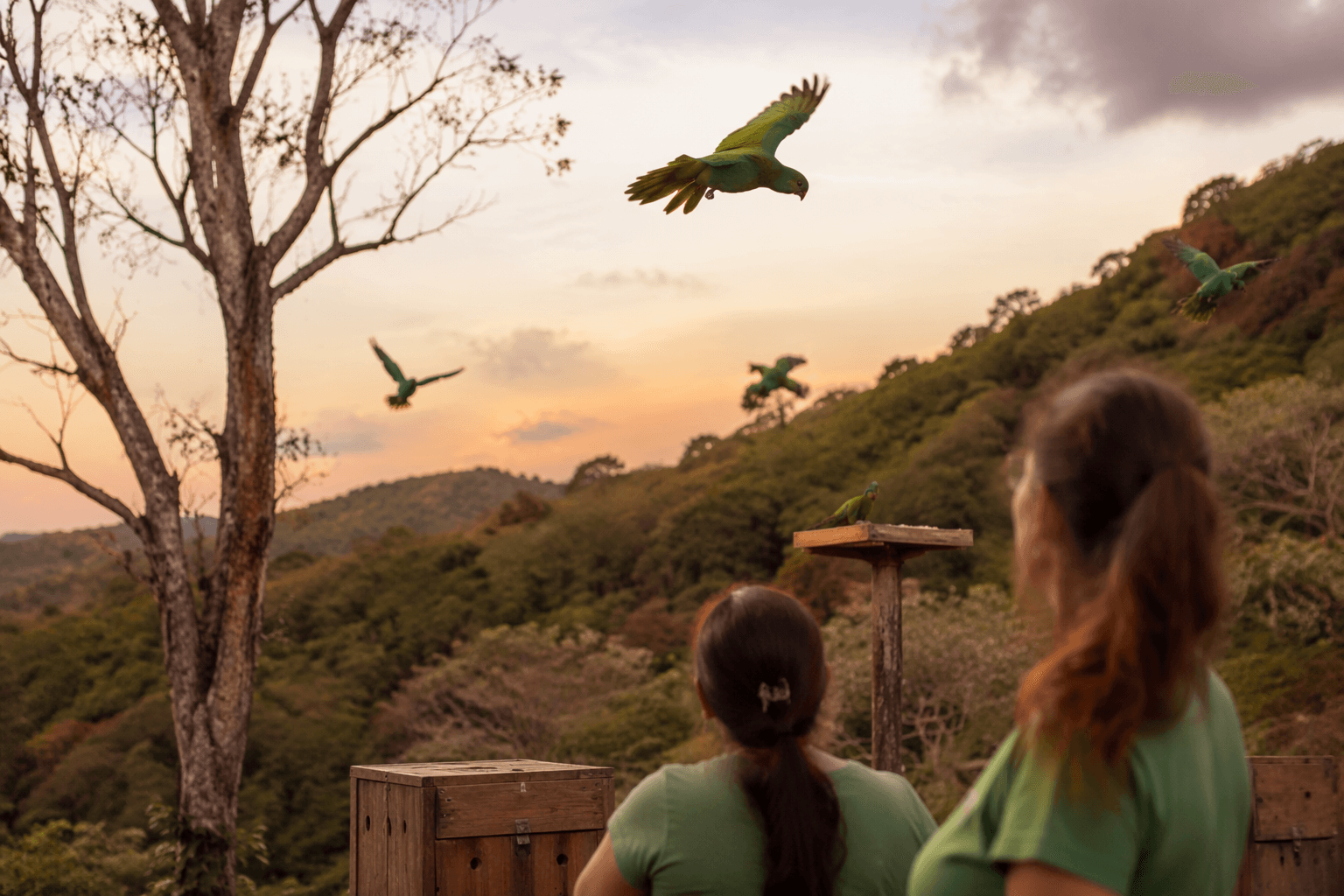
Local people were part of that survival picture too. Community members helped recover two birds and reduced negative interactions around the release site. That may sound secondary, but in real release programs it is often decisive. A bird that can be found, fed, and protected by people who live nearby has a much better chance than one that vanishes into a hostile landscape.
What sanctuaries and rescuers can take from this
For rehab teams, the practical lesson is that free-flight is not a stunt and not a shortcut. It works as part of a package:
- Select birds at the right developmental stage, before they have become badly conditioned to captivity.
- Train for flocking and navigation, not just exercise.
- Use feeders as a bridge, not a crutch, because returning birds need a reliable reason to keep checking in.
- Monitor after release, because the first few weeks are only the beginning.
- Build local trust, since recovered birds and reduced conflict can matter as much as flight skill.
The broader literature backs that up. In a 2021 Diversity paper, Constance Woodman, Chris Biro, and Donald Brightsmith reported more than 500 months of free-flight time across three parrot flocks with no losses to predation or disorientation. Those birds showed effective flocking, landscape navigation, and use of wild foods. That earlier work helped establish that free-flight can be more than a novelty when the birds are prepared properly.
The genetics side matters too. A 2024 Bird Conservation International paper used mitochondrial COI barcoding and a database of 140 reference sequences to infer the likely origin of 156 seized parrots. That kind of tool helps answer a basic question before release even starts: where should these birds go, and where should they not go? The right flight training cannot fix a bad release location.
The larger conservation play
This story is not just about one flock of Amazons outside Cartagena. It is about how rescue work is changing. TRAFFIC’s 2024 report on wildlife trafficking in Colombia calls for stronger coordination among enforcement agencies and regional information networks, which is exactly the kind of infrastructure release projects need if they are going to move from improvised to effective.
That is why this study feels like a real breakthrough. It does not pretend every confiscated parrot should be released, and it does not pretend free-flight alone solves trafficking. What it shows is narrower and more useful: when birds are young, prepared, monitored, and supported by feeders and community cooperation, the gap between confiscation and survival can be narrowed.
The next time a confiscated Amazon leaves a sanctuary and disappears beyond the treeline, the question is no longer just where it went. The better question is whether what happened before that flight gave it any real chance of coming back.
This article was produced by Prism’s automated news system from verified source data, official records, and press releases, then run through automated quality and moderation checks before publishing. The system is built and supervised by the people who set the standards it runs under. Read our full AI policy.
Did this article answer your question?