Girl helps disabled macaw experience flight through daily care
Kambre turns Scooter’s disability into a daily flight ritual, showing how a macaw can stay active, included, and deeply loved with the right care.

Scooter’s flight is not the kind most people picture, and that is exactly why it lands so hard. Every day, 12-year-old Kambre helps the disabled blue-and-gold macaw experience something close to flying, running with him outdoors and supporting him indoors so his body can take part in the world on its own terms. Scooter cannot walk or fly independently, but in this home, that limitation has become a prompt for ingenuity, not a sentence of confinement.
The video resonated because it shows a bird who is fully included in family life, not parked at the edge of it. Scooter was adopted by Kambre’s family early in 2026, after being born unable to fly, and the routines that followed are built around that reality. The result is a bird who gets movement, attention, and engagement every day, which is exactly the kind of consistent, species-aware care parrots need when their bodies do not match the standard pet-care script.
A daily ritual built around what Scooter can do
The viral clip shows Kambre running outdoors while holding Scooter, who flaps his wings as if he is flying. That detail matters more than the spectacle. This is not about pretending the disability does not exist; it is about shaping exercise and enrichment around what is still possible, then repeating it with enough consistency that it becomes part of the bird’s life instead of a one-off moment for the camera.
The family’s approach is a useful model for anyone caring for a parrot with physical limitations. Birds are not beginner-friendly pets, and disabled birds raise the stakes even further because care has to be precise, patient, and responsive. Scooter’s daily movement shows that “exercise” does not always mean a textbook version of flight or climbing. Sometimes it means assisted motion, careful handling, and building confidence into the same routine every day.
Why this story spread so fast
Part of the clip’s appeal is simple: viewers can see one identifiable bird, one clear act of care, and one unmistakable emotional payoff. The account behind the clips, @scooterandkam, describes itself as documenting “the adventures of Scooter, a disabled blue & gold macaw, and her bestie Kam,” and at the time of capture it showed about 2.8 million likes and roughly 5,060 followers. That mix of intimacy and reach is a big reason the story traveled so widely.
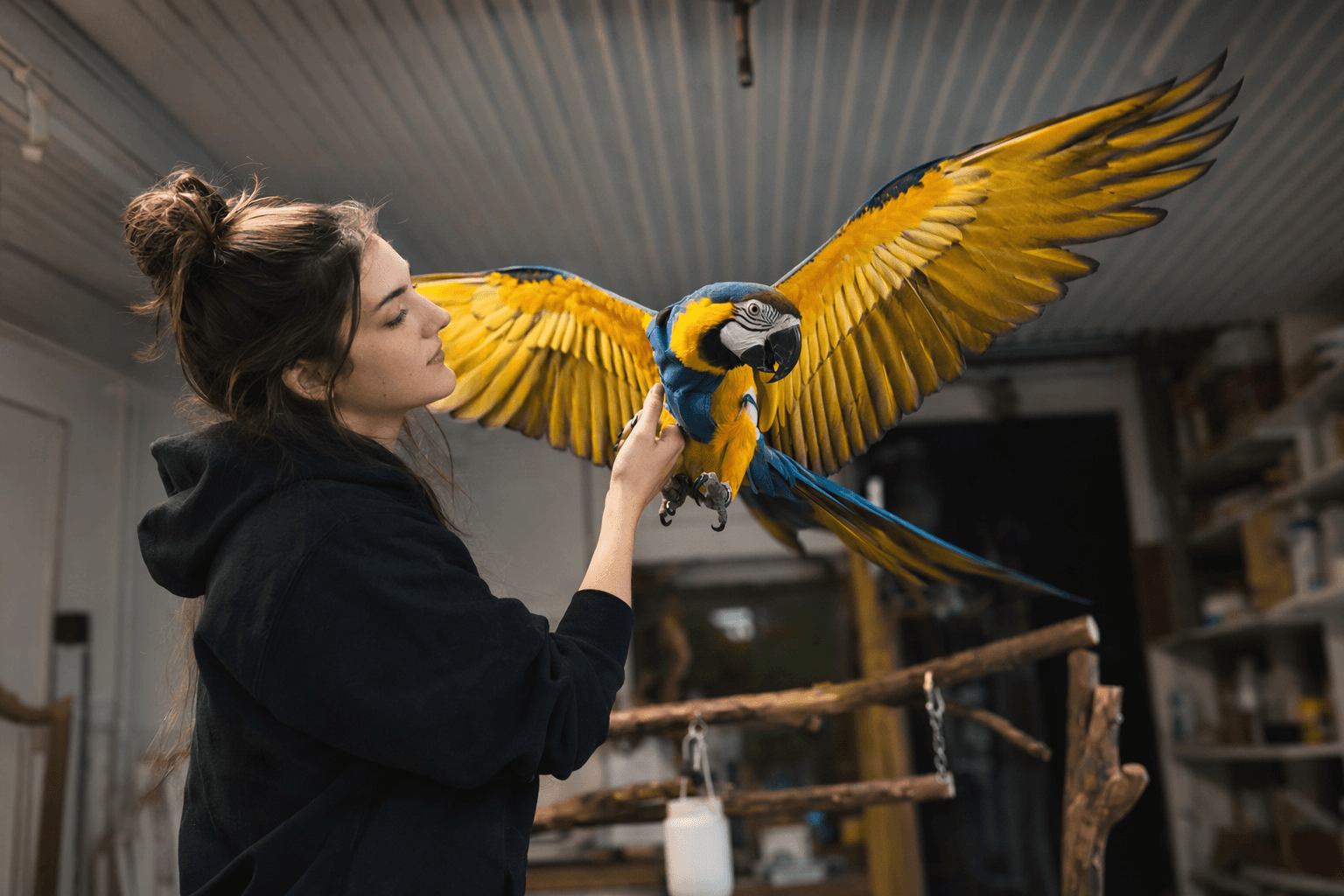
The video also spread across platforms in more than one version. One TikTok summary described it as having over 11 million views and counting, while Newsweek reported more than 6.1 million views on the clip shared by Alex, 33, from @gaspers1115. However the numbers are counted, the pattern is clear: people keep stopping for a story that makes care visible.
The comments reveal the emotional center. Viewers praised Kambre’s compassion and described her as the wind beneath his wings. That response makes sense because the clip does not ask for pity. It shows competence, trust, and a child who understands that love for a parrot can look a lot like daily labor.
What adaptive parrot care looks like in real life
Scooter’s story is useful because it turns a broad idea, “special-needs care,” into a concrete household practice. The family is not improvising once and calling it enough. They have folded assisted movement into everyday life, which is what long-term support actually looks like when a bird cannot move the way a healthy macaw would.
A few lessons stand out:
- Build around the bird’s current abilities, not the species standard. Scooter is a blue-and-gold macaw, but he does not get the same exercise plan as a fully mobile macaw.
- Make movement part of the day, not an occasional event. The family’s routine gives Scooter repeated chances to engage indoors and outdoors.
- Treat inclusion as enrichment. Scooter is not being managed on the sidelines. He is being brought into the motion, noise, and rhythm of family life.
- Watch for comfort and confidence, not just activity. The point of assisted flight is not speed. It is participation.
That mindset matters because parrots are highly demanding companion animals. They need social contact, enrichment, and handling that fits the individual bird, and disabled birds need even more customization. A one-size-fits-all setup can leave a bird under-stimulated or excluded, especially when mobility is limited.
A case study in family ingenuity, not inspiration theater
What makes Scooter’s story worth paying attention to is not that it is sentimental. It is practical. Kambre and her family saw a bird born unable to fly and built a life that still includes motion, engagement, and the feeling of being carried along with everyone else. That is the real work of caring for a disabled parrot: adapting the environment, adjusting expectations, and refusing to confuse limitation with a poor quality of life.
The viral attention helps because it spreads an idea many bird keepers need to see in action. Parrot care does not always look like the ideal version you had in your head when you imagined a healthy, high-energy bird soaring across a room. Sometimes it looks like a child running carefully with a macaw in her hands, giving him a daily taste of the air he cannot master alone. In Scooter’s case, that is not a consolation prize. It is the shape of a good life.
This article was produced by Prism’s automated news system from verified source data, official records, and press releases, then run through automated quality and moderation checks before publishing. The system is built and supervised by the people who set the standards it runs under. Read our full AI policy.
Did this article answer your question?