Macaw Hand-Holding Shows How Companion Parrots Bond Deeply
A macaw that keeps holding a hand is often showing trust, not neediness. The trick is learning when that contact builds a bond and when it starts to feed clingy behavior.
What that hand-holding really says
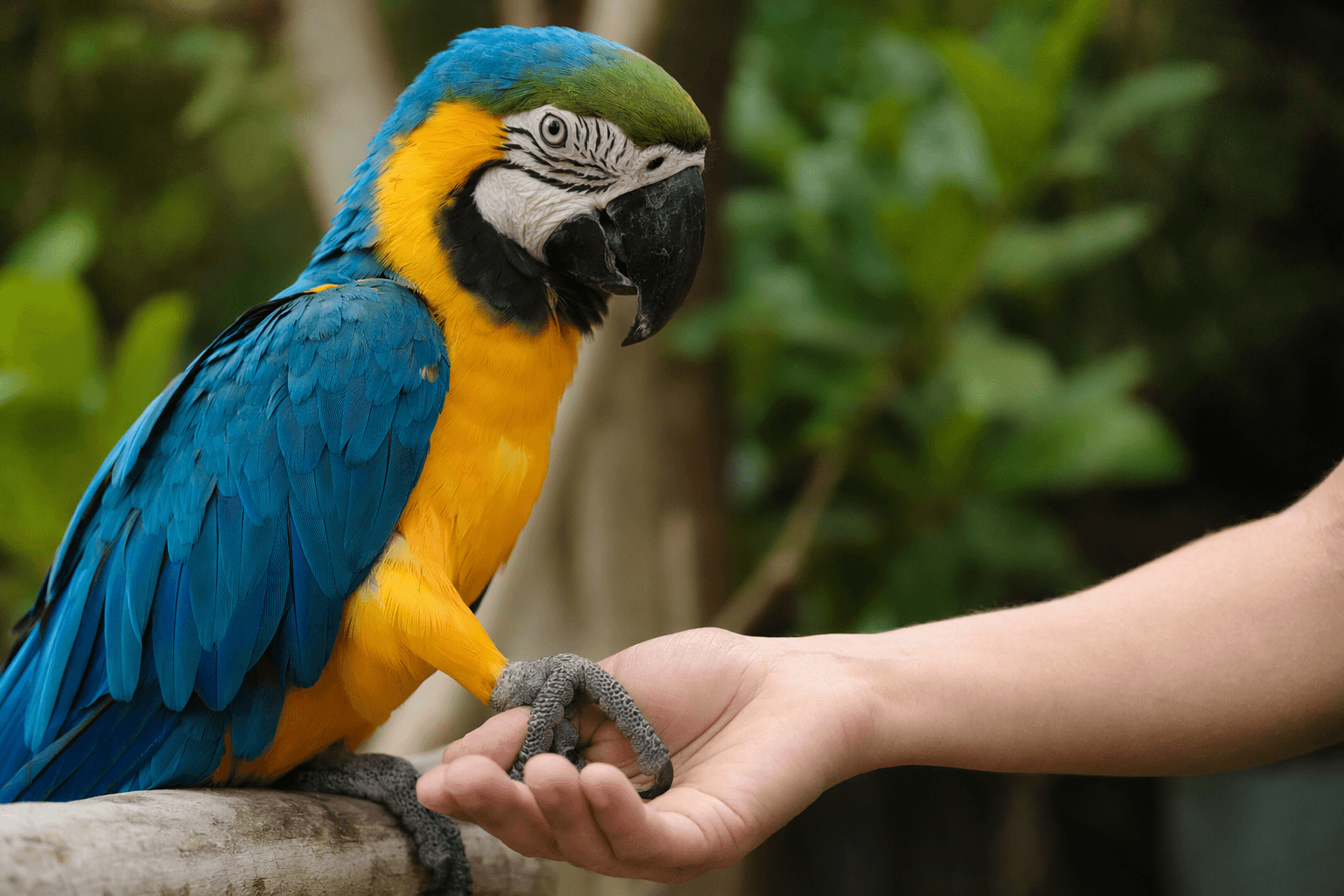
A macaw that reaches out again and again to hold a human hand is not doing a party trick. It is showing you a social instinct that runs deep in companion parrots: closeness, contact, and a place in the flock. In the right setting, that grip can look less like clinginess and more like reassurance, the bird’s version of staying tucked into the daily rhythm of the household.
That matters because parrots are flock animals. In the wild, they spend a lot of time preening one another, foraging together, and roosting in groups. Lafeber Company notes that parrots may even form same-sex “buddies,” sometimes siblings, before mating, and those pairs forage together and engage in allopreening. So when a macaw chooses to hold a hand, the behavior can fit neatly into that social logic: a substitute for mutual grooming, a flock-style attachment, or simply a calm way of saying, “I want to be near you.”
Bonding is the point, but the details matter
The most useful way to read affectionate body language is to watch for the bird’s emotional state. A macaw that is calm, content, and secure while holding a hand is telling you something different from a bird that is frantic, demanding, or unable to settle unless it is touching someone. The first is a bond. The second can slide into dependency.
Veterinary guidance is clear that macaws need daily interaction and bonding time with caregivers. Tree of Life Exotic Pet Medical Center describes them as energetic, emotionally sensitive parrots that require daily interaction, specialized care, and a dedicated, bird-savvy household. That is the baseline these birds expect. They are not decorative pets that tolerate attention on a schedule; they are social animals that need steady, intentional contact.
The trick is not to avoid closeness. It is to make sure closeness stays mutual. Bird-initiated contact, especially when it is relaxed and predictable, is usually a healthy part of companion-parrot life. Forced handling, constant pursuit by the bird, or a household routine that only functions when the macaw is physically attached to one person is where the line gets blurry.
How to tell affection from attention-seeking
A bird that is securely bonded often looks settled. It may lean in, hold on, and then relax into the interaction instead of escalating it. A bird that is attention-seeking in the restless sense often keeps pushing for more, even after it has already received the contact it wanted. That can show up as pacing, vocal insistence, refusal to engage with toys or foraging, or a constant demand to be on a shoulder or hand.
RSPCA guidance is useful here because it ties behavior to welfare: understanding what your bird is doing helps you understand what it needs, and pet birds need enrichment because they cannot behave exactly as they would in the wild. That means the goal is not to prevent every affectionate gesture. The goal is to shape the whole day so the bird has enough structure, stimulation, and social contact that a hand-hold remains a choice, not a requirement.
- Let the bird start the contact when possible.
- Keep sessions calm and brief if the bird is getting overstimulated.
- Back away from constant clinginess by redirecting to foraging, toys, or a perch.
- Protect the routine so the bird does not have to escalate to get predictable attention.
A good rule is simple:
Why macaws are especially intense about their people
Macaws are not subtle about relationships. WWF says some can live up to 60 years, which means the bond you build can last decades, not months. Britannica says there are about 18 species of macaw native to tropical North and South America, and several are under pressure from habitat loss and illegal trapping for the pet trade. That long life, paired with their social nature, is why macaw care has such a strong emotional dimension.
The species also carries conservation weight. BirdLife International lists the Hyacinth Macaw as Vulnerable and estimates a mature population of roughly 4,700 to 11,000 birds. BirdLife also notes that the species has recovered somewhat from a low point in the late 1980s thanks to conservation action and reduced illegal take. Cornell University points to the Wild Macaw Reserve and the Captive Breeding Center in Punta Islita, which houses over 100 Scarlet and Great Green Macaws. Those details are a reminder that these birds live at the intersection of pet care and conservation, where every decision about breeding, trade, and husbandry matters.
That context should make caregivers more careful, not more anxious. A macaw that wants to sit close is not asking for indulgence. It is asking for the kind of dependable relationship that these long-lived, highly social parrots are built to recognize.
Building trust without creating a needy bird
The safest way to respond to hand-holding is to treat it as one part of a broader social routine, not the entire relationship. Macaws do best when attention is predictable, calm, and interactive rather than constant. If every squeak or reach for your hand results in immediate physical contact, you can end up reinforcing a bird that cannot settle independently.
- Use consistent daily interaction times.
- Mix physical closeness with training, foraging, and quiet perching.
- Offer enrichment so the bird has something to do when you are not directly available.
- Keep contact reciprocal, so the bird learns that calm behavior brings good things.
- Respect the bird when it chooses to disengage, because trust grows faster when the bird can opt out.
What works better is a household pattern that gives the bird clear wins without making it the center of every minute:
That approach lines up with what RSPCA calls enrichment and with the social reality Lafeber describes: parrots are flock animals, but flock life includes more than constant touching. It includes shared space, grooming, feeding, rest, and the confidence to be near each other without panic.
The practical takeaway
The hand-holding clip works because it distills a big truth into one small gesture: many companion parrots do not merely tolerate their people, they choose them as flock. For a macaw, that can mean affection, security, and a deep social attachment that looks a lot like mutual grooming in bird form.
The best response is not to chase the cute moment or to dismiss it as neediness. It is to build a life that makes that moment possible without depending on it. Predictable routine, daily interaction, enrichment, and respectful boundaries are what turn affection into trust. With a macaw, that trust can last for years, and sometimes for most of a human lifetime.
This article was produced by Prism’s automated news system from verified source data, official records, and press releases, then run through automated quality and moderation checks before publishing. The system is built and supervised by the people who set the standards it runs under. Read our full AI policy.
Did this article answer your question?