Nanday Conure Profile Highlights Beauty, Noise, and Care Needs
Nanday conures are stunning, social parrots, but their clamorous calls and nonstop need for interaction make them a serious fit-or-mistake decision.
Beauty comes with volume
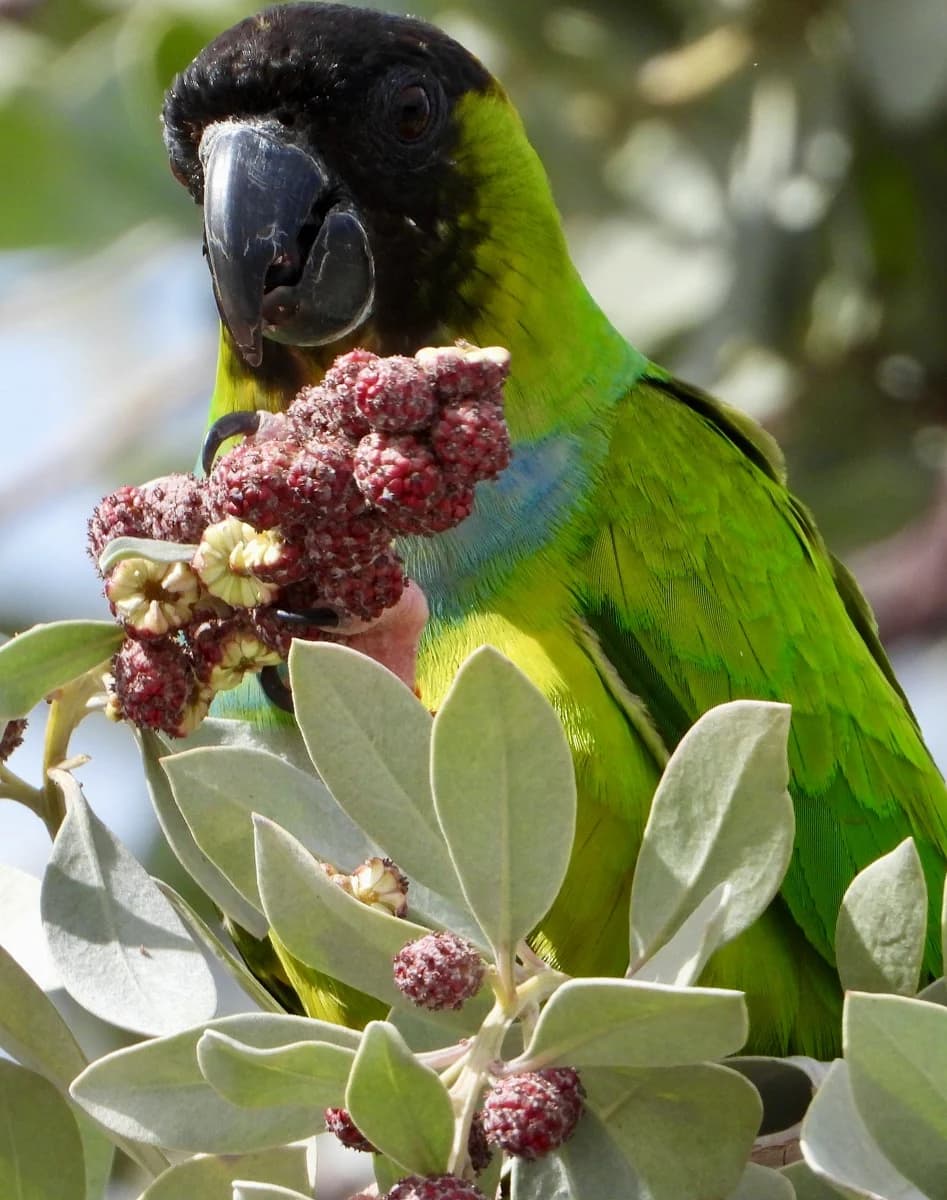
The Nanday conure is the kind of parrot that can stop a room for the right reasons and exhaust a household for the wrong ones. Its glossy black hood, bright green body, blue in the wings and tail, and red-orange thighs make it unmistakable, but the first question any prospective owner should ask is not whether it is beautiful. It is whether the family can live with a bird that is famously loud, highly social, and very much involved in everything that happens at home.
This is a medium-sized parakeet, about 30 cm long and roughly 140 g, so it is not a giant macaw with giant-macaw space demands. That smaller size can tempt first-time buyers into underestimating it. The Nanday’s appeal is real, but so is the commitment behind the bird’s personality.
Noise is the make-or-break issue
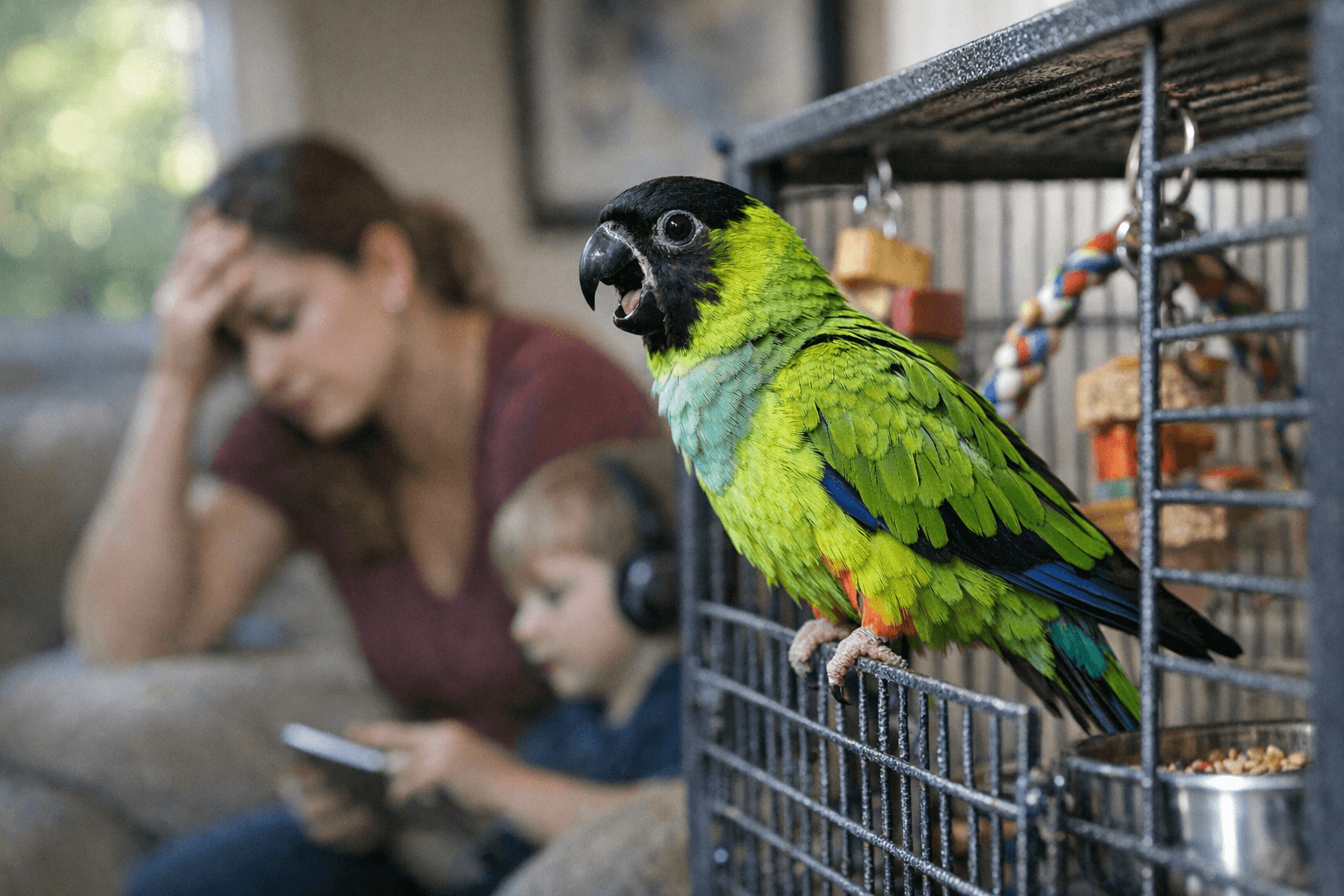
If your household values quiet, the Nanday conure is probably the wrong match. The species is known for clamorous calls, with screeching in flight and shrill chattering when perched. Those are not occasional quirks; they are part of the bird’s normal communication style, which means the sound is not something you can simply train away.
That reality matters especially in apartments, shared walls, and homes where someone works from a laptop all day. A Nanday can be a poor neighbor bird if the building has thin walls or the family expects a calm background companion. The better question is whether your home can absorb lively, persistent parrot noise without turning every movement into a noise complaint.
A daily-life fit, not just a pet purchase
The smartest way to think about a Nanday conure is as a daily-life decision. This bird is social, intelligent, and active, so the fit depends on whether your home can give it regular interaction, not just a cage and a bowl. A lonely Nanday is likely to become a frustrated one, and frustration in a parrot often shows up as loudness, demanding behavior, or a bird that seems permanently on alert.
- Time out of the cage every day
- A predictable routine with handling and attention
- Tolerance for vocal, animated behavior
- Room for toys, chewing, climbing, and foraging
- A willingness to structure life around the bird’s social needs
A household that works well for this species usually has several things in place:
If those pieces sound reasonable, the bird’s personality can be a delight. If they sound like a stretch, the mismatch will show up quickly.
Where this bird comes from helps explain how it lives
The Nanday conure’s natural home is in central South America, with its range tied to Paraguay, southern Brazil, eastern Bolivia, and northern Argentina. In the wild, it is associated with open woodlands and grasslands with scattered trees, which tells you something useful about the species: it is built for movement, social contact, and constant awareness of its surroundings.
That background matters because pet care should never ignore a bird’s ecology. A conure that evolved in open, social, active habitats is not going to thrive in a small, unstimulating setup. The more closely a home can mirror the bird’s need for movement, contact, and interest, the better the odds of a stable companion relationship.
Conservation status does not mean low maintenance
BirdLife International’s assessment lists Aratinga nenday as Least Concern, with a very large range and a population trend that appears to be increasing. That is reassuring from a conservation standpoint, but it does not make the bird an easy pet. A species can be secure in the wild and still be a serious responsibility in the home.
The Nanday’s status also reflects how adaptable the species can be. Escaped birds helped establish feral populations far from the native range, including Los Angeles, Tampa Bay, Florida’s southeast coast, and smaller numbers in Arizona. The World Parrot Trust notes a feral population in Florida numbering in the hundreds, while eBird also records introduced populations in the Americas and Europe, often around parks and gardens. In other words, this is a bird that adapts, spreads, and survives, which is impressive in the wild and demanding in the living room.
The pet trade history is part of the story
Audubon notes that Nanday parakeets were popular in the cage bird trade, and that history still shapes how people encounter them today. Some birds are kept as companions, while others are seen only after escaping and forming feral groups in urban and suburban landscapes. That split history is a reminder that the bird’s charm has always been linked to its hardiness, intelligence, and strong voice.
For an owner, that same hardiness can be a mixed blessing. A resilient bird may seem forgiving, but it also means small problems can be easy to miss until they become bigger ones. The bird that looks fine and acts normal may still be hiding trouble.
Vet care and handling need to be taken seriously
Merck Veterinary Manual adds the most important health warning for anyone considering a pet bird: parrots often mask illness until they are quite sick. By the time a Nanday conure shows obvious signs, the issue may already be serious, so routine observation and prompt veterinary attention matter far more than many new owners realize.
There is also a handling risk that should change how you think about exams and restraint. Birds have a much higher metabolism than mammals and can suffer oxygen deprivation during restraint or diagnostic sampling. That is why stress-safe handling, careful history-taking, and a step-by-step exam approach are so important, and why sedation may be warranted if a bird is extremely stressed or not used to handling. The takeaway is simple: this species needs skilled care, not improvisation.
The right home for a Nanday conure
A Nanday conure can be a vivid, charismatic companion for a household that genuinely wants a loud, interactive, high-energy parrot. It can also be a mistake for anyone looking for a quieter, lower-effort bird with modest social demands. The difference between those outcomes is not about love alone; it is about whether the daily rhythm of the home can absorb the bird’s sound, intelligence, and need for involvement.
If you want a parrot that brings color, motion, and personality into every corner of the day, the Nanday can deliver all of that in abundance. If you want peace and predictability, this is the bird that will tell you, very clearly, that those are not its priorities.
This article was produced by Prism’s automated news system from verified source data, official records, and press releases, then run through automated quality and moderation checks before publishing. The system is built and supervised by the people who set the standards it runs under. Read our full AI policy.
Did this article answer your question?