Ontario Issues HPAI Biosecurity Warning Urging Parrot Owners to Act Now
A virus that jumped into dairy cattle in 2024 is now prompting Ontario's Chief Vet to flag your parrot's harness walk as a biosecurity decision.
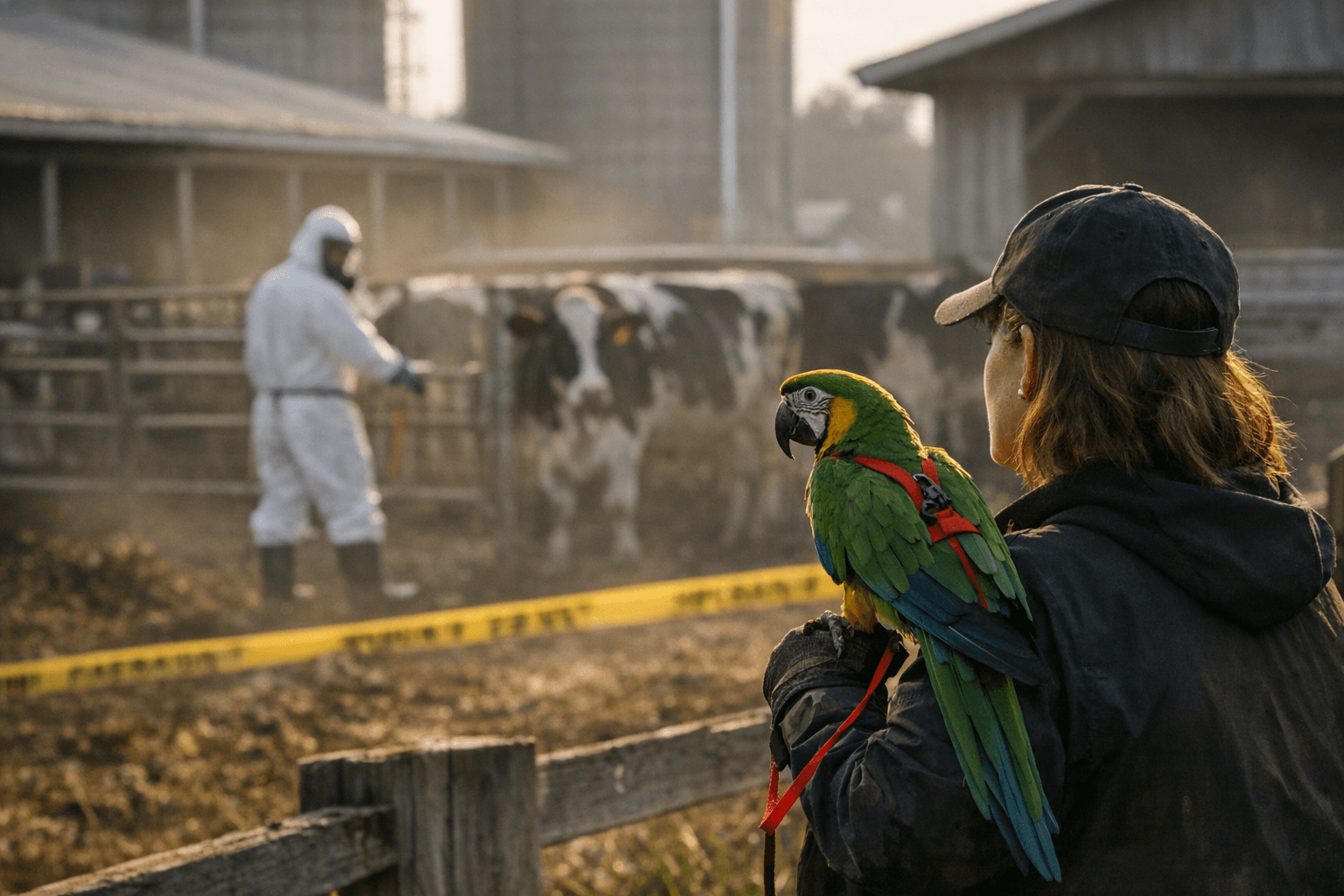
The same strain of bird flu that jumped into North American dairy cattle herds in 2024-2025 is still circulating, and Ontario's Chief Veterinarian wants companion parrot owners to rethink a few daily habits before heading out for that morning harness walk.
On April 7, the province published an updated HPAI advisory confirming no new commercial poultry detections in Ontario as of April 3, but emphasizing that the high-risk migration window, running from fall through late spring, is not yet closed. Most of Canada's recent detections were concentrated in British Columbia and Nova Scotia, though Ontario carries its own commercial case from the previous migration season.
The advisory makes clear that HPAI's risk to companion parrots is primarily indirect. The virus does not need a wild waterfowl to fly into your living room; it can arrive on the bottom of a shoe, on a jacket worn near a backyard flock, or on hands that recently handled birds at a swap or fair. For parrot owners who take their birds outside on harnesses, maintain outdoor aviaries, or use shared equipment, those everyday contact points are the biosecurity gaps worth closing now.
What to stop this week: skip bird fairs, swaps, and sales while migration is ongoing, as those events concentrate cross-exposure risk in exactly the settings the advisory flags. If a wild-bird feeder sits near your parrot's aviary or outdoor perch area, take it down or relocate it well away from where your bird spends time outside. Anyone who has recently visited a farm, a backyard flock, or another bird-keeping facility should change clothes and shoes before handling your parrot.
What is still fine: indoor sessions, perch rotations, misting, and training are all unaffected. The advisory does not call for a blanket ban on outdoor time; it calls for reducing opportunities for the virus to bridge from wild or agricultural cycles into your bird's environment. A harness walk away from ponds, waterfowl activity, and agricultural land carries far lower risk than a perch session beside a feeder visited by migrating ducks.
When to call your avian vet immediately: the advisory lists sudden severe illness, elevated mortality in a multi-bird household, neurologic signs, and respiratory distress as the clinical flags. If your African Grey, Amazon, or macaw shows any combination of these, contact your clinic before transport and follow their intake protocol. The consequences of a confirmed detection are not abstract: federal CFIA containment measures kick in automatically, including quarantine and, for poultry operations, humane depopulation.
Storing feed in sealed containers to block wild-bird access rounds out the practical list. These are low-cost adjustments, but the advisory's underlying message carries weight: HPAI's host range now routinely surprises specialists, as the dairy cattle spillovers of 2024-2025 proved. For a species as long-lived and irreplaceable as a companion parrot, the migration window is not the moment to assume the usual routine carries no risk.
This article was produced by Prism’s automated news system from verified source data, official records, and press releases, then run through automated quality and moderation checks before publishing. The system is built and supervised by the people who set the standards it runs under. Read our full AI policy.
Did this article answer your question?