Gujarat Farmer Feeds Thousands of Wild Parrots Daily for Nearly 30 Years
A broken leg in 2000 and one millet cob later, Gujarat farmer Harsukhbhai Dobariya now draws 10,000 wild parrots to his farm on monsoon mornings.
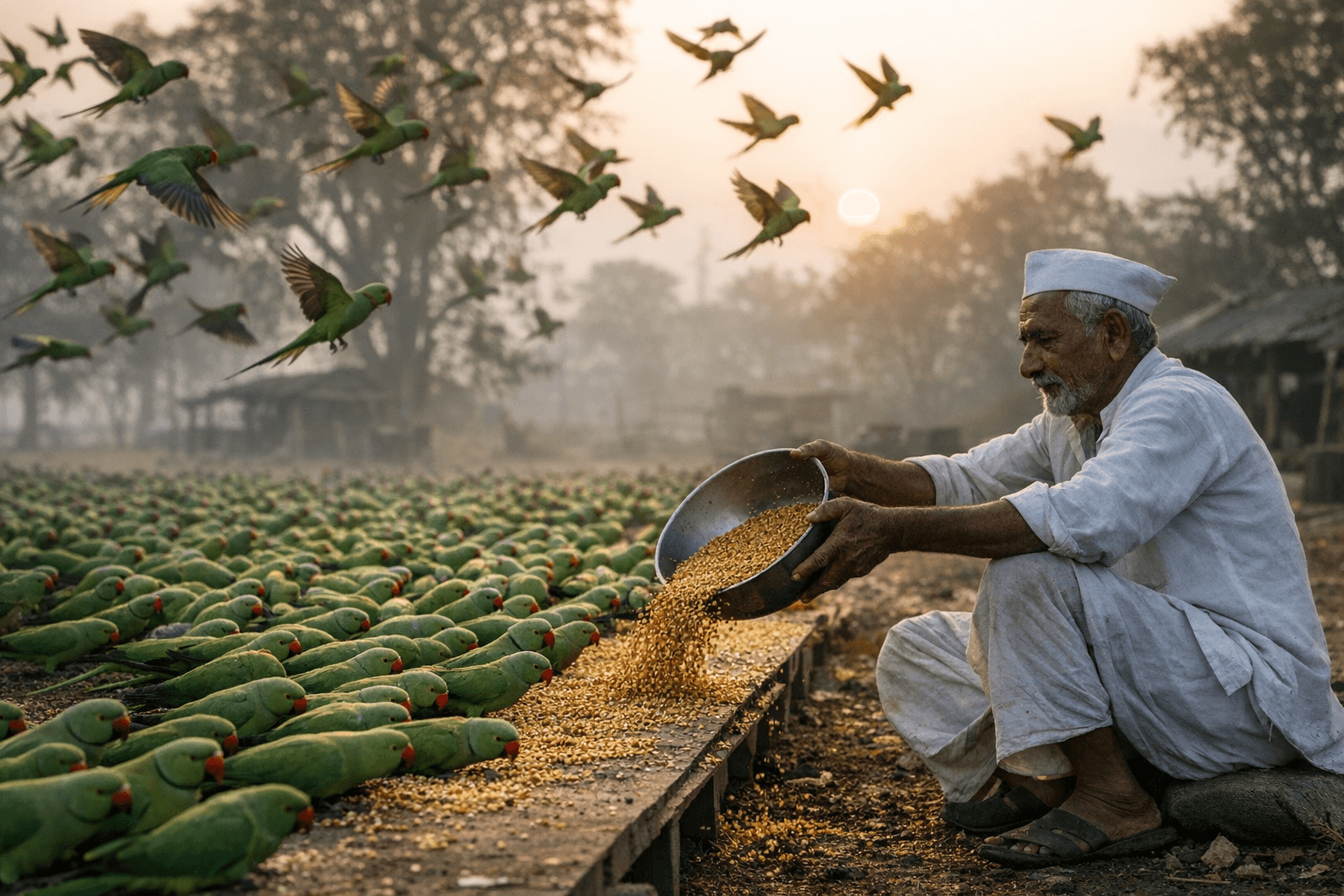
Ten thousand parrots arriving at once sounds like a wildlife documentary. For the family of Harsukhbhai Dobariya in Junagadh, Gujarat, it is simply what monsoon mornings look like from the front door.
It started with a broken leg. Confined to bed after a fracture in the year 2000, Dobariya hung a single pearl millet cob from his balcony to pass the time. One parrot arrived the first day. Two the next. "On the second day there were two parrots, then three, then four and within a month there were around 100 to 150 parrots and sparrows visiting my balcony every day," he recalled. What unfolded over the following 25-plus years is one of the most sustained examples of grassroots bird conservation in India: a farmer with no government funding, no NGO support, and no formal sanctuary status who now hosts an estimated 10,000 birds at peak season, entirely by personal choice and personal expenditure.
The operation did not scale cleanly. As the number of daily visitors grew, Dobariya and his family became a problem for their city-center neighbors, and in 2012 he relocated to a 4-acre plot on the outskirts of Junagadh. As he explained at the time: "In my old house, neighbors would get disturbed with the constant chirping of birds. The millet cobs would fall on the passerby and also the excreta of the birds was problematic for them. Though they would never complain, I still thought that these birds need a space of their own." The move gave the birds room to scale. Between 2,500 and 3,000 rose-ringed parakeets, sparrows, weaver birds, pigeons, and crows now visit the farm daily in regular season, rising to roughly 10,000 during the monsoon, when the family keeps their doors wide open so birds can shelter from heavy rain.
The infrastructure is low-tech and highly deliberate. Dobariya fabricated perching stands from old pipes with drilled holes, and changes millet cobs twice daily to keep feed fresh. Over 1,000 sparrows nest on the property each year, and the family actively protects hatchlings from predators until the young birds can fly. He also commissions the farming of tumdi, a type of gourd whose shells are crafted into sparrow nests, and distributes the seeds free of charge to neighboring farmers, extending his conservation footprint well beyond his own land. Annual feed costs run between ₹1.5 lakh and ₹2 lakh, roughly $2,350 to $3,100 USD, absorbed entirely by the family. He was awarded the Srishti Samman award for bird conservation by President Pranab Mukherjee, and the Krishi Ratna by the Gujarat state government for his experiments with new crop varieties. His own measure of the work is quieter: "I believe that the blessings of these birds have always helped me to grow in my life."
Dobariya's 2012 relocation is the detail worth sitting with if you are thinking about attracting wild parrots to your own space. The noise and mess created by a growing flock is real and accumulates fast; what begins as a charming balcony habit can strain neighbor relationships within a season or two. Starting with designated feeders, fresh millet or sunflower seed (never processed food), and being honest about the scale your property and your neighborhood can absorb are the practical baselines. Dependency is worth factoring in too: wild birds that have fed consistently at one location for years will return expecting it, turning a casual hobby into an obligation.
A comparable figure, Joseph Sekar of Chennai, learned this firsthand after taking in parakeets displaced by the 2004 Indian Ocean tsunami. His flock grew to around 4,000 birds, and he now devotes approximately 40% of his income to feeding them, waking at 4:00 a.m. daily to cook rice. Sekar has described the arrangement with dry precision: "Like how people keep parakeets in a cage, now the birds have put me in a cage."
Twenty-six years in, Dobariya shows no sign of stopping. His farm stands as a living argument that single-handed consistency, without grants or institutional backing, can build something that outlasts any formal program.
This article was produced by Prism’s automated news system from verified source data, official records, and press releases, then run through automated quality and moderation checks before publishing. The system is built and supervised by the people who set the standards it runs under. Read our full AI policy.
Did this article answer your question?