APHA and RSPCA Advise Gradual Outdoor Release to Ease Bird Stress
Companion parrots housed since November face real stress risks now that HPAI rules have eased. APHA says gradual corridor release, not a one-day flip.
Your African Grey has not seen open sky since November 6. Five months of indoor confinement under England's mandatory housing order, five months of watching the garden through glass. When APHA lifted the mandatory housing measures for poultry and captive birds in England and Wales on April 9, the instinct for many parrot keepers was to throw open the aviary door and let the bird fly. That instinct, APHA and the RSPCA both warned, is exactly backwards.
The guidance accompanying the order's lifting was direct: birds housed for several months must be acclimatised and gradually released over a period of days to minimise welfare issues. The language targeted commercial poultry producers, but it maps precisely onto the companion parrot world, where the stakes are arguably higher. A flock of hens panics and recovers. An African Grey or Timneh that spends even a short period in prolonged indoor confinement accumulates boredom and frustration that can produce problem behaviour, and a bird already sitting at that edge of tolerance is the last candidate for an abrupt outdoor reintroduction that triggers a full fear response.
Fear in a confined parrot is easy to miss until it tips into crisis. Watch for feather flattening, wide-eyed stillness, rapid shallow breathing, or sudden flight attempts toward the nearest wall or ceiling. A bird showing any of these after even a brief outdoor exposure needs to come back inside immediately, with the reintroduction timeline reset to day one.
The corridor method is the solution. Rather than moving a bird directly from indoor cage to open aviary in a single step, the approach uses an intermediate space as a pressure valve: a travel cage placed just inside an open porch, a covered safety enclosure on a sheltered balcony, or a section of aviary with one panel opened to outside air while the flight door stays shut. The RSPCA's own aviary design guidance specifies a safety porch with double doors precisely because the zone between fully inside and fully outside is where parrot escapes and panic responses concentrate. Using that porch as a phased introduction space, fifteen to twenty minutes on the first day and extending gradually across three to five days, repurposes existing infrastructure for active welfare work rather than treating it as a passive security feature.
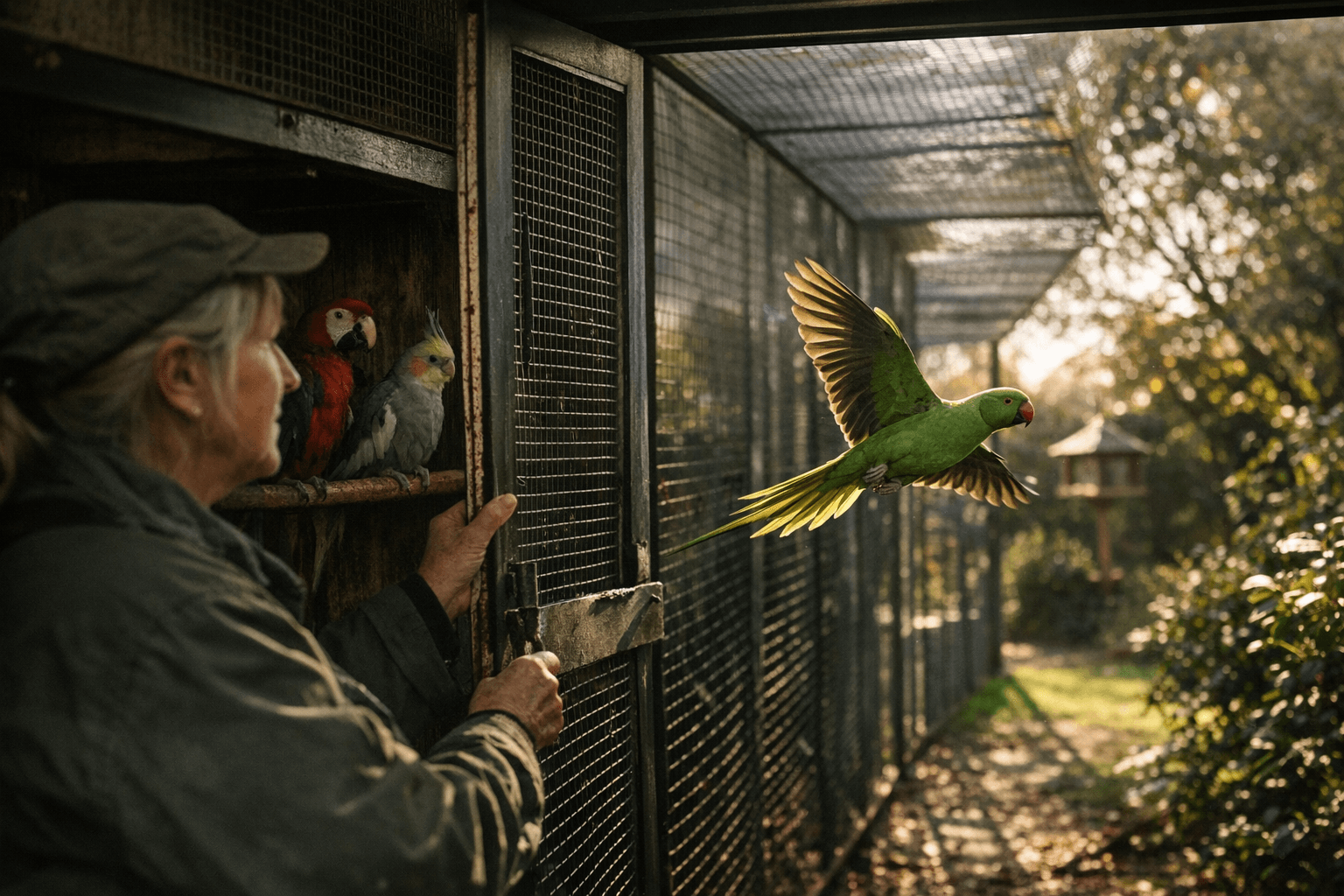
Know when to skip the process entirely. The Avian Influenza Prevention Zone mandatory biosecurity measures remain in place across England, Scotland and Wales even after the housing order lifted. Outdoor ranges and aviary runs may still carry live HPAI virus, and APHA's guidance states that hard surfaces require cleansing and disinfection, ponds and standing water must be fenced off, and wild bird deterrents need to be reinstated before any birds go outside. If those conditions are not met, the corridor stays closed. The same applies if a bird is already showing signs of illness: drooping on the perch, lethargy, watery eyes, or swollen head tissue are all reasons to contact APHA on 0300 303 8268 before any outdoor transition begins. Dead wild birds found near outdoor areas should be reported to the Defra helpline on 03459 33 55 77.
Between October 2025 and mid-January 2026, the UK logged 88 confirmed cases of avian influenza in poultry and captive birds. Welsh Chief Veterinary Officer Richard Irvine was unambiguous in his assessment: "Whilst we are seeing risk levels reducing, bird flu has not gone away."
Five months of careful indoor management is a significant investment in a companion parrot's health. A phased corridor reintroduction across the following week is what protects that investment from unravelling on the first bright April morning.
This article was produced by Prism’s automated news system from verified source data, official records, and press releases, then run through automated quality and moderation checks before publishing. The system is built and supervised by the people who set the standards it runs under. Read our full AI policy.
Did this article answer your question?