Phoenix Landing class teaches whole-bird care for parrots at home
Phoenix Landing’s core class turns scattered parrot advice into one baseline plan, with the fastest payoff likely coming from diet and enrichment.
A shortcut for the owner who is piecing care together
If your parrot care plan lives in saved videos, forum threads, and half-remembered advice, The Good Life is built to replace that patchwork. Phoenix Landing lists the self-paced online core class for April 18 through April 25, 2026, and the premise is simple: parrots do best when nutrition, behavior, enrichment, health, and anatomy are treated as one connected system, not five separate chores.
That framing is why the class feels more useful than another generic bird lecture. A bored bird can become a loud bird. A bird on a poor diet can lose condition. A bird without enough safe activity can become harder to live with. The Good Life is trying to get ahead of all of that by giving you one baseline plan that ties the whole household together.
What the class actually covers
The course description is broad, but in the right way. It covers nutrition, behavior, enrichment, health, and the anatomy of parrots, which Phoenix Landing describes as its dinosaur-like companion birds. That matters because companion parrots are not a single-issue pet. The way you feed them affects energy and condition. The way you structure their day affects behavior. The way you set up enrichment affects how much trouble they get into when you are not actively entertaining them.
The class also promises tips for making parrot care functions easier, which is the sort of detail that separates a decent class from a genuinely helpful one. Most bird homes do not fall apart because of one dramatic mistake. They get stuck in friction, the slow accumulation of awkward routines, inconsistent feeding, and enrichment that never quite gets implemented. A course that lowers that friction can improve daily life faster than a dozen scattered ideas ever will.
Who is likely to benefit most
This is the class for anyone who feels like they are assembling parrot care from fragments. New adopters will get the obvious benefit, because the self-paced format lets you move at your own speed and work through the material with other people in the house. But it is just as relevant if you have lived with birds for years and still catch yourself wondering whether your current routine is actually enough.
It is also a practical fit if you are doing Phoenix Landing adoption homework. The class can satisfy part of that requirement if the homework activities are completed, which makes it useful both as education and as a step in the adoption process. That dual purpose is smart. It means the class is not just information for information’s sake. It is a bridge from rescue and adoption into a daily care routine you can actually maintain.
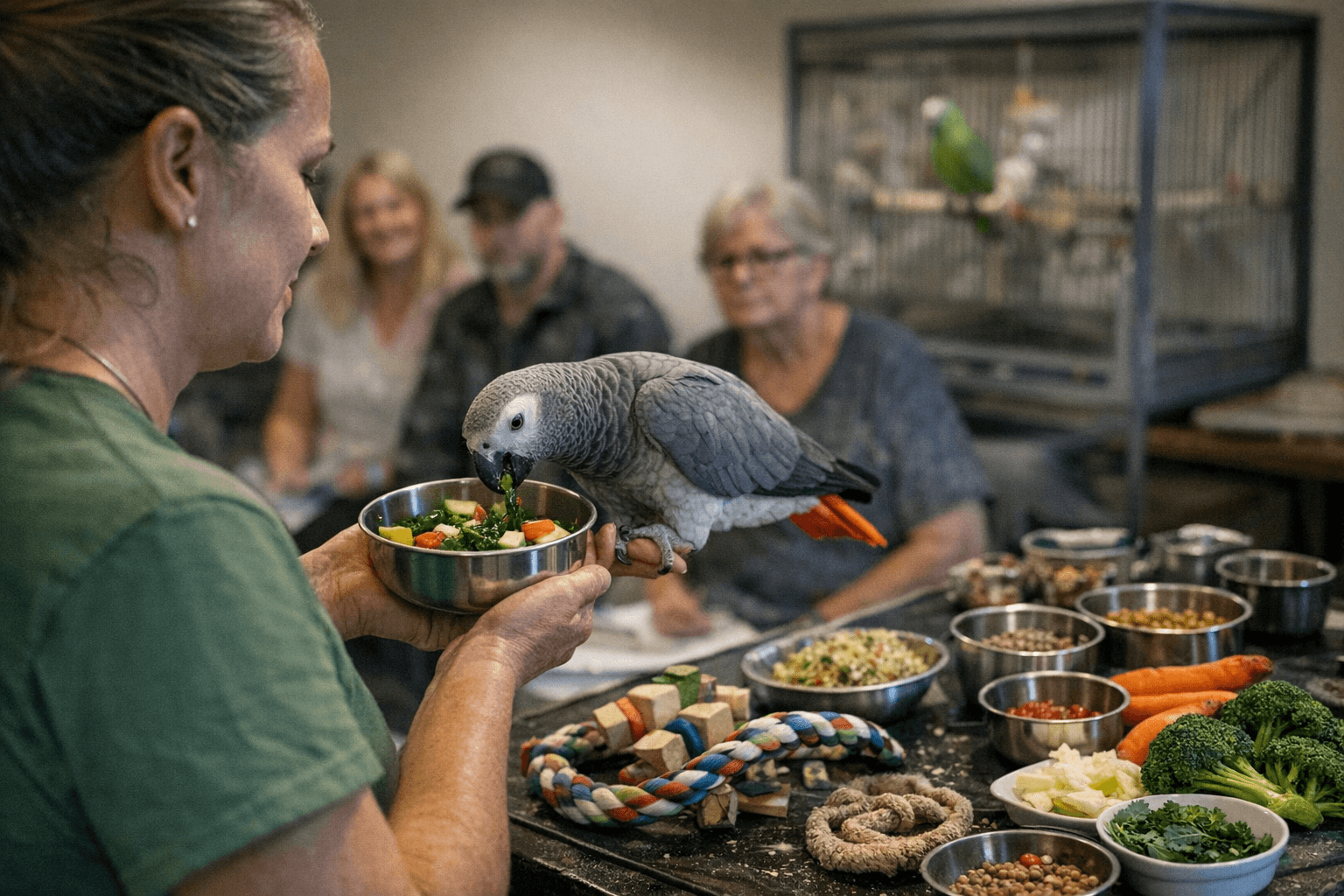
Phoenix Landing says its educational events are open to everyone, regardless of where you live, so you do not need to be in its service area to get value from the course. That openness makes it a community resource for the whole parrot world, not just a local adopter pipeline.
The everyday mistakes it can help prevent
The biggest value in a course like this is prevention. The notes around The Good Life point to the same problem again and again: parrot issues overlap. When owners treat behavior as separate from diet, they miss the way one problem feeds the other. When enrichment is treated like an optional extra, the bird pays for it at home. When health is not built into the routine, small warning signs are easier to ignore.
Here are the mistakes this kind of class is built to head off:
- Thinking a bird problem is only a behavior problem, when diet and enrichment may be driving it.
- Treating toys and activities as add-ons instead of part of the bird’s daily welfare.
- Waiting until a bird is already hard to manage before building a better routine.
- Underestimating anatomy, which is the fastest way to misunderstand why parrots need specialized care.
That last point is worth paying attention to. Phoenix Landing is not presenting anatomy as trivia. It is putting anatomy in the same box as nutrition and behavior, which tells you how seriously the organization takes the way a parrot’s body shapes its needs.
The modules most likely to change life at home fastest
If you only expect a quick payoff from one or two sections, start with nutrition and enrichment. Those are the parts most likely to change what you do every day, and they are the areas where small corrections can ripple through the rest of the household. Better food choices and better activity choices usually show up first in routine, then in behavior, then in how manageable the bird feels.
Behavior is the other important piece, but it tends to improve fastest when the basics are already steadier. That is why The Good Life is appealing as a baseline course rather than a niche lesson. It does not isolate one symptom. It connects the things that usually make life easier at home.
Why Phoenix Landing’s framing carries weight
Phoenix Landing is not a casual meetup group. It describes itself as a volunteer 501(c)(3) parrot welfare organization serving Maryland, Washington, D.C., Virginia, North Carolina, and Northeast Florida through its adoption program. Its stated goals include education, adoption, avian-medicine support for veterinary students, wild parrot research and conservation, and advocacy for standards of care. It also says it wants birds adopted through Phoenix Landing to be physically and legally protected and to maintain compliance with USDA Animal Welfare Act regulations.
The scale behind that mission is part of the story. As of March 1, 2026, Phoenix Landing said it had re-homed 3,612 birds, with 66 currently in foster and 68 still waiting to enter the adoption program. It also celebrated its 25th birthday on April 20, 2025. That is a long enough track record to make its education efforts feel like part of a larger system, not a side project.
For bird owners, that is the real value of The Good Life. It does not promise a miracle fix. It gives you a cleaner baseline, one that ties food, behavior, enrichment, health, and anatomy into a single way of thinking. If your current routine feels improvised, this is the kind of class that can make parrot care feel organized, intentional, and a lot less like you are making it up as you go.
This article was produced by Prism’s automated news system from verified source data, official records, and press releases, then run through automated quality and moderation checks before publishing. The system is built and supervised by the people who set the standards it runs under. Read our full AI policy.
Did this article answer your question?