Rainforest Parrot Habitats Reveal Better Care for Pet Birds
Rainforest parrots show why better pet care starts with movement, foraging, and flock-level complexity, not a simpler cage.
What rainforest parrots reveal about better home care
Rainforest parrots do not live in flat, predictable spaces, and your bird should not be expected to thrive in one. Their wild lives are built around movement, social contact, shifting food sources, humidity, and constant decision-making, which is exactly why the best captive care borrows from habitat, not just from husbandry rules.
The core lesson is simple: a home setup has to support behavior, not merely confinement. For Amazon parrots, macaws, cockatoos, and other mentally active species, that means designing for curiosity, climbing, chewing, and choice so the bird can behave like a parrot instead of sitting through the day as a decoration.
Foraging is the first design principle
The Association of Avian Veterinarians frames foraging enrichment in three stages: parrots should be encouraged to search for food, procure it, and then extract or process it. That sequence matters because it turns feeding from a quick delivery into a meaningful activity, the kind of work rainforest parrots are built to do.
Even a well-enriched enclosure may not match the time wild parrots spend foraging, which is why presentation matters as much as the food itself. You can improve the daily routine by hiding portions in safe feeders, varying texture and placement, and making birds work a little for what they eat instead of serving everything in an open bowl.
- foods placed in different spots so the bird has to move
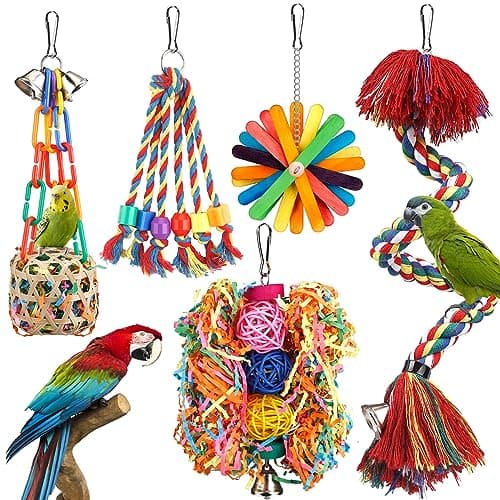
- toys or feeders that require manipulation and chewing
- rotation between familiar items and new challenges
- opportunities to peel, crack, shred, or extract food in species-safe ways
A strong feeding plan usually includes:
That approach reflects how rainforest parrots actually eat. They do not just consume calories; they investigate, gather, pry, and process, and that chain of actions is part of what keeps them mentally steady.
Build the habitat around movement and vertical life
Rainforest parrots use the full three-dimensional space around them, so vertical room is not a luxury. Perch placement, climbing routes, and cage shape should invite movement upward, downward, and sideways, because parrots are far more likely to stay active when they can change position and choose a route through their space.
That same logic applies outside the cage. Daily out-of-cage time should not be an afterthought, especially for birds that evolved to travel, feed, and socialize across large territories. A home that rewards short hops and climbing is closer to a livable habitat than one that only offers a single perch and a feeding station.
Think of the enclosure as a small patch of rainforest translated into safe captive form. Different perch diameters, chewable materials, and thoughtfully arranged landing spots help the bird keep moving, and movement is not just exercise for a parrot. It is part of how the species stays engaged with its world.
Social signals, sound, and humidity all matter
Rainforest parrots live in a rich sensory environment, surrounded by flock calls, environmental changes, and constant feedback from other birds. That is why social interaction should be planned, not accidental, and why many parrots become more settled when their routines include regular contact, predictable handling, and a responsive environment.
The soundscape matters too. A silent, empty room can feel dead to a flock-oriented bird, while gentle household activity, spoken interaction, and consistent daily patterns can provide the stimulation that keeps a parrot alert without overwhelming it. The goal is not noise for its own sake; it is an environment that feels alive enough to match the bird’s social brain.
Humidity is another rainforest trait that is easy to ignore and hard to replace after problems start. Tropical conditions shape skin, feathers, and breathing comfort, so the broader setup should avoid dry, stagnant air and instead support a healthier indoor climate that better reflects the bird’s native conditions.
Species-specific ecology should shape your decisions
One of the biggest mistakes in pet care is treating parrots as if they all want the same thing. A bird from a lowland rainforest, a palm-rich forest edge, or a different tropical region may have a very different feeding style, nesting habit, and social rhythm, which is why the species matters as much as the category.
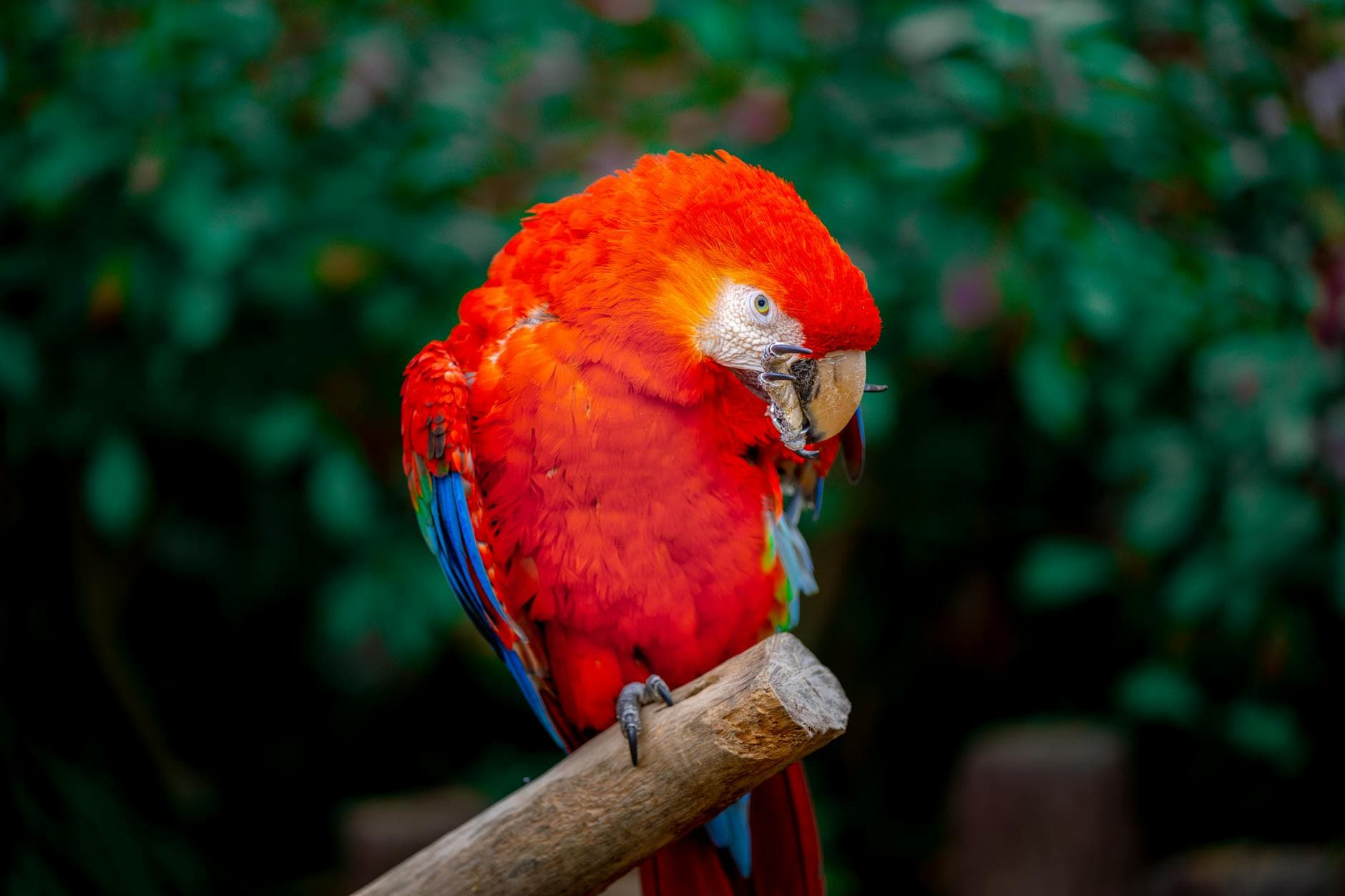
Great Green Macaws are a clear example. They depend on giant almendro trees for nesting and as a primary food source in lowland rainforest, which shows how tightly some parrots are bound to specific habitat structures. Scarlet Macaws add another layer of complexity, since they are described as eating fruits toxic enough to kill other animals, with clay possibly helping neutralize plant poisons.
That is not trivia. It is a reminder that parrots are adapted to a food landscape that is varied, selective, and sometimes chemically challenging. In captivity, that translates into more than seed or one daily mix. It means variety, safe chewability, and food presentation that supports natural processing.
Macaws in Tambopata, Peru, also gather at clay licks, one of the most vivid examples of rainforest behavior in the western Amazon. When you look at that kind of scene, the message is unmistakable: parrots are built for choice, movement, and environmental texture, not for a stripped-down routine.
Conservation and care belong in the same conversation
The wider conservation picture makes habitat-based care even more important. BirdLife reports that one in three parrot species is threatened, and the pressures are severe: habitat loss, hunting, trapping, logging, agriculture, climate change, and fragmentation all chip away at the places parrots need to breed, feed, and survive.
The IUCN Red List helps track those risks by following species range, population size, habitats, ecology, threats, and conservation actions. That kind of monitoring matters because parrots are not declining for a single reason. They are being squeezed by a stack of threats that alter the very conditions your bird’s wild relatives depend on.
The IUCN SSC Wild Parrot Specialist Group says hundreds of thousands of parrots are caught for illegal and unsustainable trade, while the World Parrot Trust has worked since 1989 on conservation and welfare projects in 22 countries for more than 40 species. It is a blunt reminder that rainforest living is both a care model and a conservation story.
History matters here too. Large numbers of wild-caught parrots were imported into the United States in the 1970s, and that trade helped seed the feral parrot colonies seen today. Hyacinth Macaws were reduced to about 3,000 birds between 1970 and 1990 when trapping was heaviest, a stark example of how quickly demand can reshape a species’ future.
That is why the rainforest lens is so useful for pet care. The same traits that make parrots dazzling companions, intelligence, social complexity, specialized feeding, and mobility, also make them vulnerable when their world is simplified. The better you translate the rainforest into your home, the more likely your bird is to live with energy, choice, and real parrot behavior intact.
This article was produced by Prism’s automated news system from verified source data, official records, and press releases, then run through automated quality and moderation checks before publishing. The system is built and supervised by the people who set the standards it runs under. Read our full AI policy.
Did this article answer your question?