Fresh Egg Pasta at Home, Made Simple for Every Skill Level
Making fresh egg pasta at home is simpler than most people expect, and your first successful batch could happen this weekend.
Pasta clubs across the country have a running joke: the first time someone brings homemade fresh egg pasta to a meetup, everyone assumes they took a class. Half the time, they taught themselves in a home kitchen with nothing more than a rolling pin, a bag of flour, and a few eggs. The gap between "I could never do that" and "I made this last Sunday" is smaller than the reputation of fresh pasta suggests, and this guide exists to close it.
Whether you're preparing for an in-person pasta class, working through techniques with a local pasta club, or simply want to stop buying dried pasta for dishes that genuinely deserve fresh, the process below is designed to be low-stress and repeatable at every experience level.
Why fresh egg pasta is worth the effort
Dried pasta and fresh pasta are not interchangeable, and that's not a quality judgment — they're built for different jobs. Fresh egg pasta, made with wheat flour and whole eggs, has a tender, silky texture and a richness that dried pasta can't replicate. It absorbs sauces differently, cooks in a fraction of the time (often two to three minutes in boiling water), and carries the flavor of whatever sauce it meets in a way that feels collaborative rather than passive.
The other reason to learn it: once the muscle memory is there, a batch of fresh pasta takes about 45 minutes from flour to finished dough, with an additional 30 minutes of resting time. It becomes the kind of thing you can fold into a weeknight without a special occasion to justify it.
The core ingredients
Fresh egg pasta requires very little: flour, eggs, and sometimes a small amount of water or olive oil. The ratio you choose shapes everything else.
- A classic Italian proportion is 100 grams of flour to one large egg, scaled up as needed. For two generous servings, 200 grams of flour and two eggs is a reliable starting point.
- "00" flour, a finely milled Italian wheat flour, produces the smoothest, most tender dough and is worth seeking out if you have access to it. All-purpose flour works and produces a slightly more rustic texture with a bit more chew.
- Whole eggs give the dough richness and a golden color. Some recipes use a mix of whole eggs and additional yolks for a richer, more deeply colored result.
- A pinch of salt in the dough is optional but adds subtle flavor.
Avoid the temptation to add too much water early. Fresh egg pasta dough is supposed to feel firm, almost stiff, before kneading softens it.
Making the dough
1. Mound your flour on a clean work surface or in a large bowl and create a well in the center.
2. Crack your eggs into the well and beat them lightly with a fork, gradually incorporating flour from the inner edges of the well.
3. Once the mixture becomes too thick to work with a fork, use your hands to bring the remaining flour in and press everything into a shaggy mass.
4. Knead firmly for 8 to 10 minutes. The dough will transform from rough and uneven to smooth, elastic, and slightly tacky but not sticky. If it tears rather than stretches, it needs more kneading.
5. Wrap the dough tightly in plastic wrap or place it under an inverted bowl and rest it at room temperature for at least 30 minutes. This rest is not optional — it relaxes the gluten and makes rolling dramatically easier.
A common mistake at the beginner stage is adding flour to fix stickiness before giving the dough time to come together. Work through the stickiness with confident kneading before adding anything extra.
Rolling and shaping
This is where the process opens up into different directions depending on what you're making and what tools you have.
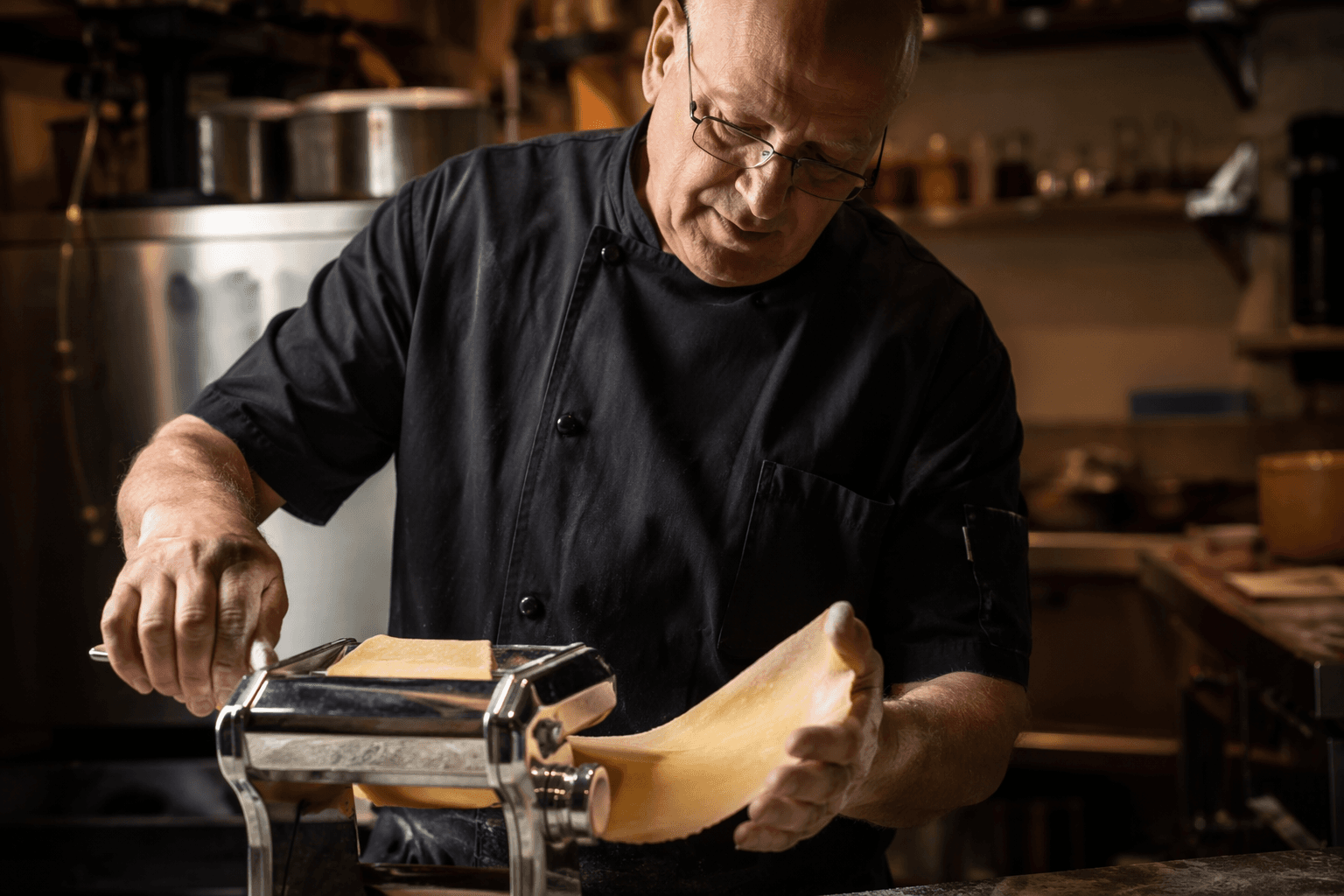
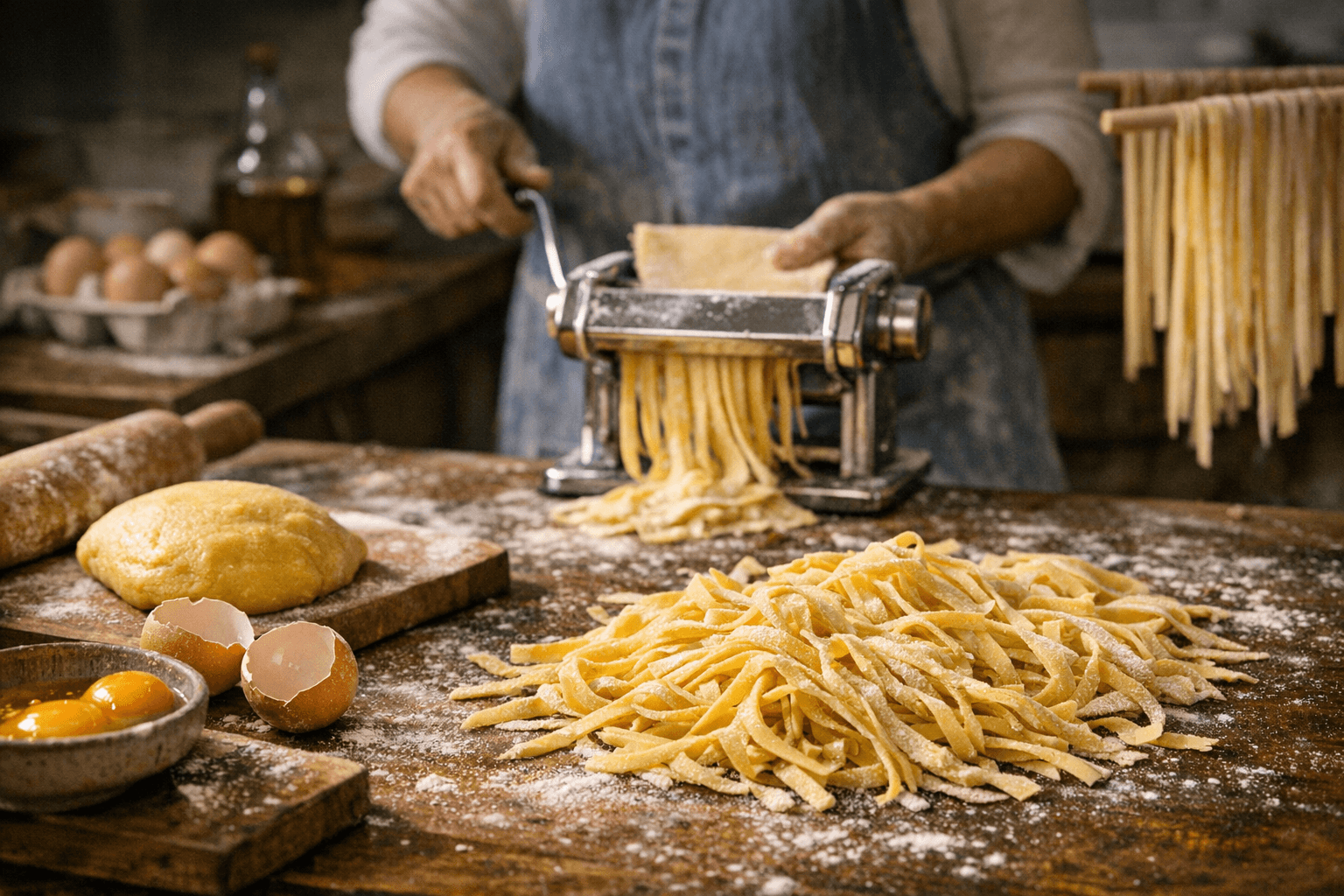
With a pasta machine, divide the rested dough into portions about the size of an egg. Working one portion at a time and keeping the rest covered, flatten each piece with your palm and feed it through the machine at its widest setting. Fold the sheet in thirds like a letter, rotate it 90 degrees, and feed it through again. Repeat this two or three times before progressively narrowing the setting, one notch at a time, until you reach your target thickness. For tagliatelle and fettuccine, setting 5 or 6 on a standard machine (out of 9) is a common endpoint. For filled pasta like ravioli or tortellini, go thinner, to setting 6 or 7.
With a rolling pin, the goal is the same: even, thin sheets that don't tear. Rotate the dough frequently and work from the center outward. It takes more physical effort than a machine, but it's entirely achievable and produces excellent results.
- Tagliatelle and fettuccine: dust the sheet lightly with flour, roll it loosely like a scroll, and cut across into ribbons. Shake the nests loose immediately.
- Pappardelle: cut wider ribbons, approximately 2 to 3 centimeters, by hand with a knife or pastry wheel.
- Maltagliati: literally "badly cut," this rustic shape is made by cutting irregular triangles or trapezoids from the sheet — a genuinely beginner-friendly shape because imprecision is the point.
- Filled pasta: lay filling in small mounds on one sheet, lay a second sheet over the top, press out air pockets firmly, and cut with a sharp cutter or knife.
For cutting:
Cooking fresh pasta
Fresh pasta needs a large pot of well-salted boiling water and your full attention for a short window. Drop the pasta in, stir immediately to prevent sticking, and start tasting at the 90-second mark. Most fresh egg pasta shapes finish between two and four minutes. The texture you're looking for is tender with just a small amount of resistance at the center; overcooking happens fast and produces something closer to boiled dough than pasta.
Reserve a cup of pasta water before draining. The starchy water is the bridge between your sauce and your pasta, and finishing the dish in the pan with a splash of it creates a cohesion that plating separately can't match.
Building the skill over time
The most useful thing you can do after your first batch is make a second one within the week. The dough will feel more familiar under your hands, the rolling will go faster, and you'll start developing instincts about hydration and thickness that no written guide can fully convey. Pasta clubs and in-person classes are particularly valuable at this stage, not because the technique is too difficult to self-teach, but because watching someone else work through the same dough in real time accelerates the learning curve considerably.
Start with tagliatelle. Master the dough ratio you like. Then branch into filled pasta when flat cuts feel automatic. That progression, more than any single technique, is what turns a one-time experiment into a regular practice.
This article was produced by Prism’s automated news system from verified source data, official records, and press releases, then run through automated quality and moderation checks before publishing. The system is built and supervised by the people who set the standards it runs under. Read our full AI policy.
Did this article answer your question?