Lund University Study Finds 7 Grams of Salt Per Litre Cooks Perfect Al Dente Pasta
Scientists at Lund University pinpointed 7 grams of salt per litre as the exact amount that protects pasta's microscopic structure and delivers true al dente texture.

Seven grams of salt per litre of water: that is the precise figure Andrea Scotti, senior lecturer of Physical Chemistry at Lund University, and colleagues identified as optimal for cooking pasta that holds its structure all the way down to the molecular level. The findings, published in the journal Food Hydrocolloids, came out of experiments using particle accelerators and neutron facilities to observe spaghetti's hidden architecture as it cooks.
"Cooking pasta with the right amount of salt is not just a matter of taste," Scotti wrote on The Conversation. "What we found is that salt doesn't just make pasta taste better; it also strongly affects the microstructure of the spaghetti and thus the whole dining experience."
Seven grams converts to roughly 1.25 teaspoons, and the guidance scales with volume: more water for larger amounts of pasta. The team also recommends a cooking time of 10 minutes for regular spaghetti to achieve perfect consistency, with gluten-free alternatives requiring 11 minutes. What happens when you overdo the salt is not simply a flavour problem. When researchers doubled the salt concentration in testing, the internal order of the pasta broke down more rapidly and the structure within the starch granules was significantly altered by the cooking process.
To observe these effects, Scotti employed small-angle neutron scattering and X-ray techniques, methods that allow examination of food at a microscopic scale down to a billionth of a metre. The team worked in collaboration with Judith Houston, lead instrument scientist for the LoKI instrument at the European Spallation Source in Lund, Sweden, alongside scientists from the Institut Laue-Langevin in France and both the Diamond Light Source and ISIS Neutron and Muon Source in the UK. Those molecular observations were then connected to everyday product characteristics including texture, shelf life and glycaemic index.
The central structural discovery concerns gluten. "We were able to show that the gluten in regular spaghetti acts as a safety net that preserves the starch," Scotti said. "The gluten-free pasta, which contains an artificial matrix, only works optimally under exactly the right cooking conditions – otherwise the structure easily falls apart." In regular pasta, that gluten scaffold holds starch granules in place even during a full boil, delivering firmness and a slower digestion rate. Gluten-free pasta lacks this natural network, leaving starch granules vulnerable to swelling and collapsing when conditions drift from ideal.
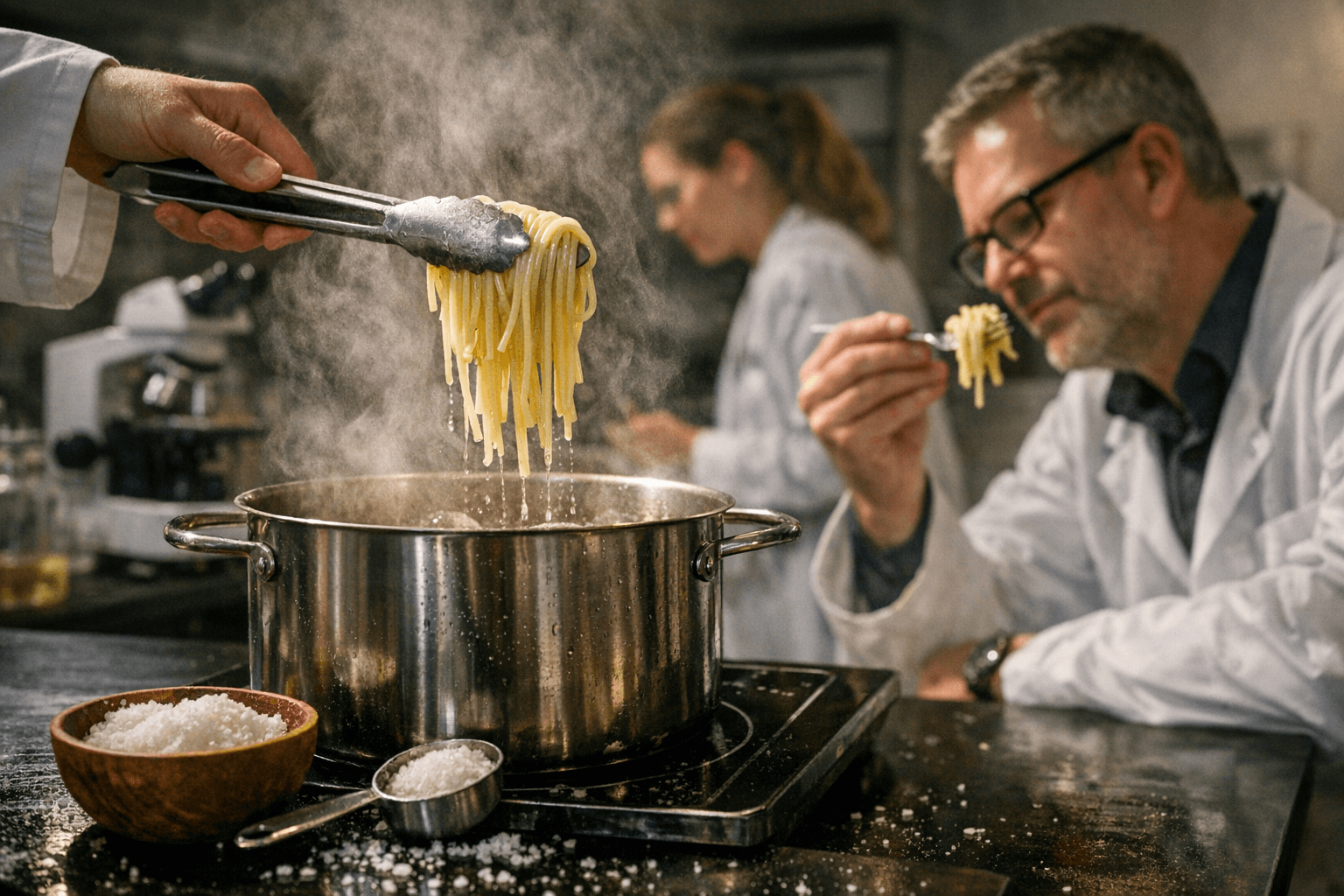
That fragility has practical consequences. "Our results show that regular pasta has higher tolerance, or better structural resistance, to less optimal cooking conditions such as being cooked for too long or too much salt being added to the water," Scotti noted. The implication is that a home cook who overshoots on time or salt will notice far more damage in a gluten-free bowl than in a conventional one.
The research tested store-bought spaghetti in both regular and gluten-free forms, examining each straight off the shelf rather than in controlled lab-manufactured conditions. That grounding in commercially available products makes the 7 g/L recommendation directly applicable to any home kitchen.
The Lund team plans to build on this work by studying more pasta types and different manufacturing conditions, and by replicating what happens once pasta enters the stomach to assess how digestion affects its chemical structure. That next phase could inform efforts to develop gluten-free alternatives durable enough to survive the variables of real-world cooking, a goal the researchers have explicitly stated as motivation for continuing the work.
This article was produced by Prism’s automated news system from verified source data, official records, and press releases, then run through automated quality and moderation checks before publishing. The system is built and supervised by the people who set the standards it runs under. Read our full AI policy.
Did this article answer your question?