Elliott Erwitt's Rare Color Work Gets New Life in Stunning Kodachrome Collection
Nearly half a million Kodachrome slides, some 70 years old, show Erwitt used color with the same comic timing as his celebrated black-and-white work.

For most of his career, Elliott Erwitt carried two cameras everywhere. One was loaded with black-and-white film for his personal work. The other held color, and it was almost always for hire. That distinction, so deliberate and so long misunderstood, is exactly what makes the new edition of "Elliott Erwitt's Kolor," published by teNeues, such a revelation.
The 304-page volume was carefully selected from an archive of nearly half a million Kodachrome slides, some dating back more than 70 years, whose colors have been remarkably preserved. The subjects span a world: showgirls in Las Vegas, military camps, bustling marketplaces, world leaders, and the particular choreography of private moments in Venice. What emerges across each frame is proof that the photographer called the "master of the indecisive moment" was applying the same wit and timing to color that made his black-and-white work legendary.
Born Elio Romano Erwitz on July 26, 1928, in Paris to Jewish-Russian immigrant parents, Erwitt spent his childhood in Milan before his family emigrated to the United States in 1939. He developed his eye as a teenager in Hollywood, working in a commercial darkroom, before Robert Capa personally invited him to join Magnum Photos in 1953, a membership that propelled a career spanning three quarters of a century. He shot for Life, Look, Collier's, and Holiday, and served as Magnum's president for three years in the late 1960s. His archive, now held at the Harry Ransom Center at the University of Texas at Austin, includes more than 31,500 signed modern exhibition prints.
His color work, though, remained largely invisible to the public for decades. In a 2022 interview at age 93, one of his last major, Erwitt explained the dynamic plainly: "The kind of work that I was doing for business in my career was color photography, which is normally required." His strategy was deliberate: he would schedule commercial color assignments to locations outside New York, places he could see with fresh eyes, and carve out time to shoot personal black-and-white work on his Leica alongside them. The color was a job; the black-and-white was a calling. But he added, with characteristic directness: "I don't want to reject my color pictures."
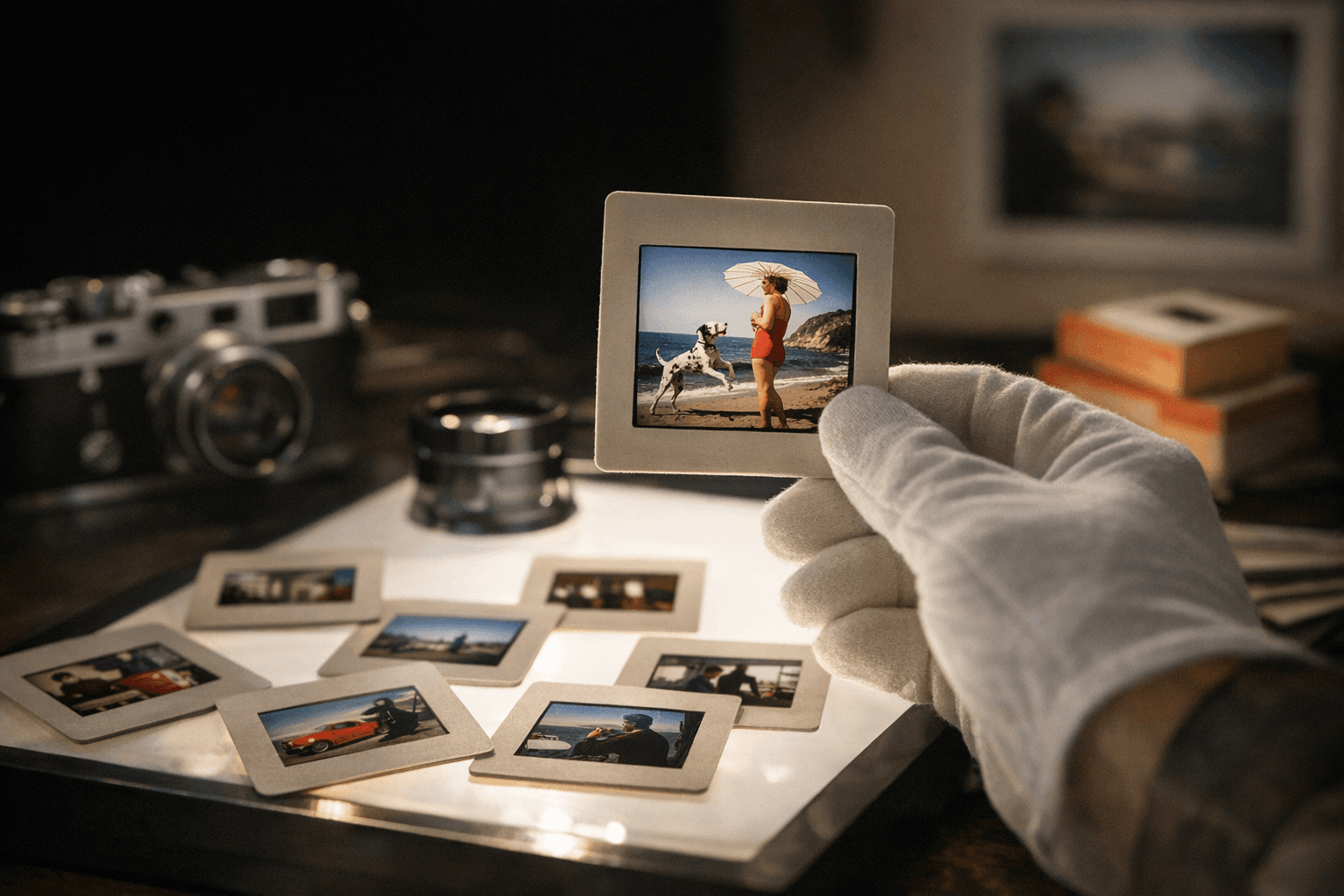
That refusal is what makes Kolor so instructive. Studying his color frames reveals a specific discipline: color functions as the punchline, not the composition. Where a less deliberate photographer might fill the frame with competing hues, Erwitt consistently isolates one loud tone against an otherwise quiet scene, letting the gesture or expression land first. The Kodachrome palette, remarkably intact after seven decades, only sharpens this effect. The practical principle is straightforward: commit to the gesture before you commit to the color. Let the human moment happen, then let one dominant hue carry the emotional weight. His Las Vegas and Venice frames demonstrate this repeatedly, the color arriving last in the eye, after the body language has already done its work.
The title itself is a wink from Erwitt to history, referencing George Eastman, Kodak's founder, who was famously fond of words beginning with the letter K. The original edition appeared in September 2013 at roughly 450 pages and $125 in hardcover. The new teNeues edition, slimmer at 304 pages but no less rich, is published in English, German, French, Italian, and Spanish, a scope that befits a photographer whose lens traveled everywhere from a Nixon state visit to the Soviet Union in 1959 to the rooms where Marilyn Monroe, Che Guevara, and Truman Capote sat for his portraits.
For photographers conditioned to see Erwitt only in monochrome, Kolor is a corrective. The archive was always there. The color was always deliberate. It just took half a million slides and a new edition to make that fully visible.
This article was produced by Prism’s automated news system from verified source data, official records, and press releases, then run through automated quality and moderation checks before publishing. The system is built and supervised by the people who set the standards it runs under. Read our full AI policy.
Did this article answer your question?