Inside The Pitt, how precise lighting builds immersive ER realism
The Pitt sells documentary realism with a fake ER that never stops moving, even when the set is locked down. The real trick is how scrubs, soft overheads, and disciplined handheld coverage make the space disappear.
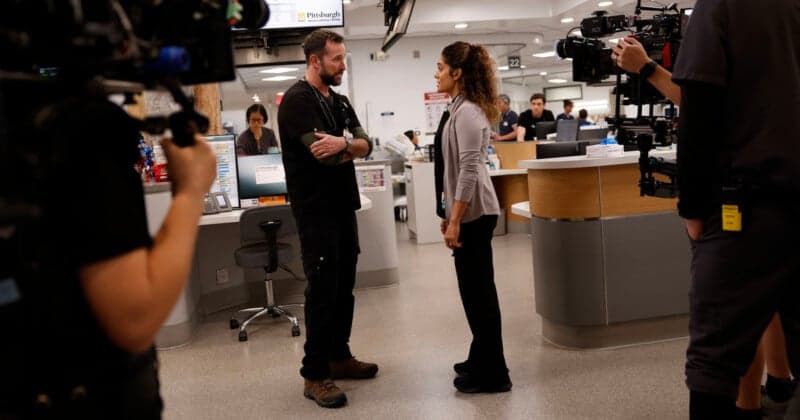
The Pitt works because it understands one hard truth about photographic realism: the more controlled the scene, the more spontaneous it has to feel. The show’s emergency department is a rigid machine built for movement, with every wall and fixed piece of furniture locked in place, yet the final image reads like a place cameras stumbled into and documented in real time.
Build the room before you build the shot
Nina Ruscio’s production design did a lot of the visual heavy lifting before a single script was finished. She drew the ER blueprint first, then the writers used that layout to assign patients and scenes to specific spaces, which meant the storytelling and the geography were tied together from day one. That matters because the show’s real-time structure, with each episode covering one hour in the ER, depends on viewers always knowing where they are.
The set was enormous, built on a 24,000-square-foot space, and one profile says about 125 professionals worked on a 10-week build to pull it off. Ruscio also borrowed cues from Pittsburgh itself, including architectural details inspired by local buildings and a visual reference to Allegheny General Hospital. For photographers, the lesson is simple: if you want an environment to feel real, lock the geography early and let the frame respect it. A believable room is easier to shoot than a constantly changing one.
Keep the floor clear and let the camera move
Johanna Coelho, who shot all 15 episodes of season one as the sole cinematographer, said the production treated mobility as sacred. The crew, the cameras, the lighting, and the sound team all had to move through the same environment at once, so anything sitting on the floor became a problem fast. That is why the production kept lighting gear and C-stands off the floor and relied on custom onboard lights mounted on the cameras, plus pole-operated lights for flexibility.
The most elegant part of the setup was the ceiling work. The team used 3D-printed diffusion frames that magnetized to ceiling troffers, along with diffusion cups for ceiling cans, which kept the light soft without cluttering the set. That approach is worth stealing if you shoot staged interiors, kitchen scenes, or cramped locations where you cannot afford to plant a forest of stands. The less hardware the audience notices, the more they believe the room exists on its own.
A practical takeaway from The Pitt looks like this:
- Put the light where the camera already is if the space needs to stay open.
- Use pole lights when you need fast repositioning without filling the floor.
- Treat ceiling fixtures as part of your lighting kit, not just set dressing.
- Keep stands, bags, and stray supports out of reflective paths and walk lanes.
Hide the crew in plain sight
One of the show’s smartest visual decisions was also one of the cheapest: the camera, lighting, and audio crew wore hospital scrubs. That was not a gimmick. In a set full of glossy surfaces, glass, stainless steel, and 360-degree camera moves, scrubs made the crew less visible in reflections and less visually disruptive in busy frames. Coelho has said the wardrobe helped the team blend into the open set during those wide moves.

That is a useful reminder for anyone staging documentary-style work. Wardrobe is not just for talent. If your crew is going to appear in mirrors, windows, polished counters, or car paint, their clothing becomes part of the composition. Matching the environment, or at least disappearing into it, can save you from a lot of ugly cleanup later.
Handheld works when the lensing is disciplined
The show’s look comes from mostly handheld, documentary-style camerawork, but it never feels sloppy. Coelho’s package, as described in other interviews, included an Alexa Mini LF with Angenieux Optimo primes and Ultra Compact zooms, a combination that keeps the image cinematic while staying nimble inside tight spaces. The result is intimate without becoming twitchy, and responsive without turning into pure coverage.
That balance is the part photographers can borrow. Handheld by itself does not create realism. It creates movement. The realism comes from knowing when to follow, when to hold, and when to let a scene breathe inside a stable frame. A camera that stays close to the action, but does not constantly call attention to itself, is often more convincing than a flashy lens choice or a more expensive body.
Treat white as a lighting tool, not a neutral default
Coelho and Ruscio tested somewhere between 50 and 100 shades of white to find a wall color that would work for every skin tone while still bouncing light effectively. That sounds obsessive because it is. It is also exactly the kind of detail that separates a convincing interior from a flat one.
White on a set is never really white. It is a reflector, a color cast, and a skin-tone problem all at once. If you are lighting a staged environment, sample paint under the same fixtures you plan to use, not under showroom light. The wall color has to support the image, not fight it. The Pitt proves that the background can be just as important as the key light when you are trying to make a fabricated space feel medically real.
Why the illusion holds up
The real achievement here is that all these decisions reinforce the same idea: the audience should feel trapped inside a 15-hour shift, not entertained by a production method. The series premiered on Max on January 9, 2025 as a 15-episode season, was renewed on February 14, 2025, and season two was later set for January 8, 2026. That kind of confidence only happens when the visual system works, and in this case the system is the story.
The best part is that the realism has moved beyond television chatter. The medical community has praised the show’s accuracy, and the production model has been discussed as a sustainable way to maximize immersion while minimizing location shooting. For photographers, that is the real takeaway: the most convincing staged environments are not the ones with the most gear, but the ones where set design, lighting, lensing, and crew behavior all agree on the same lie.
Know something we missed? Have a correction or additional information?
Submit a Tip