Landscape Photographer Says Sunset Chasing Can Undermine Stronger Compositions
Sunset color can flatten a scene into a postcard. Mitch Green’s reminder is simple: stronger landscapes often come from the land, the texture, and the light that social feeds overlook.
The sunset is not the whole picture
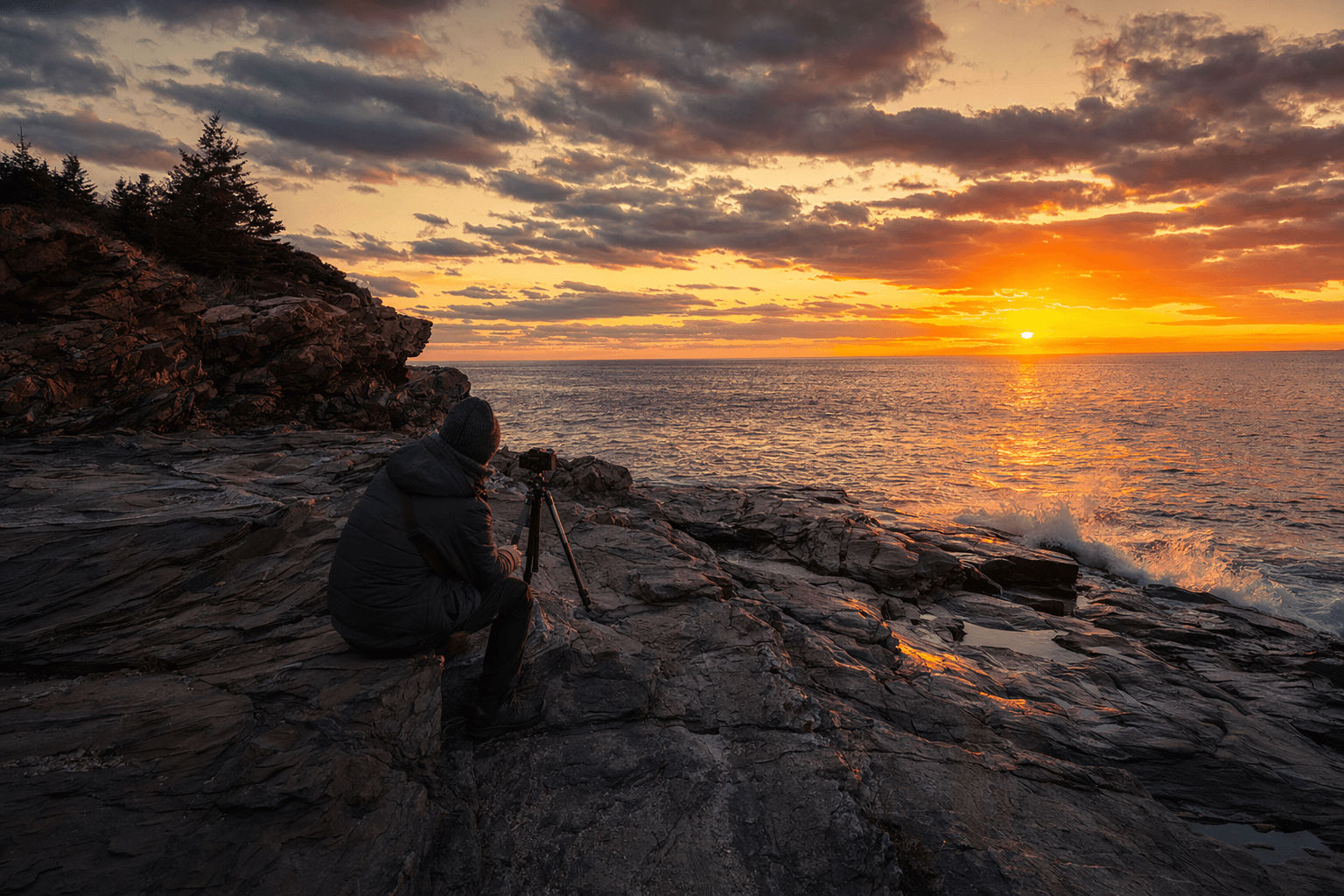
Mitch Green’s latest landscape-photography essay takes aim at a habit many photographers know too well: treating the sky as the entire subject. Looking back on years spent chasing dawns and sunsets across the South Coast of New South Wales, including Bombo Quarry and Cathedral Rocks, he argues that the obsession with color can shrink the frame instead of expanding it.
That matters because a sky-heavy image can be easy to make and hard to remember. Green’s point is not that dramatic light has no value, but that the race for a glowing horizon often turns foregrounds into silhouettes and leaves the land doing nothing more than holding up the top third of the composition.
Why pretty skies can weaken the frame
The trap is subtle. Once the sky becomes the reason to stop, the rest of the scene starts to feel optional, and the photographer stops looking for shape, texture, and depth. Green says that early Instagram feedback, likes, reposts, and even fire emojis, pushed him toward ever-more spectacular skies, which reinforced the idea that visual intensity was the same thing as stronger work.
That habit shows up everywhere in landscape feeds. The most obvious composition is often the one where the horizon sits neatly across the image and the color in the sky does all the heavy lifting. It reads quickly, but it can leave the land underused, especially in places where the geology and texture are the real story.
What to shoot instead of chasing the horizon
The useful shift is to ask what the scene offers when the sky is no longer the headline. On the NSW South Coast, that might mean leaning into the basalt structure at Bombo Headland, the monolithic forms of Cathedral Rocks, or the pebbly bay at the Boneyard rather than waiting for the horizon to explode with color.
A better habit is to build the frame from the ground up:
- Look for foreground texture first, not last.
- Use rock edges, tide lines, and quarry lines to create depth.
- Let the land lead the eye before the sky enters the conversation.
- Move until the composition feels balanced without relying on color alone.
That approach fits the places Green names especially well. Bombo Headland, a former blue-metal quarry, shows basalt columns shaped by quarrying in the 1880s and 1900s and long-term ocean erosion. Boral says the Bombo Quarry precinct has produced millions of tonnes of aggregates since the first quarry was gazetted in 1947, and the landholding is about 46 hectares. These are not empty backdrops; they are visually layered places with history built into the rock.
When flatter light works better
Green’s essay does not dismiss brilliant light, and that is the part many photographers will find most practical. Bright color still has its place, but flatter or softer light can be better when the goal is to show the structure of a scene instead of its spectacle. That is especially true at sites like Bombo Headland, where the NSW Government says the formations are frequently used for television commercials and photo shoots and are especially photogenic at sunrise.
Flatter light helps in three common situations:
- When the landscape depends on texture, such as basalt columns, quarry faces, and pebbled shorelines.
- When the subject is shape and rhythm, not a glowing sky.
- When the frame needs detail across the scene instead of a bright top half and a dark foreground.
At Cathedral Rocks, where towering basalt formations rise at the southern end of Jones Beach, the appeal is not just in the sky behind them. Destination Kiama describes the area as a “photographer’s hat trick,” pairing Cathedral Rocks with Bombo Quarry and the Boneyard, and notes that the region is increasingly popular for wedding photos and filmmaking. That kind of demand says a lot: the land itself is doing real visual work.
A longer tradition than Instagram
Green’s critique lands because it is also a question photography has wrestled with for decades. The National Park Service’s profile of Ansel Adams points to his use of chiaroscuro, the strong contrast between light and dark, to create scale and drama in natural scenes. Adams helped define landscape photography as an art form, but he did it by using light to describe structure, not by making the sky the only event.
Contemporary composition guides still make the same case in modern language. They emphasize foreground interest, horizon placement, depth, and balance, all of which ask the photographer to read the scene as a whole. Green’s essay fits squarely into that tradition: the strongest landscape is not always the brightest one, but the one that shows how a place actually holds together.
Why the social feed keeps rewarding the wrong habit
Part of the reason sunset chasing persists is that social media pushes photographers toward easy, legible drama. A 2025 study on Instagram landscape imagery found that the platform often rewards idealized, romantic scenery that tries to compress as many appealing elements as possible into one instantly readable frame. Another recent Instagram aesthetics study examined how color and composition shape likes and comments, reinforcing the idea that engagement can steer creative choices.
That helps explain why sky-heavy frames remain so sticky online. They are built for quick approval, and they deliver it fast. But Green’s deeper warning is that a habit rewarded by a feed is not automatically the habit that produces better photographs, especially when the real character of a place lives in the stone, the lines, the spacing, and the quieter light between obvious moments.
A better measure of success
The most useful takeaway from Green’s argument is not to abandon sunsets, but to stop letting them set the limits of the work. If every landscape depends on a dramatic sky, the camera is probably arriving too early in the creative process and leaving too soon. The stronger frame often comes after the obvious color has faded, when the land, the geometry, and the light start speaking on their own.
On the South Coast, that means the basalt at Bombo Headland, the monoliths of Cathedral Rocks, and the mixed textures around Bombo Quarry and the Boneyard are not just scenic stops waiting for a bright sky. They are subjects with enough shape, history, and depth to stand on their own. Once the photographer starts seeing that, the landscape stops being a backdrop for pretty weather and becomes a subject with something far more lasting to say.
This article was produced by Prism’s automated news system from verified source data, official records, and press releases, then run through automated quality and moderation checks before publishing. The system is built and supervised by the people who set the standards it runs under. Read our full AI policy.
Did this article answer your question?