Library of Congress Restores Possible First On-Screen Robot Film
A battered trunk in Michigan yielded a 45-second Méliès film restored to 4K, and its automaton may be the first robot ever caught on camera.
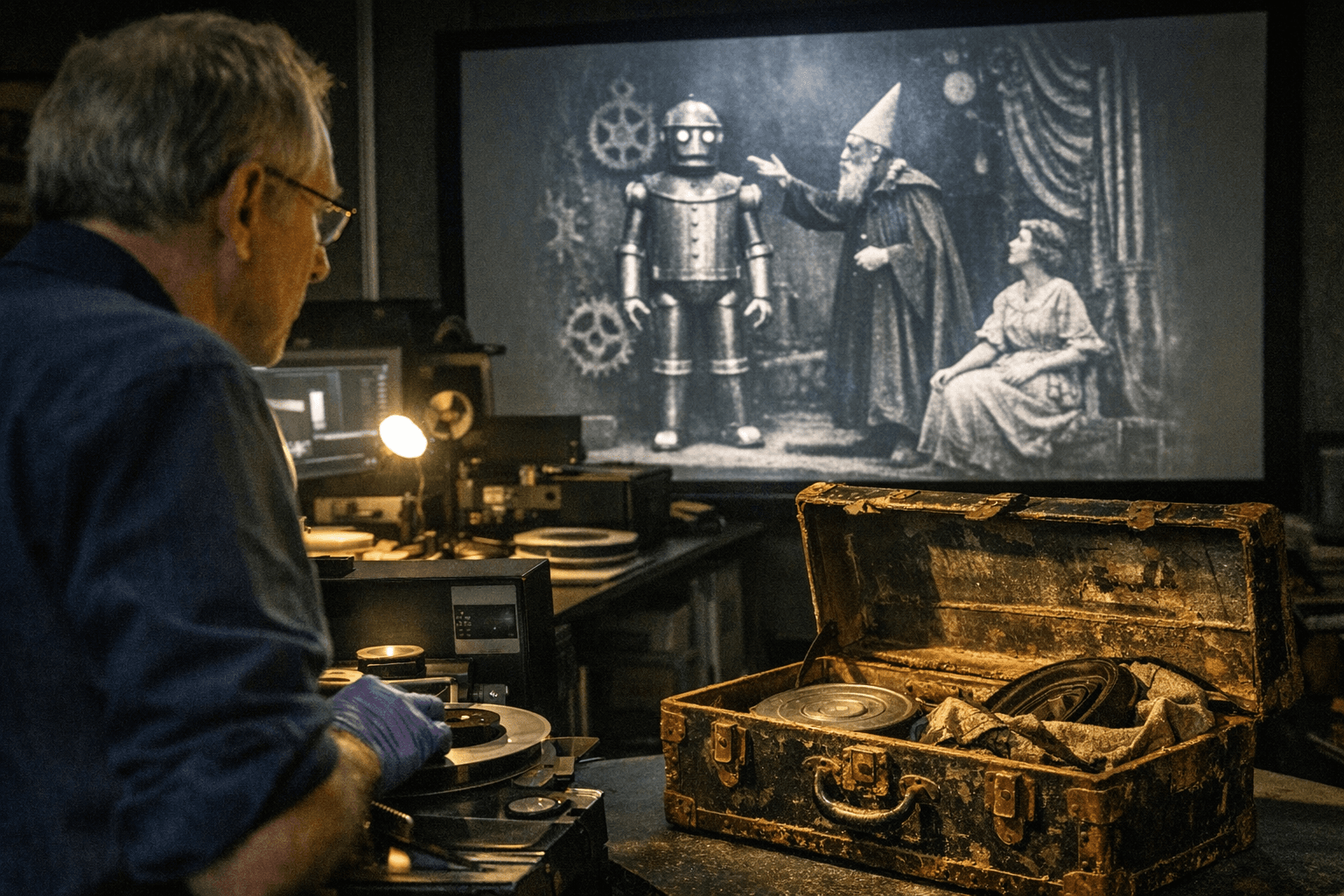
A forgotten trunk in Michigan opened onto one of early cinema’s strangest surviving images: a 45-second Georges Méliès film that may show the first robot-like figure ever filmed. The Library of Congress has restored Gugusse et l’Automate, a battered 1897 print that had sat for about two decades before landing in federal conservation hands, and the result is now available in 4K.
The reels belonged to retired teacher Bill McFarland, whose great-grandfather, William Delisle Frisbee, was a potato farmer, schoolteacher and traveling showman in western Pennsylvania. McFarland had tried to place the film with museums and antique shops, but the nitrate stock made the handoff difficult. The material was too flammable and too fragile for casual handling, even before age had pushed it toward collapse.
A technician finally pointed McFarland toward the Library of Congress. In September 2025, he drove roughly 700 miles to the National Audio-Visual Conservation Center in Culpeper, Virginia, and delivered the reels himself. When librarians opened the package, they found a damaged duplicate print at least three generations removed from the original. Some reels were rusted or misshapen. Others had crumbled, or fused together in brittle layers.
Restoration required frame-by-frame patience. Conservators separated the strips, identified the film as Gugusse et l’Automate, and stabilized the image for scanning. The Library later cataloged the film as Gugusse et l’Automate, also known as The Clown and the Automaton. Its description makes the scene clear: Gugusse the clown turns a crank, Pierrot Automate marches and waves a stick, then the automaton grows from child-sized to adult-sized and turns on him. In retrospect, that gives the 1897 film a special place in visual history, because the word robot would not enter common use until Karel Čapek’s R.U.R. in 1920 to 1921.
For photographers and film historians, the bigger story is not just the novelty of the subject. It is the survival of the image itself. Méliès, born in Paris on December 8, 1861, attended the Lumière brothers’ first public Cinématographe screening on December 28, 1895, then became one of the medium’s earliest masters of fiction and trick effects. This rediscovered reel shows how much history can still be hiding inside damaged physical media, waiting for the right hands to recover it.
Know something we missed? Have a correction or additional information?
Submit a Tip