Nikon should revive classic Nikkor lenses for modern Z-mount cameras
Nikon has a real opening for a Heritage Series: classic Nikkor formulas, modern Z mount, and the kind of character shooters still pay for.
Nikon does not need another sterile prime lineup announcement. It already has the ingredients for something more interesting: a vintage-leaning Zf and Zfc, a Z-mount system with room for native glass, and a catalog of old Nikkors that still make experienced photographers sit up and grin. Jaron Schneider’s case is simple and commercially smart: bring back the lenses people actually remember, but make them usable on modern Z cameras without adapters, compromises, or nostalgia tax.
Why this idea has traction now
Nikon’s own history starts in 1948 with the Nikon I, so the company has no shortage of optical identity to pull from. That matters because the current mirrorless market is crowded with lenses that chase resolution charts first and personality second. Schneider’s argument lands well in that environment: classic Nikkor formulas are not just museum pieces, they are product ideas with a built-in audience.
Nikon has already signaled that it understands the appeal. The company sells the retro-styled Zf and Zfc, and it has said it is open to more vintage-inspired cameras if there is demand. It also already spends real effort on its legacy through the long-running “NIKKOR - The Thousand and One Nights” series and its Camera Chronicle archives. In other words, Nikon is already telling the story. The missing piece is letting photographers buy into it with modern Z-mount lenses.
The lenses that would actually move the needle
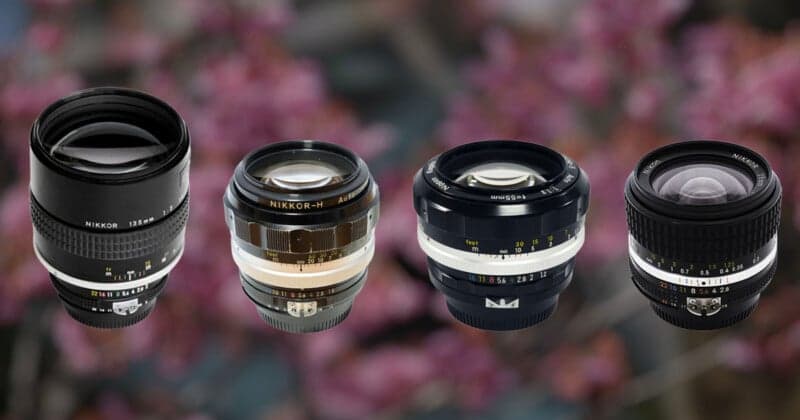
Schneider’s own Heritage Series concept is not random nostalgia. He points to specific lenses that still carry weight with photographers who care about rendering, handling, and focal length utility: 28mm f/2.8, 35mm f/2.8, 55mm f/1.2, 85mm f/1.8, 105mm f/2.5, and 135mm f/2. Those are the kinds of optics that map cleanly onto how people actually shoot, from street to portraits to general-purpose use.
The 105mm f/2.5 is the centerpiece for a reason. Nikon’s own history pages trace that lens back to the S-type camera and the Leica screw mount, and Schneider calls it one of his favorite lenses of all time. That is the kind of lens that earns its reputation in real use, not on a spec sheet, because it combines a focal length people still want with a rendering signature many photographers remember. If Nikon were choosing one lens to prove the concept, that would be the obvious one.
The 85mm f/1.8 also makes sense, especially because Nikon’s archive says the Nikkor-H Auto 85mm f/1.8 was designed by Saburo Murakami, one of Nikon’s important early lens designers. Nikon has already got a modern Z 85mm f/1.8 S, but a heritage version would not be about replacing that lens. It would be about offering a different kind of image, one with a more distinctive old-school feel and a more obvious tie to Nikon’s own optical history.
The 35mm family is equally interesting because Nikon’s history pages say development of the Nikkor Auto 35mm f/2 began around 1961, and Nikon’s Nikkor-S Auto 35mm f/2.8 stayed on the market for a long time before it was remodeled. That is exactly the kind of endurance that makes a Heritage Series believable. A 35mm prime with classic rendering and updated Z-mount usability would slot neatly into the everyday shooting habits of street photographers, travel shooters, and anyone who wants a compact normal-wide lens with some attitude.
What Nikon would need to modernize
A Heritage Series would only work if Nikon kept the character and upgraded the weak points. Schneider lays out two workable versions: one that keeps the original formulas but adds autofocus hardware, and another that preserves the lenses in a more faithful, largely manual form. Both approaches have value, but the autofocus version is the one that would most clearly separate Nikon from the adapter-heavy old-glass game.
At minimum, modern coatings and better build quality are non-negotiable. The whole point is to preserve the look people love while making the lenses easier to live with in 2026. That means stronger serviceability, tighter tolerances, and the sort of mechanical feel that makes the lens enjoyable to use instead of merely collectible.
The other important modernization is simple compatibility. Z users already have a substantial third-party lens ecosystem, including retro-inspired manual lenses from brands such as Brightin Star and Lensbaby. They also have plenty of ways to adapt older F-mount glass. So if Nikon wants to sell premium heritage lenses, it has to offer something those options do not: native Z integration with classic rendering and Nikon’s own support behind it.
Why this is more than nostalgia
The strongest part of Schneider’s argument is that this is not really about looking backward. It is about market demand for lenses that do something distinct. In a system where many lenses are optimized to look almost too perfect, there is room for optics that are a little less clinical and a lot more memorable. Classic formulas often have compact, surprisingly simple constructions by modern standards, yet they still produce beautiful images.
That matters because photographers do not buy lenses only for sharpness. They buy them for the way those lenses shape portraits, street scenes, and everyday work. A modern Heritage Series would give Nikon users a native option for that kind of shooting without forcing them into adapters or into the used market. For people who love the tactile experience of classic lenses, that is a real product benefit, not a marketing slogan.
It would also sharpen Nikon’s position in the current mirrorless lens race. Nikon already covers the practical bases with lenses like the NIKKOR Z 28mm f/2.8, NIKKOR Z 35mm f/1.4, NIKKOR Z 50mm f/1.4, NIKKOR Z 85mm f/1.8 S, and NIKKOR Z 135mm f/1.8 S Plena. A Heritage Series would not duplicate that lineup so much as complement it, giving Nikon a second lane: modern convenience on one side, optical personality on the other.
The commercial opportunity Nikon should not ignore
What makes this idea feel overdue is that Nikon already has proof of concept in its own archive. The Nikon S3 Year 2000 Millennium Model was a near duplicate of the original S3 released in March 1958, and Nikon says it was produced in limited quantity to commemorate the millennium. That tells you the company already knows how to make heritage matter when it wants to.
A Z-mount Heritage Series would take that instinct and aim it at today’s buyers instead of collectors. It would let Nikon turn the brand’s most admired classic formulas into lenses people can mount, shoot, and actually keep in the bag. In a market full of overcorrected optics and interchangeable brand identities, that kind of character is not sentimental. It is a business opportunity hiding in plain sight.
This article was produced by Prism’s automated news system from verified source data, official records, and press releases, then run through automated quality and moderation checks before publishing. The system is built and supervised by the people who set the standards it runs under. Read our full AI policy.
Did this article answer your question?