ObscuraFlex adds Ricoh GR support for large-format digital backs
ObscuraFlex now lets a Ricoh GR III or GR IV sit on a 4x5 body, turning vintage movements into a cheap digital playground.
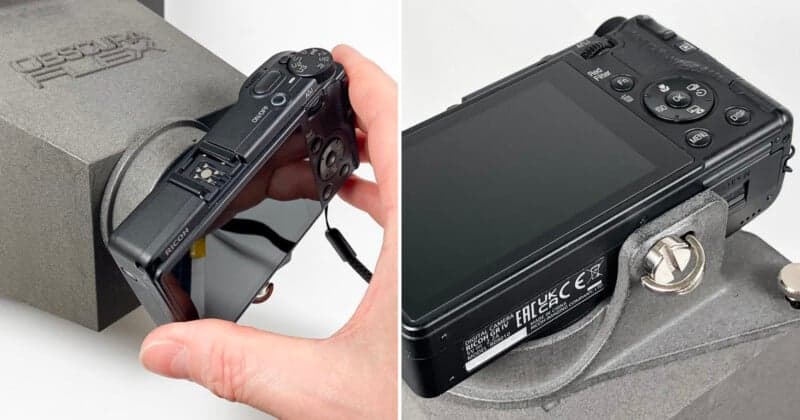
ObscuraFlex just made its large-format hybrid rig a lot more interesting. The latest update moves the system beyond phones and adds dedicated Ricoh GR III and GR IV support, giving 4x5 bodies and adapted vintage platforms a compact camera back with a fixed lens, real controls, and a more stable mount.
That is the key shift here. ObscuraFlex started as a smartphone-based digital back and viewfinder, which made sense for a bright touch display, orientation tools, and RAW capture. But a phone has always been a compromise on a serious large-format setup. A Ricoh GR is a better fit for photographers who want to tilt, shift, and compose on a vintage chassis while still shooting with a camera built for image quality, not just convenience.

The company says it built custom cradles for each camera model and secures the body through both the accessory bayonet and the 1/4-inch tripod socket. That matters in the field, because a large-format rig is unforgiving once you start moving the standards. If the digital back is even slightly off, your composing reference becomes annoying instead of useful. ObscuraFlex says the GR IIIx is excluded because of optical alignment constraints, while future compatibility may include the GR II.
For anyone who likes to use movements as a creative tool rather than a museum feature, this opens up a very specific kind of play. The GR III’s 18.3 mm lens, equivalent to 28 mm full-frame, is a natural match for broad scenes and careful framing on a 4x5 front standard. The GR IIIx, with its 26.1 mm lens equivalent to 40 mm, is the one that falls outside the mounting geometry. In practice, that means the supported GR bodies line up with the kind of work where large-format controls and a pocketable digital sensor can actually feed each other.
ObscuraFlex says the project is the work of “one human being,” founder Toby Wilkins, a semi-retired British filmmaker and photographer based in Portland, Oregon. The company also says Leica D-Lux and Panasonic Lumix L10 support are coming soon, while its Graflok universal adapter is meant to turn most Graflok-compatible large-format cameras from the 1950s onward into 4x5 digital rigs.
The timing gives the move some extra weight. Ricoh says the GR IV arrived in September 2025, the GR IV Monochrome was announced as a development project on October 20, 2025 and officially launched on January 15, 2026, and the GR series will hit its 30th anniversary in October 2026. For large-format shooters who want to experiment without dragging a full digital back into the mix, ObscuraFlex has now made the setup feel less like a workaround and more like a deliberate system.
This article was produced by Prism’s automated news system from verified source data, official records, and press releases, then run through automated quality and moderation checks before publishing. The system is built and supervised by the people who set the standards it runs under. Read our full AI policy.
Did this article answer your question?