Scientists photograph 31 new deep-sea species off Brazil
A camera on Falkor (too) helped turn Brazil’s midwater into a taxonomic gold mine, confirming 31 new species in days instead of years.
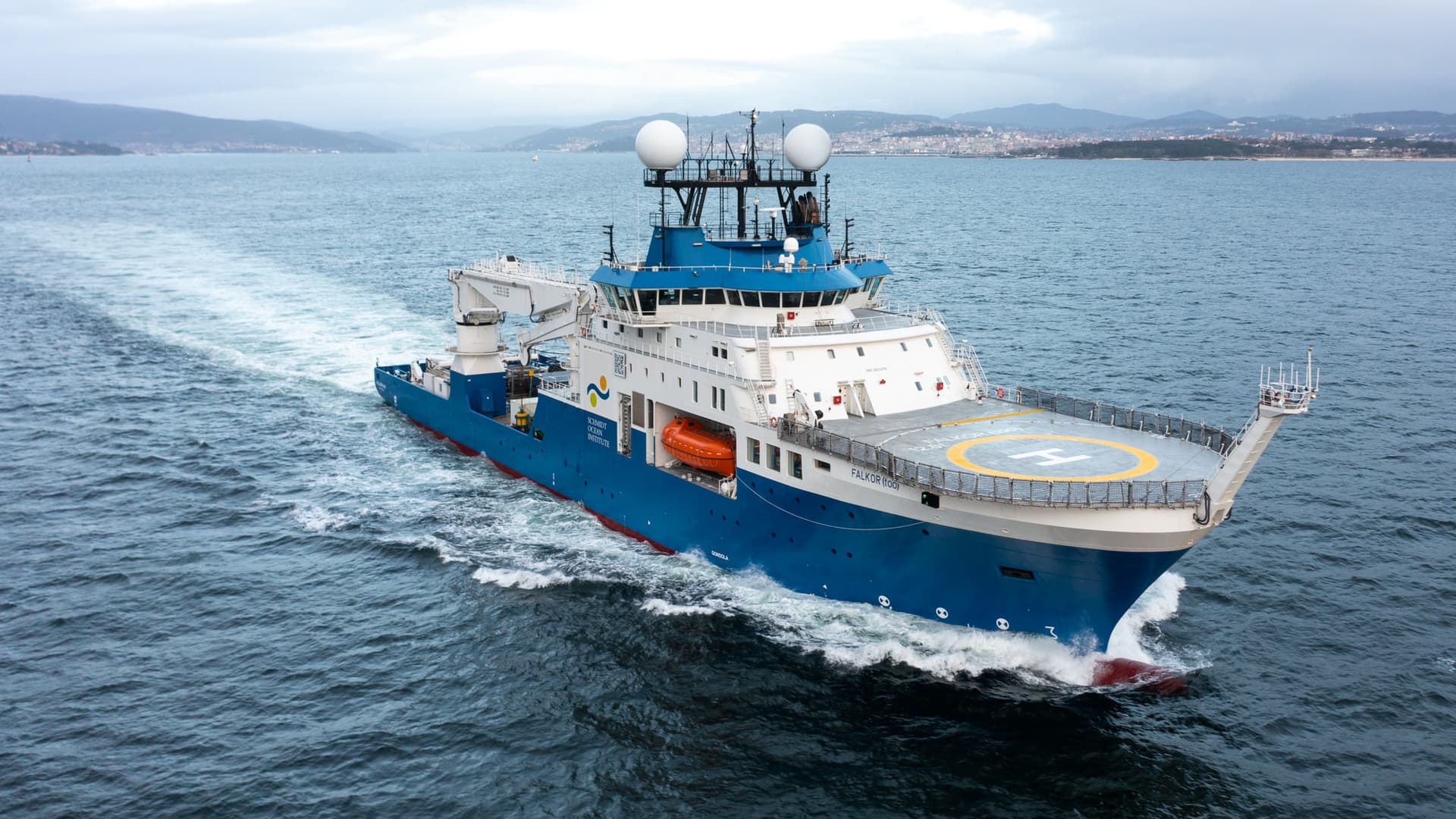
The most important tool on the Schmidt Ocean Institute’s R/V Falkor (too) was not a net or a dredge. It was the imaging system, which let scientists photograph fragile midwater life in the tropical South Atlantic off Brazil and confirm 31 new species without destroying the animals in the process. For photographers, that is the real story here: in a place where darkness, pressure and delicate bodies make collection a blunt instrument, the camera became the discovery device.
The expedition worked in international waters off the coast of Brazil, in the midwater zone between the sunlit surface and the seafloor, a habitat described as Earth’s largest and least explored habitable ecosystem. Schmidt Ocean Institute said the team used state-of-the-art imaging systems, paired with genome sequencing, to confirm the species within days rather than the years or decades this kind of taxonomy can usually take. The newly identified life forms include an amphipod, a gossamer worm, nine jellyfish, seven siphonophores, seven comb jellies, four larvaceans and two giant rhizarians.

The frames that stand out are the ones photographers immediately understand: a female octopus consuming a jellyfish at 2,624 meters, and a siphonophore recorded at 552 meters. Bigelow Laboratory for Ocean Sciences said the team saw more diversity and abundance than expected, including glass squid and a pelagic octopus feeding on a bright red jellyfish. Those are not just rare natural-history moments. They are proof that lighting, exposure and camera placement on deep-sea platforms can preserve behavior and color that would disappear the instant a specimen came out of the water.
Karen Osborn of the Smithsonian National Museum of Natural History led the cruise as chief scientist, with Bigelow Laboratory’s John Burns among the lead scientists and University of Alaska Fairbanks oceanographer Russ Hopcroft also on board. Hopcroft said there is a shortage of experts who can identify unusual species, and he labeled four previously undescribed midwater species during the cruise, each only about half a centimeter to 2 centimeters long. Schmidt Ocean Institute said the work was also supported by the Sasakawa Peace Foundation’s Ocean Shot Research Grant Program, which funded two midwater programs, one at Bigelow Laboratory and another at the University of Western Australia.
That is what makes these deep-sea photo missions so effective: they do not just show the ocean, they lock down evidence. Schmidt Ocean Institute has welcomed more than 1,000 scientists aboard Falkor since 2012, and the Brazil cruise fits a pattern already seen in Argentina, where the institute documented 28 possible new species in February and 40 suspected new species in August 2025. The payoff is bigger than spectacle. In the deep ocean, a well-lit image can do the work of a specimen tray, a field note and a breakthrough all at once.
This article was produced by Prism’s automated news system from verified source data, official records, and press releases, then run through automated quality and moderation checks before publishing. The system is built and supervised by the people who set the standards it runs under. Read our full AI policy.
Did this article answer your question?