Stephen Felce’s seven-decade photography journey spans film to mirrorless
Stephen Felce’s 70-year span from film prints to mirrorless proves the best photography lesson is still simple: keep looking, keep editing, keep adapting.
A lifetime that started in a darkroom
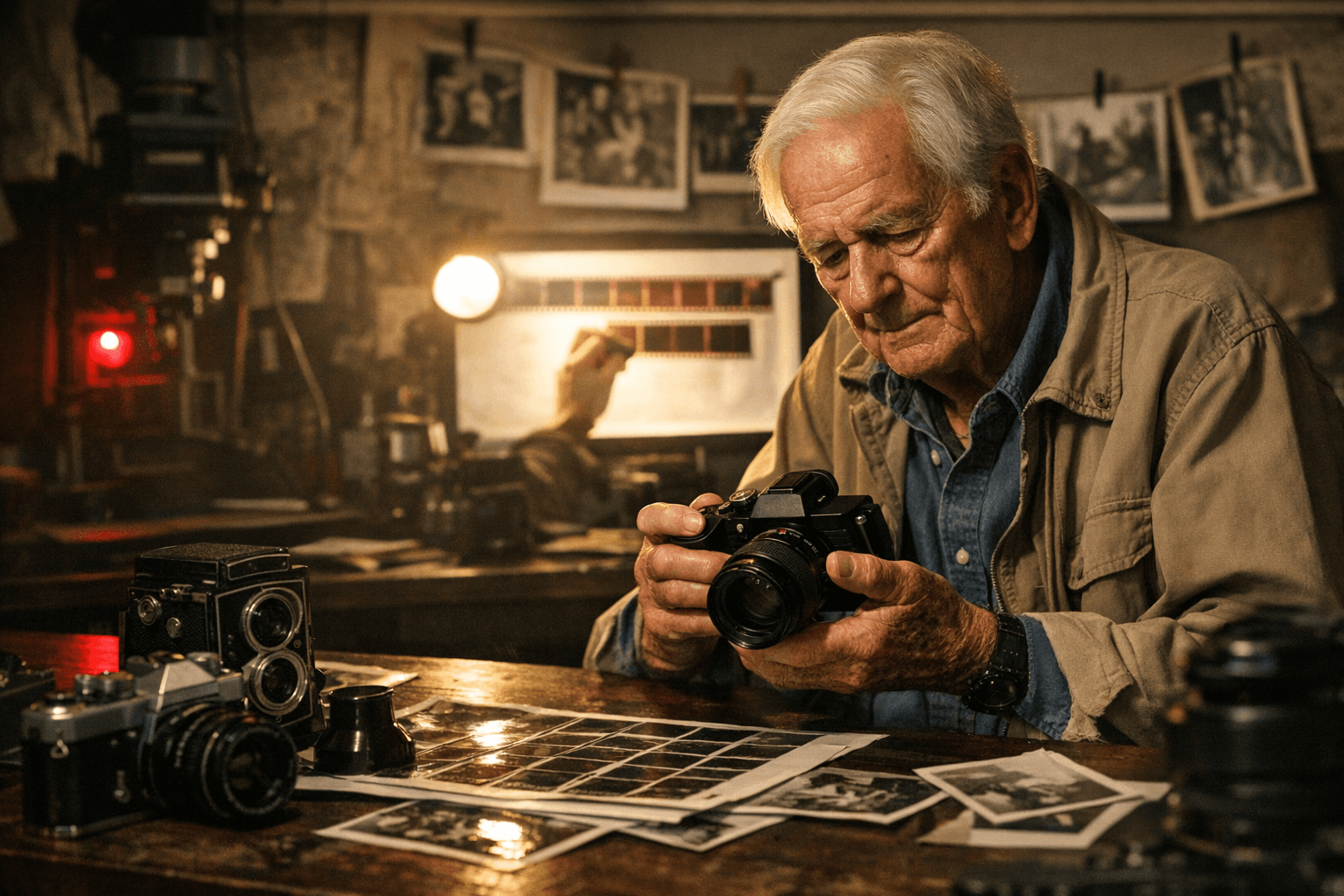
Stephen Felce’s biggest photography lesson is hiding in plain sight: he has stayed curious long enough to watch the medium change around him. Known in the DPReview forums as keepreal, he has been photographing for more than 70 years, and the path began at age nine, when his father taught him how to print film. That matters more than any spec sheet because it frames photography as a practice built on repetition, patience, and craft, not just on buying the next body.
Felce’s timeline also tracks the medium itself. He moved through black-and-white film, color film, digital, and now mirrorless, but the important part is not that he changed with the market. It is that he did not let the transition break his eye. The lesson for anyone carrying a camera today is simple: the camera changes, the work does not begin until you learn how to see with it.
What seven decades behind the camera teach that reviews do not
Felce’s strength is not gear chasing. It is consistency of vision. DPReview describes work that leans toward portraits, street scenes, and landscapes, with a clear affection for the Scottish Highlands and the American Southwest. That combination tells you he is drawn to subjects with atmosphere, texture, and strong shape, the kind of scenes that reward waiting for light rather than forcing an image with equipment.
That is the first habit worth copying: build a body of work around places and subjects you actually return to. A photographer who keeps revisiting the Highlands or the desert is not just collecting pretty backdrops. He is learning how weather shifts mood, how distance affects composition, and how light changes the same scene from ordinary to memorable. That kind of repetition sharpens judgment in a way no product launch ever can.
Natural light, atmosphere, and post-processing as part of the craft
DPReview’s profile makes another thing clear: Felce is not treating editing as an afterthought. His post-processing helps turn complex scenes into more evocative photographs, which points to a photographer who sees the finished image as a chain of decisions, not a single shutter press. That is a useful reminder in a culture that often overvalues capture and undervalues finishing.
For practical purposes, that means three things. First, shoot with the final edit in mind, especially when the scene has layered tonal range or distracting detail. Second, use natural light to your advantage instead of fighting it. Third, think of post-processing as interpretation, not rescue. If the raw file is already carrying the right structure, editing becomes a matter of emphasis, not invention.
The kit choices tell the real story
Felce’s favored setup is not built around bulk or bragging rights. His kit centers on an Olympus OM-D E-M5 II, Laowa 6mm Zero-D and 10mm Zero-D lenses, plus Olympus 12-45mm PRO and 75-300mm II zooms. That mix says a lot about what he values: portability, wide-angle composition, edge sharpness, minimal distortion, and enough reach to move from sweeping scenery to tighter details without hauling around unnecessary weight.
The OM-D E-M5 Mark II, launched in 2015, fits that approach neatly. It is a compact, dustproof and splashproof Micro Four Thirds body with 5-axis stabilization and a 40-megapixel high-resolution mode, which makes it a strong tool for travel and landscape work without turning the bag into a brick. The body’s appeal is not prestige; it is utility. It gives you a stable, flexible platform for making files you can shape later.
The lenses make the philosophy even clearer. The 12-45mm F4.0 PRO, announced in February 2020 and sold from late March 2020, was positioned as a compact, lightweight standard zoom, exactly the kind of lens you choose when you want range without the burden. The 75-300mm II is a 35mm-equivalent 150-600mm super-telephoto zoom, which gives serious reach while staying portable. And the Laowa 6mm f/2 Zero-D MFT is sold as a very wide rectilinear option, weighing 188 grams and measuring 52mm long, which explains why it suits a photographer who likes dramatic perspective without distortion getting in the way.
What to copy from Felce’s approach
If you want the short version of Felce’s working method, it looks like this:
- Learn the fundamentals early, then keep using them as the tools change.
- Build around light and atmosphere instead of gimmicks.
- Return to the same subjects until you understand how they behave in different conditions.
- Treat editing as part of the image, not a patch job.
- Choose gear that matches how you actually shoot, especially if you value travel-friendly portability.
That last point is the one reviews often miss. A camera body can be technically impressive and still be wrong for the way you work. Felce’s setup is coherent because every piece supports the same idea: make strong images in the field, then refine them with care afterward. The gear is there to serve the eye, not replace it.
Why this story reaches beyond one photographer
DPReview’s community spotlight is really about the people who build lives around cameras, not just the products themselves. Felce’s story pushes back against the idea that photography is mostly about specs, launches, or upgrade cycles. It shows that the real value sits in the habits you keep for decades: attention, patience, editing discipline, and the willingness to adapt without abandoning what already works.
That wider context matters because photography’s own history is a story of adaptation. Modern photography is commonly dated to 1839, when Louis Daguerre’s silvered plate process in France and William Henry Fox Talbot’s paper-negative process in Britain helped launch the medium. From those beginnings to today’s mirrorless bodies, the technology has never stopped moving, but the core challenge has stayed the same: find a way to see clearly and make that vision hold up on the final print or screen. Felce has spent seven decades answering that challenge, and the answer is still useful because it is built on practice, not fashion.
In the end, the most valuable thing in Felce’s bag is not the E-M5 II, the Laowa wides, or the long Olympus zoom. It is the habit of staying engaged long enough for experience to become instinct. That is the part no gear review can sell, and the part every serious photographer eventually has to earn.
This article was produced by Prism’s automated news system from verified source data, official records, and press releases, then run through automated quality and moderation checks before publishing. The system is built and supervised by the people who set the standards it runs under. Read our full AI policy.
Did this article answer your question?