TTArtisan’s $125 35mm lens delivers vintage character for APS-C shooters
TTArtisan’s $125 APS-C 35mm f/1.8 II trades perfection for personality, and that trade looks smarter than the price suggests. It feels metal-solid, focuses close, and sharpens up fast when you stop down.

TTArtisan’s APS-C 35mm f/1.8 II is not trying to win the cleanest-lens contest. It is trying to give crop shooters a compact everyday prime with some character, and at $125, that pitch lands harder than you might expect. On APS-C bodies, the lens gives roughly a 52.5mm full-frame equivalent field of view, which puts it right in that useful, walk-around normal zone where street, travel, and casual portraits all make sense.
What makes this one stand out is that TTArtisan did not sand off all the rough edges in the name of low cost. The lens has a metal build, feels substantial in the hand, and comes with two lens hoods in the box. That matters because this is the kind of lens you are supposed to grab often, not baby in a gear drawer. For Fuji X, Sony E, and Nikon Z APS-C users who want a normal prime without paying flagship money, the value case is obvious.
The specs are small, but not flimsy
The Mark II is the second generation of TTArtisan’s APS-C 35mm f/1.8 line, and it is a real step up from the original 2023 version. The first lens launched at $149, weighed 199g, and focused down to 0.6 meters. The new version came in at $125, drops the close-focus distance to 0.4 meters, and trims the weight to 176g on one quoted spec sheet and 179g on another. That is a meaningful upgrade in a lens meant to live on a camera all day.
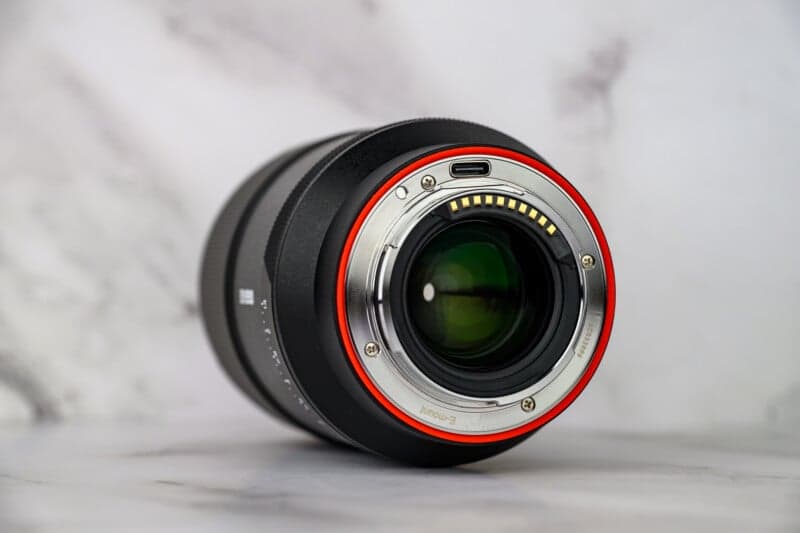
TTArtisan says the lens uses 10 elements in 7 groups, including 2 high-refractive elements and 2 ED elements. It accepts 52mm filters, measures 49mm long according to DPReview, and uses STM and lead-screw autofocus with eye and face detection support on compatible Sony, Fujifilm, and Nikon bodies. There is also a USB-C port in the rear cap for firmware updates, which is the kind of practical detail that keeps a cheap lens from feeling disposable.
This is where the lens earns its price
The most interesting thing about the TTArtisan is not that it is sharp. It is how it renders. Wide open at f/1.8, the background blur has a slightly swirly, vintage-leaning look that gives the frame some life instead of that flattened, over-corrected look you get from some sterile modern primes. The center stays very sharp, while the corners soften up, which makes the image feel purposeful rather than perfectly clinical.

Stop it down and the lens settles in quickly. By f/4 or f/5.6, the frame improves noticeably, and by f/8 it is effectively sharp edge to edge. That makes it a very easy lens to use in the real world: wide open for a bit of mood, stopped down for the kind of clarity you want when the scene demands it. Chromatic aberration also was not a serious issue in testing, which helps this lens avoid the usual penalty box for budget glass.
That rendering profile is exactly why the lens has a stronger identity than most bargain primes. It does not just promise “sharp optics” and stop there. It gives you a look.
The compromises are sensible, not annoying
There is no manual-focus switch on the lens, and that is probably the most obvious everyday inconvenience. If you like to flip between autofocus and manual focus on the barrel, you will not get that here, so you will be doing it in-camera. That is not a dealbreaker for an everyday prime, but it does remind you that TTArtisan kept the controls simple.
The other boundary is format. This is an APS-C lens, not a full-frame optic, so it is built for crop bodies rather than being a future-proof buy for every camera in the bag. But that limitation is also why it makes sense. On a Fujifilm X, Sony E, or Nikon Z APS-C body, the lens behaves like a compact normal prime instead of a big expensive flagship lens pretending to be all things to all people.
Compared with mainstream first-party alternatives, that is the real trade. You usually spend 2 to 4 times more for a native lens with a more polished control layout and a safer, more conservative rendering style. TTArtisan is not trying to beat those lenses at being generic. It is trying to beat them at being fun, small, and cheap enough to use without guilt.
Who this is for, and who should skip it
This is the lens you buy when you want a second-body normal prime, a travel lens that does not dominate the bag, or your first autofocus prime on a crop camera without blowing the budget. It makes the most sense if you care about center sharpness, quick stopping-down performance, and a bit of vintage-flavored blur more than you care about absolute uniformity across the frame at f/1.8.
It is also a smarter buy if you have been eyeing a pricier first-party 35mm and mainly want a dependable walk-around focal length rather than the most perfectly corrected rendering on the shelf. The TTArtisan gives up some refinement, but not enough to feel cheap in use. The metal shell, the close focus, the two hoods, and the compact size all help it feel like a serious tool.
If you want the safe choice, the first-party lens is still the safe choice. If you want the lens that gives an APS-C camera a little more personality without asking much from your wallet, this TTArtisan makes a very strong case.
A line that fits TTArtisan’s whole playbook
The Mark II also fits neatly into TTArtisan’s broader strategy. The company, established in 2019 in Shenzhen, has been building a lens lineup that sits between practical and playful, and this 35mm prime shows exactly what that means. The limited-edition Orange Pop version introduced in January 2026, priced at $140, pushed that point even further, with the same optics and autofocus behavior in a body that was meant to stand out visually.
That is the larger story here: TTArtisan is not just selling cheap glass. It is selling compact APS-C primes that feel distinct enough to remember. And in a market full of lenses that all promise to be neutral, that extra bit of character is what makes this $125 35mm hard to dismiss.
This article was produced by Prism’s automated news system from verified source data, official records, and press releases, then run through automated quality and moderation checks before publishing. The system is built and supervised by the people who set the standards it runs under. Read our full AI policy.
Did this article answer your question?