Topspin Drop Gives Pickleball Players a More Offensive Transition Weapon
The topspin drop gives you a softer ball with more bite, turning the transition game from survival mode into a real offensive chance. Used well, it forces weak contact and opens the kitchen race.
Why the topspin drop matters
The biggest mistake in drop-shot development is treating every soft ball the same. A recent The Dink guide, with input from James Ignatowich, makes the case that the push drop and the topspin drop solve different problems: one is built for survival, while the other is designed to create pressure and pull the point your way.
That distinction matters once your safe push drop stops moving the needle. A push drop is about control, getting the ball back low, and staying alive in the rally. A topspin drop is the next step when you want to do more than reset the point. It gives you a way to apply pressure from deeper court positions without giving up touch, and that can be the difference between arriving at the kitchen line under stress and arriving with the point already tilted in your favor.
Mechanics start before the brush
The spin itself is not the first thing to think about. Ignatowich’s approach begins with footwork and balance: get the left leg forward, get underneath the ball, set the proper angle, and stay balanced through contact. If your body is off-line or your weight is drifting, the spin will not save the shot.
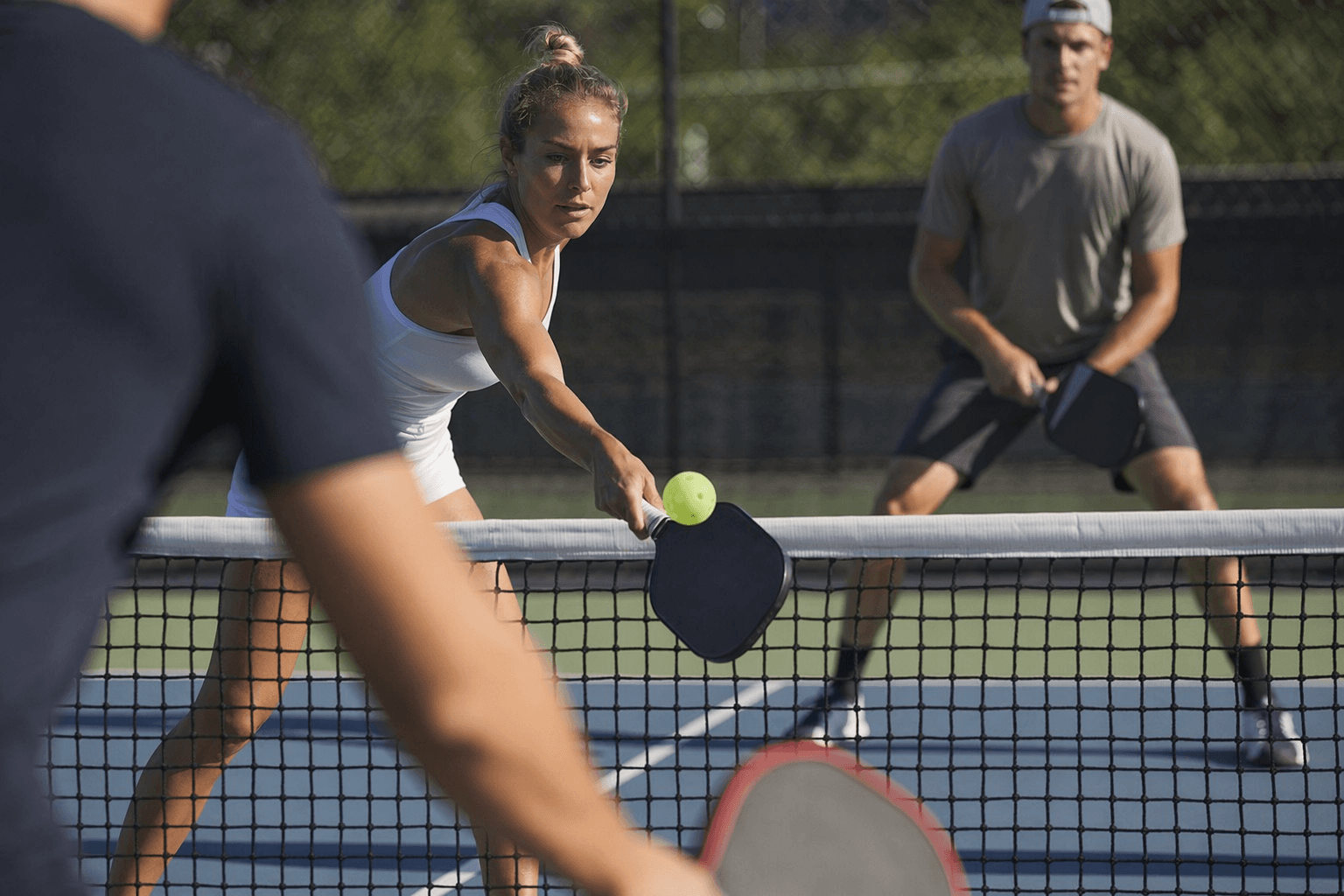
From there, the body position does the heavy lifting. Bend your knees, lower your center of gravity, and contact the ball from below with a smooth upward brushing motion. That upward path is what creates topspin, and topspin is what lets the ball dip sharply after it clears the net. The result is a softer-feeling ball that still travels with urgency, which makes it much harder for opponents to attack cleanly.
What the shot is really trying to buy you
The topspin drop is valuable because it changes the quality of the reply you receive. Instead of simply hoping your opponent mishits a neutral ball, you are creating a shot that invites a weaker contact, a higher ball, or a rushed decision. In practical terms, that can buy you time to keep moving forward and can even open a window to win the point outright.
That is why the shot is so useful for players who have plateaued with the standard push drop. If you can make the ball land softly while still carrying enough pace and dip to make the bounce uncomfortable, you are blending aggression and control in the same swing. The point is not to rip the ball. The point is to make a soft shot act like an offensive one.
Where USA Pickleball fits into the picture
USA Pickleball’s coaching materials back up the same idea. The organization describes topspin as a way to make the ball dip down and jump forward off the bounce, letting you hit with more pace while forcing opponents into more uncomfortable positions. It also frames the topspin drop as an advanced shot that adds offense to the soft game while keeping control intact.
That sits neatly beside the traditional third shot drop, which USA Pickleball describes as a fundamental shot hit by the serving team on its third contact of the rally. The third shot drop is there to turn defense into offense and get the serving team safely to the kitchen line. The topspin drop is not a replacement for that foundation. It is the more aggressive variation you reach for once consistency is already in place.
A simple progression you can use in your next drill session
If you want this shot to stick, work it in layers instead of chasing perfection on the first rep. The best drill progression is simple, repeatable, and honest about how the shot behaves under pressure.
1. Start with body position only. Shadow the step with the left leg forward, knees bent, and chest stable so you can feel how to get underneath the ball without reaching.
2. Feed slow balls and focus on a clean upward brush. The goal is contact from below the ball, not a big swing or a forced scoop.
3. Aim for a soft landing with a sharper dip. You want the ball to clear the net comfortably, then fall faster than a standard drop.
4. Add transition movement after contact. Hit the drop and immediately recover forward so the shot becomes part of your kitchen-line plan, not a stand-alone trick.
5. Finish with live reps against a partner who is looking to pressure the next ball. That is where you learn whether the topspin drop is actually forcing weaker contact.
Why this matters beyond one shot
The value of this skill has only grown as pickleball has expanded. USA Pickleball’s 2025 Annual Growth Report says the Pickleheads court-location database added over 2,300 new locations in 2025, bringing the total to 18,258 locations nationwide, and the database now includes 82,613 courts. The same growth story shows just how much the player base has widened: USA Pickleball cited 13.6 million U.S. players in 2023, while SFIA-based reporting put participation at an estimated 19.8 million in 2024, up 45.8 percent from the year before, with more than 24 million in 2025.
That kind of growth changes the demand for instruction. More players means more people trying to break through the same intermediate ceiling, and the topspin drop is exactly the kind of upgrade that helps a player move from safe to dangerous. It also matters in the broader rules and competition landscape. USA Pickleball’s rules summary says singles and doubles are played on the same size playing area, and its rulebook notes that sanctioned tournaments can affect player ratings on a national or international basis. In other words, the shots you sharpen in practice can carry straight into competitive pathways.
Why retreat and camp settings are built for this
This is the sort of skill that fits naturally into the Pickleball Retreats world. Programs like Pickleball Pro Retreats, RipPickle, and Pickleball Getaways are built around concentrated coaching time, pro-led reps, and the kind of instruction that helps you refine transition patterns instead of just playing more points. The topspin drop belongs in that setting because it rewards attention to details that are easy to miss in a casual open play session.
If you are already comfortable surviving with a standard push drop, the next step is not to hit softer. It is to hit smarter. The topspin drop gives you a practical way to turn a defensive-looking touch shot into an offensive transition weapon, and that is exactly the kind of progression that separates a steady player from one who starts dictating the rally.
This article was produced by Prism’s automated news system from verified source data, official records, and press releases, then run through automated quality and moderation checks before publishing. The system is built and supervised by the people who set the standards it runs under. Read our full AI policy.
Did this article answer your question?