London turns into table tennis canvas ahead of 2026 worlds
London is using gold tables, a mascot and a centenary story to pull table tennis out of the bubble and into everyday city life before the 2026 Worlds.
London becomes the warm-up act
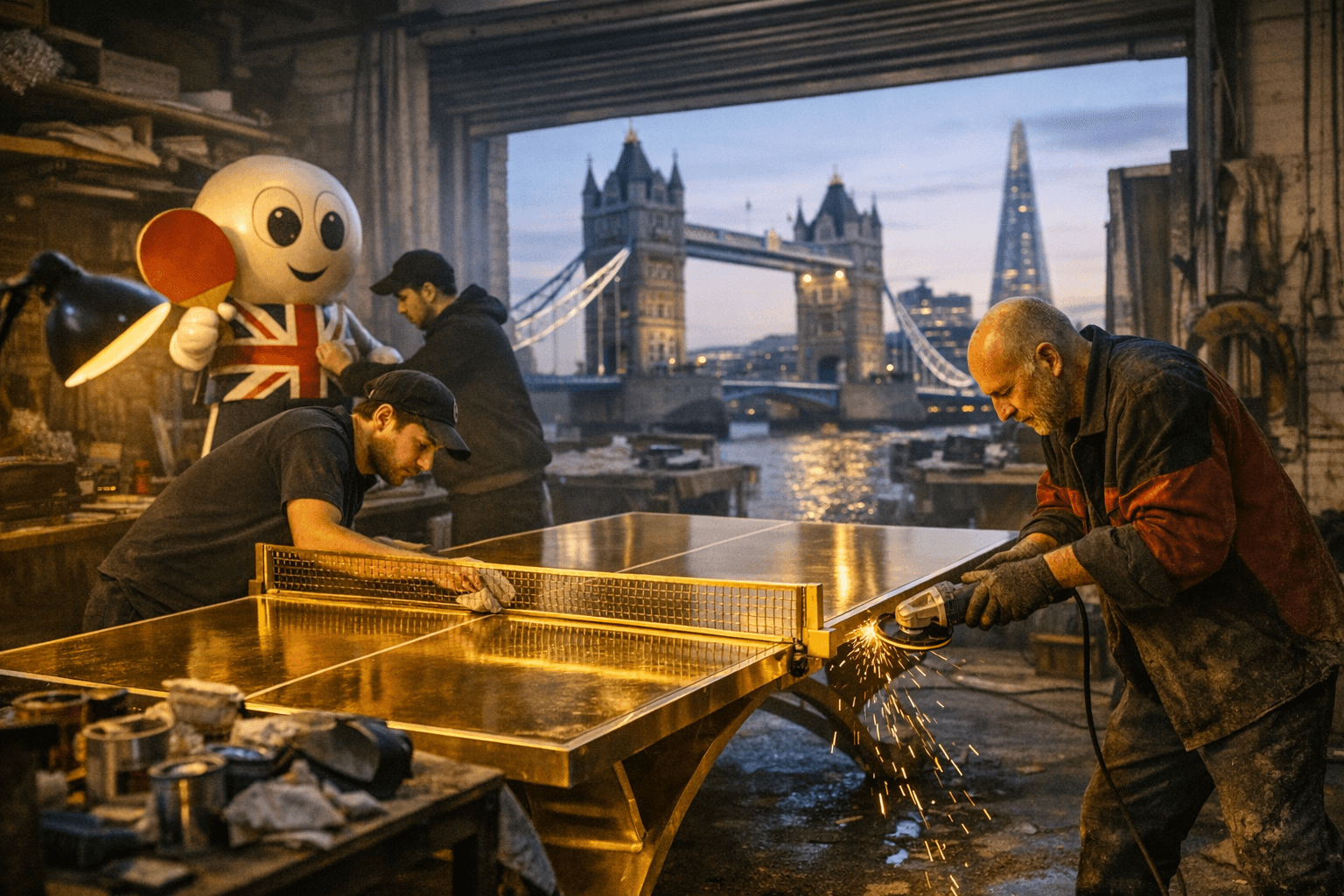
The smartest thing London has done ahead of the ITTF World Team Table Tennis Championships Finals London 2026 Presented by ACN is make the sport visible before the first serve. Golden tables have already started showing up in busy central spots, and that changes the feel of a major event fast: table tennis stops being something you only seek out and becomes something you bump into on the way to work.
That matters because this is not just a tournament preview. It is a centenary homecoming, with the sport returning to the city where the inaugural ITTF World Table Tennis Championships were staged in 1926. The build-up is trying to turn that history into something you can actually touch, play on and walk past, not just read about in a program.
Public space is doing the heavy lifting
Table Tennis England has installed 10 gold table tennis tables across central London as part of London Sports Festival, and that is the clearest sign that the event is aiming beyond the usual fan base. One of the most visible installations sits at St Paul’s Cathedral Churchyard, which is exactly the kind of place that forces table tennis into the city’s daily rhythm instead of hiding it in a sports hall.
The point is not decoration. A golden table in a place like Victoria or St Paul’s gives office workers a real chance to pick up a bat during lunch and see the game as accessible, not intimidating. That is how you build public-table culture: not with slogans, but with a net, a few paddles and a spot where normal life already happens.
The mascot, Ping, is part of that same strategy. Mascots can feel like filler when they are just a logo in costume, but here Ping is doing a job: making London 2026 feel present in the city well before the competition starts. Combined with the gold tables, the branding gives the centenary a public face instead of leaving it trapped inside the existing table tennis bubble.
The centenary gives the event real weight
This is where London 2026 separates itself from a standard major championship. The ITTF has framed the event as a return to the birthplace of both the federation and the World Championships, and that language is not just ceremonial. Petra Sörling captured that sentiment directly: “One hundred years on, we return to London, the birthplace of our Federation and the World Championships.”
That line lands because the historical loop is unusually clean. The 2026 Finals mark 100 years since the inaugural championships in London in 1926, and that gives the whole build-up a sense of completion as well as renewal. The sport is not simply visiting a big city for a fortnight. It is coming back to where the modern story began.
There is also a governance thread running through the build-up that sharpens the anniversary angle. World Table Tennis Day falls on 23 April because it marks the birthday of Ivor Montagu, the first ITTF Chair and also the first Chair of the ETTA. That detail ties the centenary celebration to the people who shaped the sport’s institutional identity, which is exactly the kind of historical depth that makes the London staging feel more meaningful than a standard venue rotation.
How the competition is set up
The tournament itself runs for 13 days, from 28 April to 10 May 2026, and it is split across two London venues: Copper Box Arena and OVO Arena Wembley. That setup matters because it separates the early build-up from the decisive rounds, giving the event a clear escalation rather than one long blur of matches.
The field is huge, with 64 men’s teams and 64 women’s teams competing. Stage 1A and Stage 1B are group and seeding phases, which means the opening days are about sorting the draw as much as they are about survival. Then Stage 2 brings the knockout rounds, where the margin for error disappears and the championship starts to feel like a real march toward the medals.
The seeded nations do not enter immediately. The eight seeded teams join the action at OVO Arena Wembley from 2 May, which should raise the intensity of the second half of the event. That staging gives London 2026 a built-in narrative arc: smaller early-stage pressure, then the heavyweight teams arriving once the crowd and city buzz have already been primed.
The trophies still carry the sport’s old weight
Even with all the branding and public activation, the history of the event still runs through the trophies. The men’s team title is tied to the Swaythling Cup, while the women’s title is tied to the Corbillon Cup, and those names remain central to the World Team Championships identity. That matters because it reminds you this is not a fresh invention dressed up as heritage. The heritage is baked into the competition format itself.
For fans, that is part of the appeal of this London staging. You are not just watching a new event in a famous city. You are watching the oldest team tradition in the sport return to the place where the whole championship era began. That is a rare combination, and it gives every match a little more gravity.
What London 2026 is really trying to change
The open question is not whether London can host a world event. It can. The real test is whether the centenary can push table tennis into more everyday visibility before the elite action takes over. The gold tables, the St Paul’s placement, the mascot and the public branding are all pointing in the same direction: make people notice the game first, then sell them on the spectacle inside Copper Box Arena and OVO Arena Wembley.
That is the useful part of this build-up. If a commuter at Victoria picks up a bat, if a lunchtime crowd swells around a table in the city center, if a passerby learns that London is hosting 64 men’s and 64 women’s teams across 13 days, then the sport is doing more than commemorating its past. It is proving that a 100-year anniversary can still function like a modern growth plan.
Know something we missed? Have a correction or additional information?
Submit a Tip