Fan Team Ports Sonic Mania to Dreamcast, Targeting Native Hardware Experience
A fan team has already moved Sonic Mania's full rendering pipeline onto the Dreamcast's own PowerVR GPU, targeting locked 60fps native performance rather than a compatibility layer.
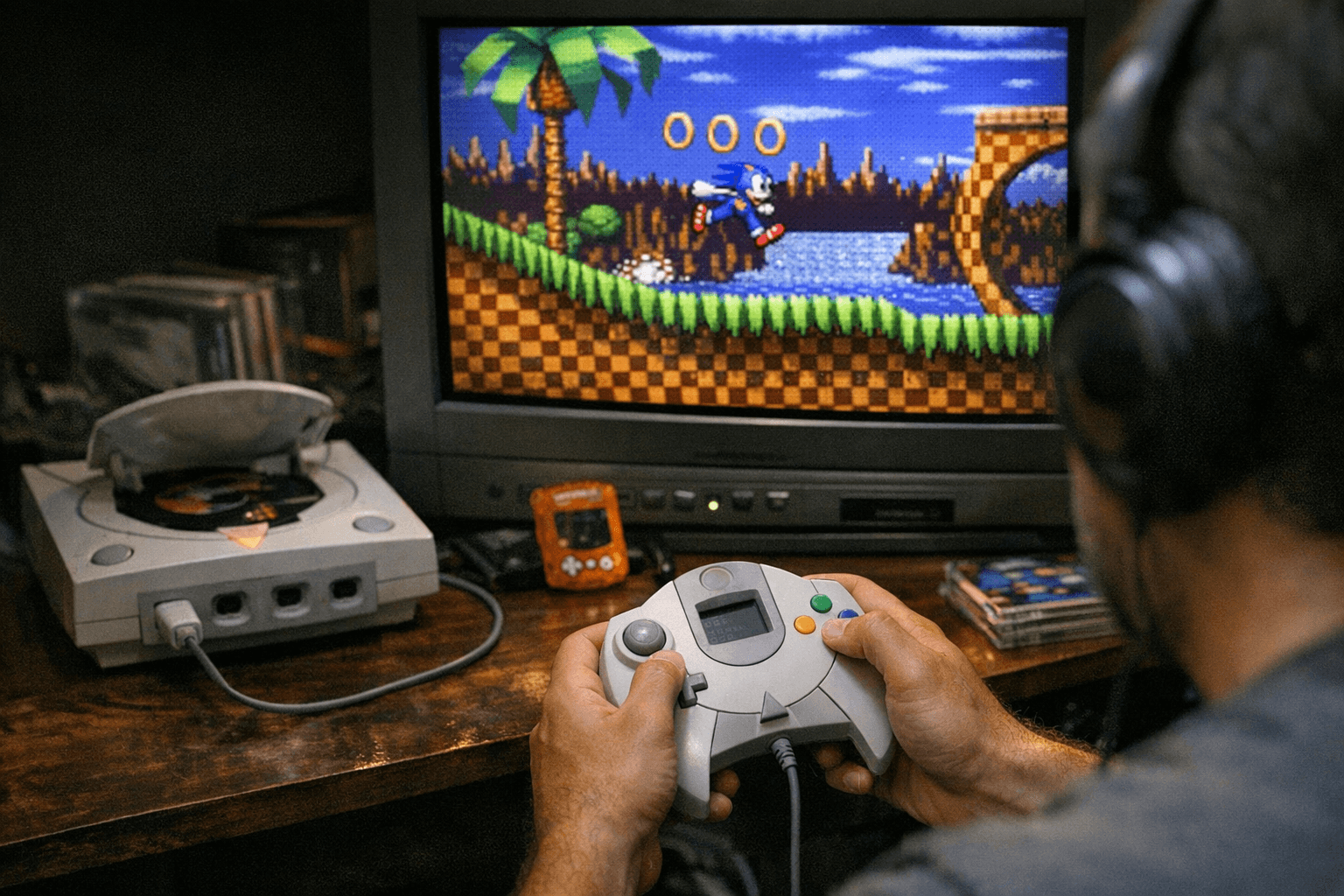
The impossible port has a working renderer.
Developer falco_girgis and collaborator SonicFreak94 have moved all rendering in their Sonic Mania Dreamcast port directly onto the console's PowerVR GPU, clearing the most technically demanding hurdle in what RetroRGB called "a massive undertaking years in the making." The Sega Guys published a development first-look video on March 26, bringing the project to a wider audience and drawing the retro community's attention to a fan effort that is measurably further along than most homebrew announcements.
The target is specific: Sonic Mania, the 2017 platformer built by Christian Whitehead, Headcannon, and PagodaWest Games for Sega, runs at a locked 60 frames per second on modern hardware. Reproducing that on a console discontinued in 2001, equipped with a Hitachi SH-4 CPU, a PowerVR2 GPU, 16MB of RAM, and 8MB of VRAM, means there is no margin for lazy engine calls or unoptimized asset pipelines. The team has been transparent about the bar they have set for themselves. RetroRGB's coverage put it plainly: the developers don't just want to "make it work."
The SH-4 has been the primary obstacle. Once the team offloaded both 2D and 3D rendering to the PowerVR GPU, a second bottleneck emerged: the matrix and vector math driving Sonic Mania's 3D bonus stages was implemented in fixed-point integer operations, leaving the SH-4's floating-point hardware unused while the CPU bore the full transformation load. Falco_girgis described the result without softening it: "Our poor SH4 CPU is now being absolutely murdered." The team's solution, which they call direct rendering, uses the SH-4's store queues, two 32-byte memory regions that bypass the cache entirely, to push sprite geometry to the PowerVR without intermediate RAM copies. That kind of low-level hardware specificity is what separates a native port from an emulation wrapper in a nicer case.
Audio is also present in current builds, which matters more than it sounds. The Dreamcast's AICA sound chip runs on a dedicated ARM7 processor and must be fed data on a precise schedule, independent of the main CPU workload. A port that holds audio sync under game-load conditions demonstrates correctly managed CPU-to-audio handoff, not just a working visual pipeline.
When evaluating footage from the Sega Guys' video or any future test builds, the frames to scrutinize are act transitions and bonus-stage entrances. Those are the moments where the CPU-GPU workload spikes hardest, and frame-pacing hitches there signal unresolved bottlenecks. A clean transition with locked audio is a more meaningful performance marker than any single well-composed gameplay clip.
If you want a useful baseline before the Dreamcast build reaches public testing, Flycast is the right tool. Running it through RetroArch with per-game overrides and toggling between native 480i output and upscaled modes quickly illustrates how much the hardware's constraints shaped the Dreamcast's visual identity. It also makes the team's asset rework decisions easier to read when test footage surfaces, because you will already know what accurate Dreamcast output looks like, and where the compromises are.
The project carries no release date and remains in active development. What the March footage confirms is that the rendering pipeline is functional on real hardware, the 3D special stages are being solved rather than quietly cut, and audio is holding. For a fan port of a commercially published Sega game running on Sega's own discontinued hardware, that combination of technical depth and refusal to settle is the definition of a project worth watching.
Know something we missed? Have a correction or additional information?
Submit a Tip