MiSTer Adds Mandelbrot Fractal Core, Expands Retro Preservation and Arcade Support
MiSTer’s latest wave goes beyond console recreation, with a Mandelbrot core, full Darius board support, and a 3DO build that pushes preservation deeper.
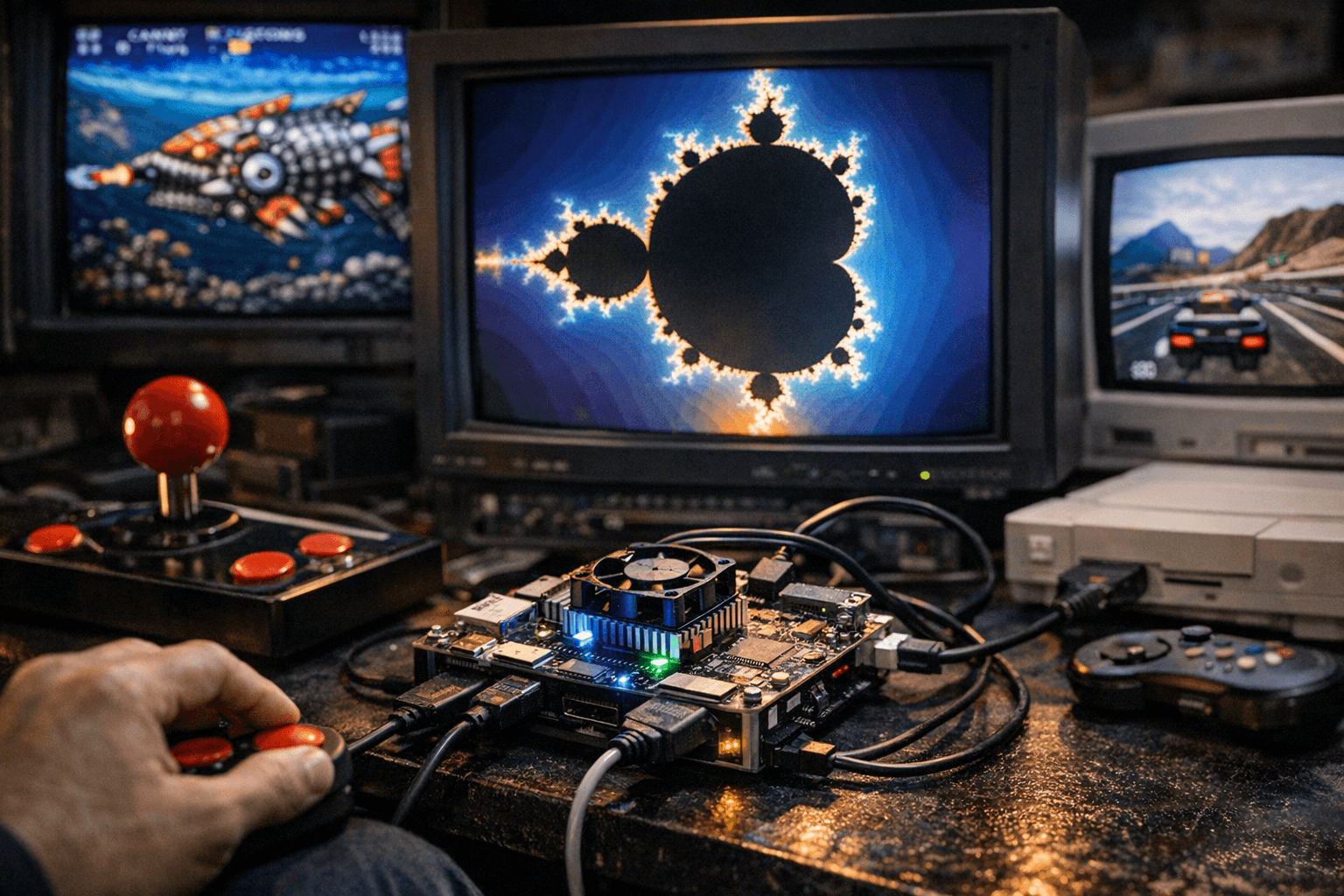
MiSTer is starting to look less like a console-recreation project and more like a full preservation platform with room for experiments that would have sounded unlikely a year ago. The newest attention grabber is MiSTerbrot, a Mandelbrot fractal core from catallo that runs in native 320x240, uses eight parallel hardware iterators, offers 47 palettes, and adds attract-mode zooming across 25 points of interest with color cycling. In the forum thread, it was described as a “real-time Mandelbrot fractal core” and a “spiritual successor to digital eye candy from the 90s,” which fits MiSTer’s growing identity as a place for hardware-style art as much as games.
That same preservation impulse shows up in the Darius core. The repository says the original arcade board used dual 68000 CPUs, two Z80s, two PC080SN tile layers, PC090OJ sprites, PC060HA master-slave communication, and YM2203 x2 plus MSM5205 audio. The MiSTer build now runs the full game end-to-end on all supported ROM sets and has been tested on real MiSTer hardware. That matters because Darius is not just another arcade port candidate; it is a hardware showcase, with the three horizontal tile panels composed into an 864-pixel virtual screen to match the original presentation.
The community has already started pushing that setup in a widescreen direction. In an April 13 exchange, one user suggested a 1720x720 mode for Darius, and the developer replied that it worked fine. That kind of quick back-and-forth says a lot about where MiSTer sits now: not only preserving the board logic, but also giving players room to explore how old arcade layouts look on modern displays without losing the structure of the original machine.
The bigger hardware story is still ahead with 3DO. Sergiy Dvodnenko, better known as srg320, has been building the 3DO_MiSTer project in SystemVerilog, and earlier work-in-progress footage showed games such as Flashback, GEX, Primal Rage, Samurai Shodown, and Super Street Fighter II Turbo running on the platform. The caution flag is real, though. Srg320 has said absolute accuracy may not be achievable, especially given how hard the 3DO’s sprite engine is to reproduce faithfully. Even so, the fact that the project is moving at all puts another historically awkward system within reach of MiSTer users.
The ecosystem is broadening in other directions too. PGMcenter is organizing around IGS PGM support, with a GitHub organization dedicated to making it easy to set up and play those games on MiSTer and other emulators. MiSTerOrganize’s PICO-8 project adds another twist, with native 256x256 output at 59.64 Hz, hot-swapping carts without a restart, and CRT-friendly video timing directly from the FPGA for zero-lag scanlines and shadow masks. MiSTer keeps proving that its most interesting progress is no longer just about cloning old consoles. It is about keeping strange, specific, and increasingly fragile hardware experiences alive.
This article was produced by Prism’s automated news system from verified source data, official records, and press releases, then run through automated quality and moderation checks before publishing. The system is built and supervised by the people who set the standards it runs under. Read our full AI policy.
Did this article answer your question?