MattKC Shows How to Derive RGB from the NES Composite Signal
MattKC’s NES RGB demo is a preservation win disguised as a modding trick: it shows how original-chip logic can produce cleaner, more accurate color than guesswork ever could.
Why this matters
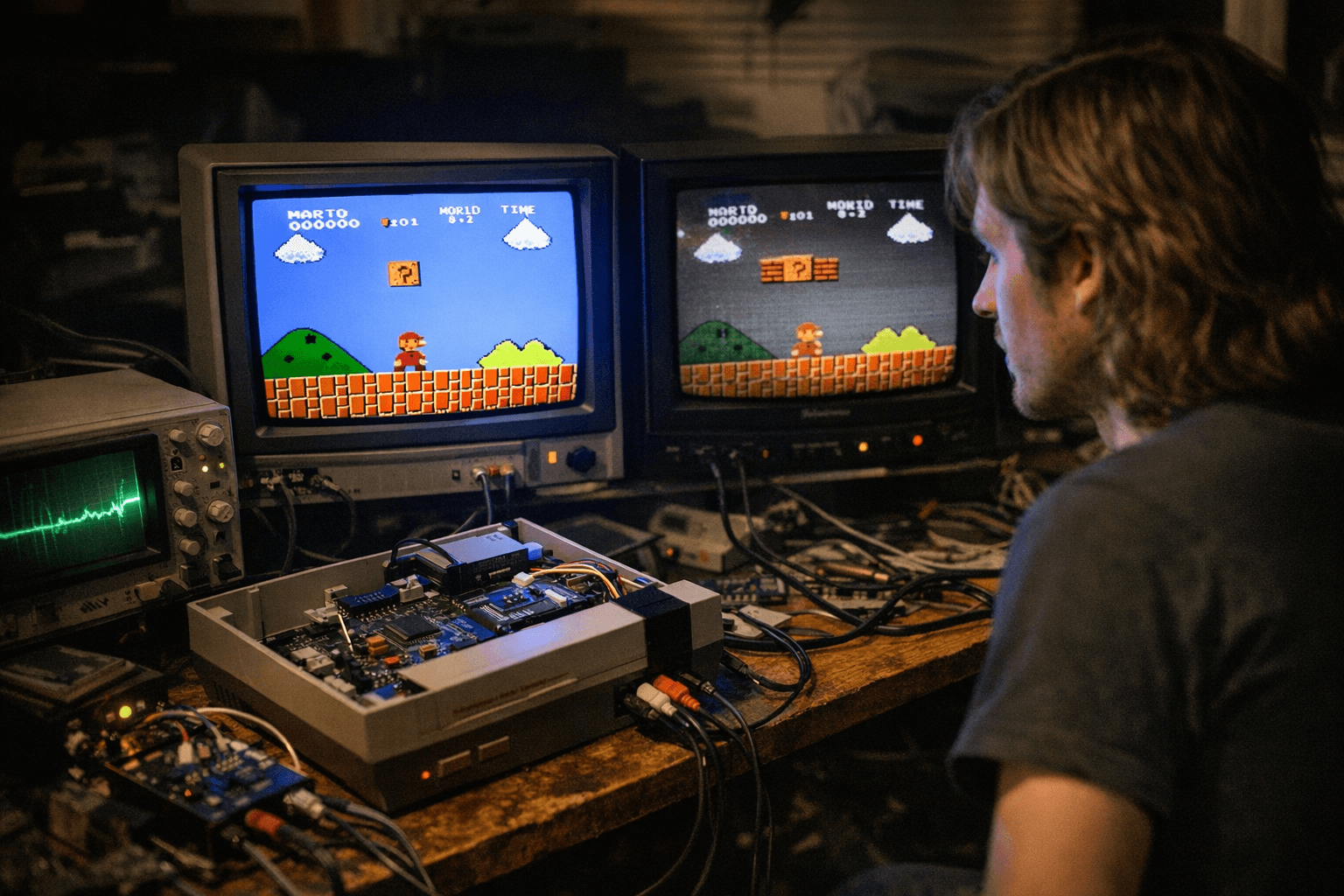
MattKC’s breakdown of RGB from an NES composite signal is interesting for one reason that matters to accuracy-minded players: it shows that the NES can be understood, and in some cases reproduced, at the level of the original hardware instead of through approximation. The machine was built around composite video, yet the work described here maps the color path closely enough to pull out a cleaner RGB representation that tracks the original PPU behavior far better than generic conversion shortcuts.
That changes the conversation. This is not just “can you mod an NES to look nicer on a modern display?” It is a signal-path question, and signal-path questions are where real accuracy lives.
What the NES was actually doing
The important detail is that the NES was never designed to output RGB cleanly in the first place. Its color output comes from the way the original PPU, the picture processing unit, generates and encodes the image, which is why the composite signal is the system’s native language. MattKC’s video digs into how developers figured out a way to use an FPGA, a field-programmable gate array, to generate a faithful RGB output based on that original PPU behavior.
That matters because RGB is not automatically “better” just because it is sharper. On the NES, the value of RGB comes from stripping away the fuzz and variability that composite introduces, while still respecting the way the console actually produces color. If you get that mapping wrong, you are not preserving the NES experience, you are redrawing it.
Why the FPGA angle is such a big deal
The engineering story here is what makes the video more than a curiosity. An FPGA can be programmed to mimic the logic of original hardware, which is why it is useful in a project like this: it can recreate the color-generation path in a way that is much closer to the machine than a simple converter box ever could be. That is the difference between translating a signal and actually modeling the thing that created it.
For modders, that opens the door to cleaner RGB conversions, better PPU-informed output, and more reliable test setups for scalers and captures. For the rest of us, it is a reminder that the best-looking output is often the one built on the most boring part of the stack: careful hardware modeling.
The historical context that keeps this from being a one-off trick
Bob from RetroRGB frames the video as part of a longer conversation about how the NES generates its colors, and that broader context is important. The explanation is pitched so it can make sense to beginners without losing the people who already know the technical background, which is exactly the right balance for a topic this dense.
The other useful detail is a surprisingly concrete one: Bob says his CRT photos from more than fifteen years ago are still being referenced. That says a lot about the retro display scene. Old reference material does not stop mattering just because new capture gear or new shaders show up, especially when people are arguing over color accuracy in emulators, RGB mods, and capture workflows.
What this changes for emulation and original hardware
The practical takeaway is that NES owners and emulator users both benefit when the signal path is understood at the chip level instead of being guessed at. On original hardware, that can mean more trustworthy RGB conversion and a cleaner way to compare what the console is doing against what a scaler or capture chain is showing. In emulation, it helps explain why different cores, different palettes, and different displays can make the same game look dramatically different.
That last point is where accuracy-minded players should pay attention. A lot of disputes about “correct” NES color are really disputes about reference points. If one setup is calibrated against authentic hardware behavior and another is not, the disagreement can look like taste when it is really a measurement problem.
Who should care, and why
If you mod consoles, build capture chains, or care about display correctness, this is worth your time because it gives you a better reference model for what the NES is supposed to output. If you mostly play through emulation, it still matters, because it explains why your software core and your monitor settings can drift from what original hardware looks like on a well-tuned CRT. The lesson is not that every NES needs RGB, but that every serious comparison needs a proper reference.
That makes the video relevant in two different ways. For preservation-minded players, it shows how reverse engineering and display knowledge can reconstruct a cleaner version of the original signal. For everyday players chasing good-looking output, it is a reminder that authenticity is not just about resolution or scanlines, it starts with the color path itself.
The real takeaway
What MattKC demonstrates here is not an enthusiast party trick. It is a careful example of how original-chip understanding, FPGA logic, and display reference work can come together to produce output that is closer to the NES’s real behavior than generic conversion solutions. That is why the discussion matters beyond the modding crowd.
In a scene full of shortcuts, this is the better path: respect the original signal, measure against real references, and only then decide what “correct” should look like on a modern screen.
This article was produced by Prism’s automated news system from verified source data, official records, and press releases, then run through automated quality and moderation checks before publishing. The system is built and supervised by the people who set the standards it runs under. Read our full AI policy.
Did this article answer your question?