MiSTer gains Zaparoo Launcher as core devs fix arcade bugs
MiSTer’s new Zaparoo Launcher, arcade bug fixes and fresh hardware options make the platform easier to browse, easier to build around and more capable at the bench.

MiSTer finally starts feeling more like a complete living-room system
Zaparoo Launcher is the kind of release MiSTer users have been asking for without always saying it out loud: a cleaner, TV-friendly way to get from the couch to a game without fighting the interface first. It gives the platform a more polished front end for browsing a library, showing box art and system artwork, jumping back into recently played media, and writing selected games to NFC tokens. That is a meaningful shift for MiSTer, because the biggest barrier for many setups has never been the cores themselves, but the friction around getting to them quickly and comfortably.
Zaparoo says the launcher is functional and usable today, but still has rough edges and missing features. Even so, the roadmap already points at the pain points MiSTer owners will recognize immediately: search, filtering, CRT support and more. Media scraping also happens on a computer through third-party software, which keeps the launcher focused on the handheld, remote, or controller-driven browsing experience on the MiSTer display itself. For anyone running a living-room setup, that separation matters because it turns the launcher into the front door, not just another utility buried in a scripts menu.
What Zaparoo is really building
The launcher is only one piece of the larger Zaparoo Project, which describes itself as an open-source universal loading system that can launch media and scripted actions using physical objects. That broader ecosystem supports NFC cards, QR codes and optical discs, and it stretches well beyond MiSTer FPGA to SteamOS, Windows, Batocera and Linux. In practical terms, Zaparoo is not just trying to make MiSTer prettier. It is trying to make it easier to trigger content in a way that feels natural, physical and fast across multiple platforms.
That wider support helps explain why the MiSTer release matters so much. MiSTer has always been strongest when it behaves like dedicated hardware instead of a pile of files and menus, and Zaparoo pushes in that direction. If the launcher keeps maturing, it could become one of those small but decisive quality-of-life layers that changes how often people actually use their setup.
City Connection gets the kind of fix FPGA users care about
While front-end polish gets the attention, the core development side is still where MiSTer earns its reputation. One of the standout updates in the roundup is City Connection, which is being worked on by the same creator behind the Darius cores. The developer reportedly spent days disassembling the original 6809 ROM to fix a pixel-position bug, then validated the correction with help from a video of the real arcade PCB.
That is the sort of detail that separates a good FPGA project from a convincing one. Anyone can aim for a game that boots, but the preservation-minded goal is deeper: the board has to behave correctly, not just approximately. A pixel-position issue sounds small, but on an arcade title it can affect timing, alignment and the feel of the original hardware. The fact that the fix was checked against footage of the actual PCB shows exactly why MiSTer has built such trust in the arcade scene.
MiSTer Multisystem2 Arcade turns the platform into a cabinet-ready package
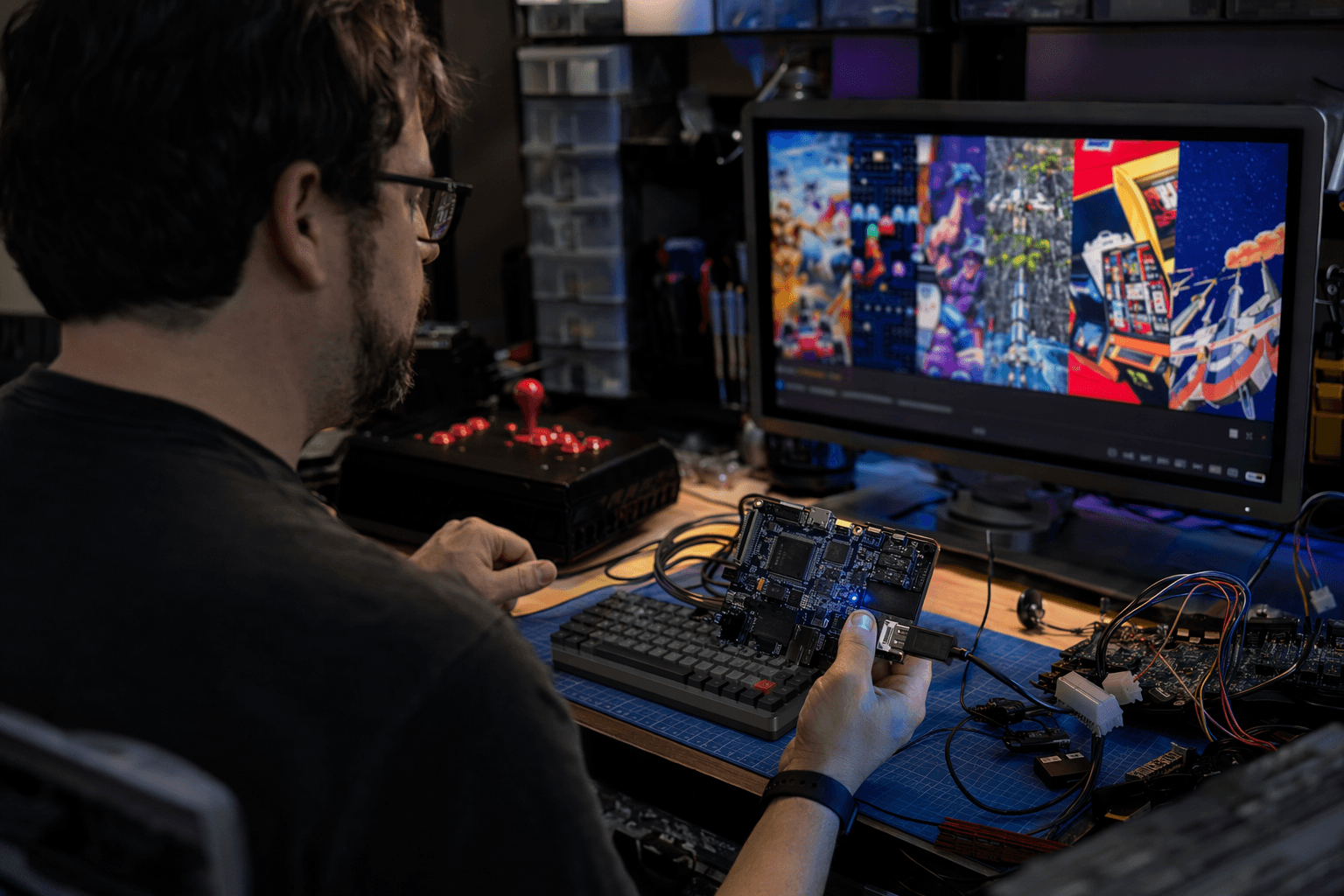
The hardware story is just as important. The MiSTer Multisystem2 Arcade is now open for preorder at £258.00 including VAT, with shipping expected to begin in August 2026. Preorders started on May 6, 2026, and the listing positions it as an all-in-one board for people who want MiSTer to drop into a more authentic arcade-style setup instead of a general-purpose desk build.
The feature list is aimed squarely at real hardware use:
- integrated audio amplifier
- CTRLDock Arcade
- JAMMA dual-player I/O
- analogue inputs for spinners, trackballs and wheels
- kick-harness expansion for up to 9 buttons per player
The system is described as compatible with MiSTer arcade, console and computer cores, which makes it more than a niche cabinet part. For anyone trying to build a compact, wired, arcade-style MiSTer setup, the appeal is obvious: fewer adapters, fewer compromises and less time spent solving basic integration problems.
SMS BASIC 1.0 opens another door for homebrew work
The roundup also highlights SMS BASIC 1.0, a BASIC environment for the Sega Master System that adds graphics and audio commands tailored to the hardware. That makes it noteworthy not only for preservation, but for learning and homebrew development. The Master System has a documented development scene, and SMS Power remains the key reference point for the system’s hardware and software ecosystem, which gives this kind of tool an important foundation.
A dedicated BASIC layer does more than make experimentation easier. It lowers the barrier for people who want to understand how the Master System behaves, create small projects, or prototype ideas without diving straight into lower-level toolchains. In a scene where preservation and creation often overlap, that matters a lot.
MiSTer Frontier broadens the ecosystem beyond traditional cores
Another important piece of the puzzle is MiSTer Frontier, a new repository from MiSTer Organize aimed at hybrid cores like PICO-8 and OpenBOR. That tells you something about where the MiSTer ecosystem is heading: it is no longer just about classic console, computer and arcade preservation, but also about homebrew, experimental content and easier access to non-traditional software.
The Frontier project’s GitHub instructions say it can be installed or updated through MiSTer’s Scripts menu via update_all, and its files appear automatically in the _Other/, games/ and docs/ locations. A recent forum post also says MGL launcher support has been added for Frontier cores including PICO-8 and OpenBOR, letting users launch a specific cart or PAK with one click. That kind of integration is exactly what makes a platform feel finished, because it reduces the number of steps between knowing something exists and actually playing it.
The arcade pipeline is still moving
There is also plenty happening on the pure arcade side. Operation Wolf, Rainbow Islands, Gradius and Argus are all under development by a Jotego director, keeping the arcade pipeline active alongside the newer quality-of-life work. For MiSTer users, this matters because it shows the scene is not choosing between preservation accuracy and usability. It is pushing both forward at once.
That is the real story running through this week’s MiSTer updates. Zaparoo Launcher tackles the front end, core development keeps tightening arcade behavior, Multisystem2 Arcade gives builders a more complete hardware path, SMS BASIC 1.0 expands the homebrew lane, and MiSTer Frontier makes it easier to bring non-traditional content into the same ecosystem. MiSTer is becoming more capable not just because there are more cores, but because the whole experience around them is finally catching up.
This article was produced by Prism’s automated news system from verified source data, official records, and press releases, then run through automated quality and moderation checks before publishing. The system is built and supervised by the people who set the standards it runs under. Read our full AI policy.
Did this article answer your question?