SuperStation One review spotlights FPGA PlayStation revival with broad legacy support
SuperStation One is the FPGA PlayStation that makes a real case for hardware-accurate retro play, with broad AV output, original accessory support, and disc-drive ambition.
Why this machine matters
SuperStation One is interesting because it does not try to win the retro race by being the cheapest box or the flashiest one. It tries to be the one that feels right. Retro Remake pitches it as an open-source, mainstream FPGA gaming console, and that matters because FPGA is the route you take when software emulation is not good enough for the feel, timing, and input response you want from a PlayStation.
That distinction is the whole story. Nintendo, Sony, and Sega leaned on software emulation for their mini consoles, while other hardware projects have leaned into recreated chips. SuperStation One instead uses FPGA cores to reproduce console behavior at the hardware level, which is why it appeals to players who care about low latency, accurate timing, and how a PS1 actually behaves when you press a button, not just how the game looks on a menu screen.
What you actually get for your money
The part that separates SuperStation One from a lot of FPGA curiosities is that it is built to be livable, not just technically impressive. The official package currently includes a pre-installed 64GB microSD card, an HDMI cable, and a USB-C cable, and the product page says shipping is expected in June 2026 or earlier with a limit of one unit per order.
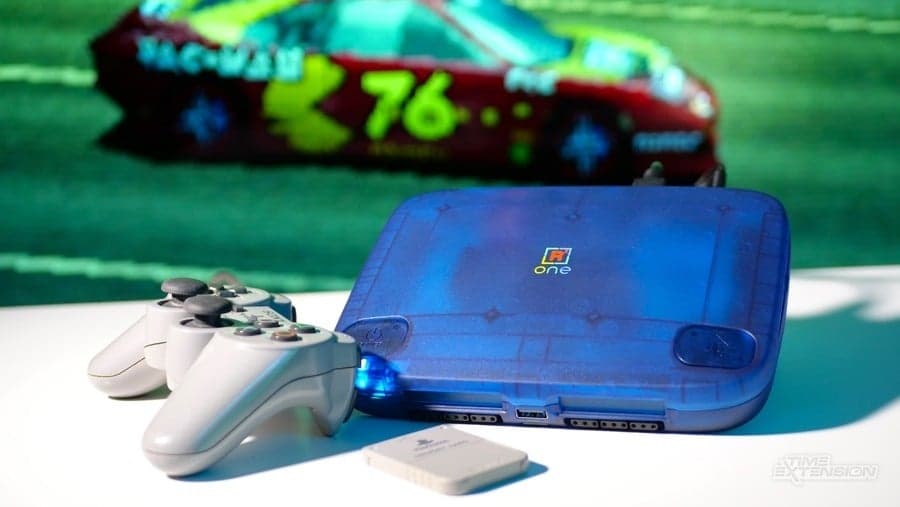
Time Extension’s review also notes the physical presentation, which is exactly the sort of thing that matters when you are buying this kind of machine. The reviewed unit came in transparent blue, grey was also available, and the box did not include a controller or power brick. That makes the real-world setup a little less “plug and play” than a Sony mini console, but it also telegraphs what this machine is: a component in a serious retro setup, not a toy bundle.
The hardware story is the appeal
Under the shell, CNX Software reported that SuperStation One is built around an Intel/Altera Cyclone V SX FPGA with a dual-core Cortex-A9 HPS at 800 MHz and 128MB of BGA SDRAM. It also has dual PS1 SNAC ports, Wi-Fi, Bluetooth, Ethernet, NFC, three USB Type-A ports, and analog and digital video output options. That combination is why the hardware keeps coming up in the same breath as higher-end MiSTer builds rather than cheap HDMI-only emulation boxes.
Retro Remake says the console is inspired by the PS One design, and that is not just cosmetic nostalgia. The box is meant to sit in a living room and still speak the language of old gear, with built-in Wi-Fi and Bluetooth, support for original controllers and peripherals, and compatibility with MiSTer FPGA cores. In practical terms, you are not buying one narrow-purpose shell around a single PlayStation preset. You are buying a platform that can live inside a broader FPGA setup.
Legacy support is the real upgrade
This is where SuperStation One pulls ahead of the usual software-emulation conversation. The review emphasizes support for VGA, RGB, S-Video, component, composite, and HDMI, so the machine can talk to CRTs, scalers, and modern displays without forcing everything through the same digital funnel. If you still care about old display chains, that kind of output flexibility saves you from adapter hell.
The accessory support is just as important. Through the SNAC module, SuperStation One supports original PlayStation controllers, memory cards, and even light guns, which is exactly the kind of detail that tells you the machine is aimed at people who still own the real peripherals. A software box can play the game; this kind of hardware is trying to recreate the surrounding ritual of playing it.
The disc-drive angle changes the equation
The optional SuperDock is the big swing here. Early coverage said it was offered with a $5 deposit and would add a disc drive for PlayStation 1 discs, plus an M.2 2280 SSD slot and extra USB ports. That gives SuperStation One a path toward a physical-disc workflow, not just a ROM-and-microSD workflow, which is a meaningful difference if your PS1 library is still sitting on shelves.
That is the part that pushes it beyond “another FPGA box.” If you want an accurate, modern, convenient way to use original PS1 media, memory cards, controllers, and displays in one system, SuperStation One is chasing that exact intersection. The result is not just faster setup, but a setup that feels less detached from the hardware era it is trying to preserve.
Price, rollout, and the tradeoffs you should expect
The pricing history shows how Retro Remake has tried to make the idea accessible without pretending it is bargain-bin hardware. Launch coverage in January 2025 said Founder’s Edition pre-orders started at $149.99, the standard version was $179.99, and the price would rise to $225 after the introductory period. That puts the machine in the range where expectations get stricter, because once you are past impulse-buy territory, buyers start asking whether the fidelity and flexibility are really there.
The answer is yes, but only if you value the right things. A software emulation box is still easier if all you want is fast setup and low cost. Sony’s PS Classic is still the simpler nostalgia object. SuperStation One earns its place when you care about hardware-level timing, broad legacy output, original peripherals, and a path toward original discs through the SuperDock. It is the rare retro box that makes a convincing case that accuracy, compatibility, and living-room practicality can sit in the same chassis, and that is what makes it worth watching in 2026.
This article was produced by Prism’s automated news system from verified source data, official records, and press releases, then run through automated quality and moderation checks before publishing. The system is built and supervised by the people who set the standards it runs under. Read our full AI policy.
Did this article answer your question?