3 marine circuit breakers that protect DIY boat wiring from fires
That flaky 12V panel is not just annoying. The right breaker style can stop corrosion, nuisance trips, or runaway current before it turns into smoke.
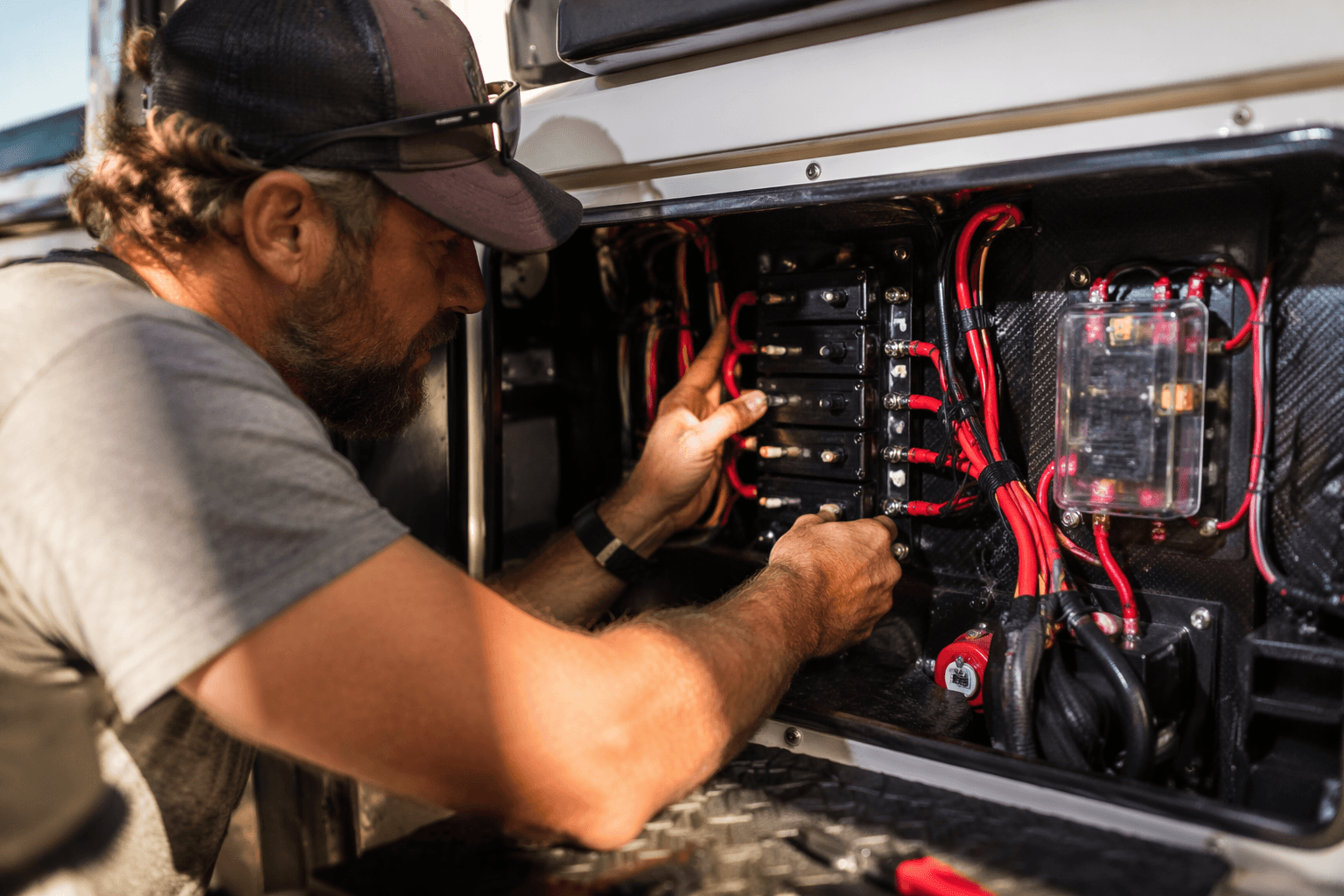
A flaky 12V panel rarely fails politely. One pinched wire, one tired motor, or one extra load on a branch can heat copper fast enough to cook insulation and start a fire if the breaker is the wrong style for the job. Marine breakers are built for saltwater, vibration, and temperature cycling that would beat up a household breaker in short order, which is why boat electrical safety stays tied to the same uncomfortable fact: water and electricity keep meeting in the same spaces.
ABYC has been developing boat safety standards since 1954, its standards guide more than 90% of boats built in North America, and its 2025 supplement updated E-11, the AC and DC electrical systems standard. NFPA marina guidance addresses leakage current, shock hazards, and ground-fault protection.
Water-resistant rocker panels for exposed helms
If your breaker panel lives where spray, washdowns, or open-cockpit weather can reach it, a water-resistant rocker-style panel is the right kind of armor. Blue Sea's water-resistant circuit breaker panels are designed for flybridge and open cockpit applications, and the front is IP66-rated, which means it is protected against powerful water jets. The panel also uses a watertight mounting gasket and waterproof boots for push-button reset-only circuit breakers, so the control face is built to shrug off the kind of moisture that quickly turns ordinary hardware sloppy.
The real trap on exposed installations is not always the breaker body itself; it is the connection side behind the faceplate, where trapped moisture and salt can attack terminals and turn a clean panel into a mystery fault. Blue Sea's panels are ignition protected and safe for gasoline-powered boats, which matters because U.S. Coast Guard regulation 33 CFR 183.410 calls for ignition-protected devices in critical areas.
Clear labeling matters here too. When a crew member needs to isolate a circuit fast, the whole point of the panel is that the breaker can be found, understood, and reset without guessing.
Metal DC breaker panels for a dry below-deck load center
A traditional metal DC breaker panel belongs in the drier, more sheltered part of the boat, where the electrical system can be centralized and serviced without fighting spray every time you open the locker. This is the setup that fits a nav station, an electrical cabinet, or another protected below-deck location where the panel can be read quickly and the circuits can be traced without contorting around a cockpit bulkhead.
This style is the better fit when nuisance trips are tied to messy DIY wiring, unclear labeling, or a panel that has become a guessing game. When a bilge pump, cabin light, or electronics circuit drops out, the fastest path back to normal is a panel that tells you exactly what tripped and lets you isolate it without tearing into the harness. Corrosion behind the faceplate is one of the leading ways a seemingly solid panel turns flaky.
ABYC's 2025 supplement updated E-11 along with other standards. If your boat is gasoline-powered, ignition protection is still not optional in the critical spaces that call for it.
Compact thermal breakers for small surface-mount runs
For cramped installs, compact thermal breakers make the most sense because they combine switching and protection in one package. That makes them useful on small surface-mount applications where there is no room for a full panel and you still want proper overcurrent protection at the circuit itself. When the load is a compact accessory circuit rather than a whole distribution bank, this style gives you a simple way to stop a fault before the wire becomes the weak link.
If a motor starts failing, a wire gets pinched, or someone piles too many accessories onto one branch, the thermal breaker is there to open the circuit before the conductor gets hot enough to become a fire source. That is the practical payoff of right-sizing the breaker instead of shopping by price or by whatever form factor happens to be on the shelf.
- Amperage: size it for the circuit and the conductor, not for the biggest number you can squeeze into the space.
Before you buy one, check three things:
- Ignition protection: if the circuit sits in a gasoline-powered boat or any critical area with fuel vapor exposure, make sure the device is ignition protected.
- Reset style: choose a reset method that matches how you troubleshoot. Push-button reset-only breakers make sense on protected exposed panels, while combined switch-and-protection layouts suit compact local runs where space is tight.
NFPA's marina guidance tightened ground-fault protection from 100 mA in the 2011 NEC to 30 mA in the 2017 NEC for shore-power feeder and branch circuits, after substantiation that cited more than 50 deaths and over 30 injuries. The Coast Guard's ignition-protection rules and the Boston Whaler recall that once involved a non-ignition-protected main electrical distribution panel point the same way.
This article was produced by Prism’s automated news system from verified source data, official records, and press releases, then run through automated quality and moderation checks before publishing. The system is built and supervised by the people who set the standards it runs under. Read our full AI policy.
Did this article answer your question?