Aging Shorepower Cables Can Trip Marina Power, Test Before Trouble Starts
A 5-year-old shorepower cord in Puerto Montt tripped one boat and three neighbors. Test aging cables before they become a shock or fire hazard.
A shorepower cord can look serviceable right up until it starts taking down a dock. In Puerto Montt, Patagonia, David Lynn and his crew plugged in for a longer stopover, then watched the GFCI trip every few hours and shut off not just their boat, but three other boats on the same circuit. The marina electrician traced the fault to a 5-year-old cable, and that embarrassment is the whole lesson: a shorepower lead is not “good enough” just because the jacket still looks intact.
The problem starts long before the jacket looks damaged
Lynn’s warning is brutal because it is ordinary. Insulation begins aging the moment it is manufactured, and sunlight, temperature swings, and saltwater all push it downhill faster. That means the cable can be leaking current while still passing the eye test on the dock, and the first clue may be a breaker or GFCI that keeps doing exactly what it is supposed to do.
That is the point where a lot of owners make the wrong call. They blame the marina, swap pedestals, or nurse the cord along for another season. If the insulation has started to leak, the protection device is not the problem, it is the alarm bell.
What leakage looks like in real life
The most obvious symptom is repeated nuisance tripping on shorepower, especially when the same cord is used on different pedestals. You may also see the problem only under load, which is why it can feel random at first. A cord can behave normally for hours, then trip again when moisture, heat, or vibration pushes the fault over the edge.
The important mindset shift is this: a shorepower cord does not need to look destroyed to be unsafe. Lynn’s article drives home that a cable can be five years old and still be the source of a marina-wide outage. Cruising World has reported a shore-power cord with 710 milliamps, or 1.12 amps, of leakage, a level that is wildly beyond acceptable thresholds and a good reminder that visual condition tells only part of the story.
Why this becomes a shock hazard, not just an annoyance
NFPA’s warning is simple and serious: electric shock drowning happens when marina or onboard electrical systems leak current into the water, and that current can paralyze a swimmer and lead to drowning. NFPA also notes that many marinas lack GFCIs and that recurring inspection rules are inconsistent, which leaves a lot of prevention work on the boat owner and dock crew.
NASBLA adds the technical reason this gets dangerous so fast. Electric shock drowning usually needs two faults, a leakage fault from a live wire to a grounded metal part, plus a failure of the AC grounding system. In that scenario, as little as 10 to 20 milliamps through the human body can seize muscles, while higher currents can cause fibrillation and cardiac immobilization. In freshwater marinas, the risk is even sharper because the human body conducts better than fresh water.
The test a multimeter cannot do
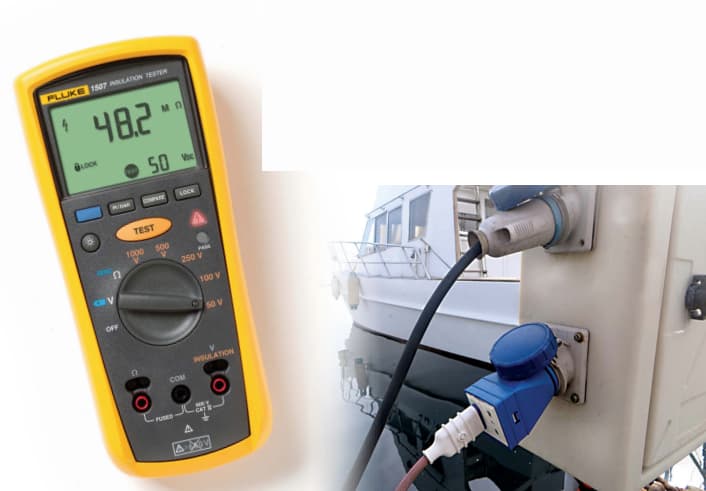
An ordinary multimeter is not enough for this job. Lynn points out that a standard meter uses too little voltage to reveal insulation breakdown, so it can miss a cable that is already leaking under real-world conditions. What you need is a megohmmeter, which applies a much higher test voltage and measures very high resistance values.
Those meters are no longer exotic tools reserved for yard techs. Lynn notes that handheld units are now small and can be bought for less than $75, which puts them within reach for boat owners who want to test their own shorepower leads instead of guessing. For a cable that carries marina power into your boat, that is cheap insurance.

How to check a cable before it starts trouble
The proof-test process is straightforward enough to do in the yard or at the dock with the cable isolated.
1. Disconnect both ends of the shorepower cable.
2. Connect the megohmmeter leads appropriately.
3. Test at the 1,000-volt setting, which Lynn specifically cites for this kind of proof test.
4. Look for leakage, not just continuity.
If the cable fails that test, the safe answer is not to keep patching around it. A cord that leaks current is not a convenience issue, it is a safety defect.
Where standards and regulations draw the line
ABYC’s E-11 standard covers AC and DC electrical systems on boats, including shore power cable systems, and ABYC says it reviews each standard at least every five years. That matters because shorepower wiring is treated as part of the vessel’s life-safety system, not as an accessory. U.S. Coast Guard regulations for recreational vessels require electrical equipment to be installed and maintained to protect passengers, crew, others, and the vessel from electrical hazards including shock and fire.
On the dock side, NEC Article 555 guidance has pushed marinas toward ground-fault protection and leakage-current measurement devices so dock systems do not become shock hazards. The Electric Shock Drowning Prevention Association was created to promote prevention using ABYC, NFPA, and NEC standards, and a U.S. Coast Guard-funded ABYC study on currents in marina water helped inform later protection levels in NEC Article 555. That history matters because it shows this is not a theoretical problem, it is a documented one.
When to retire the cord, not nurse it
The retire-now line is clear. If a shorepower breaker or GFCI keeps tripping, do not assume the marina pedestal is to blame. If a megohmmeter test shows leakage at the 1,000-volt setting, the cord has crossed from aging gear into unsafe gear.
A cord should also come out of service immediately if it has spent years in sunlight, heat swings, and salt exposure and now shows repeated fault behavior. This is exactly the kind of consumable safety equipment that gets cheaper to replace than to gamble on. A cable that can trip three other boats on the same circuit is already telling you it no longer belongs in service.
The most useful habit on the dock is the simplest one: treat shorepower cords like any other critical safety component. Test them before they fail in front of everyone, because the first visible sign of trouble may already be a dark marina, a dead circuit, or a swimmer in danger.
This article was produced by Prism’s automated news system from verified source data, official records, and press releases, then run through automated quality and moderation checks before publishing. The system is built and supervised by the people who set the standards it runs under. Read our full AI policy.
Did this article answer your question?