Ericson 31 owner revives clogged Whale Gusher 10 bilge pump
A clogged flapper valve killed an Ericson 31’s bilge pump, but a careful teardown brought it back for far less than a $250 replacement.
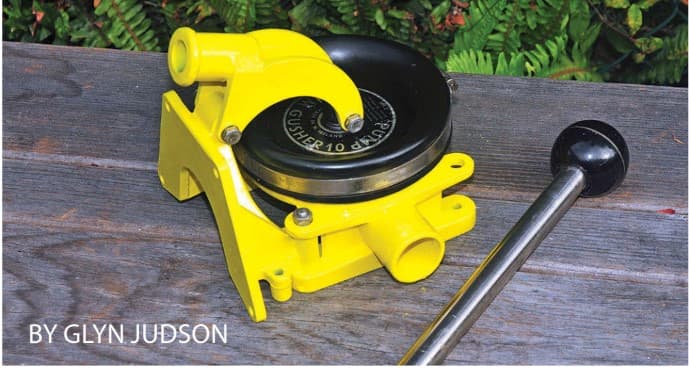
When a bilge pump stops, you are looking at emergency gear failure, not a convenience problem. On Glyn Judson’s Ericson 31, Dawn Treader, the nonfunctioning Whale Gusher 10 was supposed to be the system that keeps water moving out when everything else is going wrong. A replacement would have cost about $250, so he opened the pump first, and that decision exposed a failure mode every DIY sailor should know: the pump was not dead because it had shattered. It was jammed by aluminum oxide debris under one flapper valve.
Why this rebuild matters
That detail changes the whole repair-vs-replace calculation. A Whale Gusher 10 is sold as a long-life, die-cast alloy manual bilge pump built for tough marine conditions, and Whale lists the unit at 65 liters per minute, or 17 U.S. gallons per minute, with 1½-inch hose connections. That is serious emergency capacity for a hand pump, which is exactly why a clog, not a catastrophic break, deserves a teardown before you write the gear off.
The bigger lesson is that a manual bilge pump can fail in ways that look fatal from the cockpit but are actually mechanical and local. If the housing is intact, the valves can still seal, and corrosion has not eaten through the working parts, a rebuild can be the smart move. If the sealing surfaces are destroyed or the parts no longer close properly after cleaning, replacement becomes the safer choice.
How the failure showed up
Judson’s discovery came after disassembly. The pump would not function because aluminum oxide debris had collected beneath one flapper valve, preventing it from sealing. That is the kind of fault that is easy to miss if you only look at the outside of the pump, and it is exactly why a “dead” bilge pump should be opened up before it is discarded.
His rebuild also shows what usually deserves inspection in an older manual pump: corrosion on aluminum pieces, contamination on valve seats, and the condition of the stainless components and rubber flapper valves. In this case, the problem was not a mysterious internal collapse. It was a serviceable pump that had been handicapped by debris and wear.
Repair signs that make sense, and warning signs that do not
The best rebuild candidates are the ones that fail because of grime, corrosion, or a single damaged section that can be restored. Judson’s pump fit that pattern. He found one corroded corner on an internal plate, but the rest of the unit could be cleaned, treated, and reassembled. That is the sweet spot for a repair: a known flaw, limited damage, and parts that still have enough integrity to seal once they are cleaned.
The riskier rebuilds are the ones where the damage is structural or the valve system no longer has a reliable seal. If the internal surfaces are too far gone, no amount of paint or cosmetic work will bring back confidence. For a bilge pump, confidence matters because a pump that looks good but does not move water is worse than useless.
The hands-on fix
Judson kept the repair practical and inexpensive. He used a small home sandblaster to clean the corroded aluminum parts, then patched the damaged corner of the internal plate with thickened West System epoxy. After that, he applied zinc chromate primer and three coats of Rust-Oleum yellow enamel to protect the parts and finish the job cleanly.
He also cleaned the stainless components and the rubber flapper valves, then treated the valves with Armor All before reassembly. That combination matters because the goal was not a pretty shelf piece. It was to return a 37-year-old safety system to service and give original hardware more useful life.
- Inspect for debris before assuming the pump is finished.
- Clean the metal parts thoroughly, especially around the valve seats.
- Rebuild only if the structure still has sound metal where it counts.
- Treat a successful repair as a safety win, not just a savings win.
For a DIY sailor, the takeaway is simple:
Why installation and maintenance still matter
Whale’s own guidance reinforces why keeping this pump alive is worth the effort. The company says the Gusher 10 can be mounted on-deck, through-deck, or on a bulkhead, and it warns that installation conditions and pumping rate affect capacity. It also cautions that output may not be enough to handle a rapid influx of water. In other words, a manual bilge pump is not a substitute for good seamanship, but it is still a vital last line of defense.
The installation instructions also stress easy access for servicing, avoiding sharp bends in the pipework, and limiting air leaks in the hose run. Those details matter because a pump that is theoretically rated at 17 gallons per minute will not behave that way if the hose run is compromised. The hose itself is part of the system, and so are the clamps, bends, and access points that let you service it before it fails.
The legal backdrop is not optional
The safety case gets even stronger under U.S. rules. Federal regulation 46 CFR 28.255 requires bilge pumps and piping capable of draining watertight compartments under all service conditions for certain vessels, and it also requires strainers on bilge suction lines to prevent clogging. That is the same failure family Judson ran into: obstruction, contamination, and a pump that could not do its job because the flow path was compromised.
For DIY sailors, that regulation is a reminder that bilge gear is not just maintenance theater. It is part of the boat’s survivability. If you are already opening the pump, it is smart to inspect the suction side, the strainers, and the run of the hose while you are there.
Why this story hits home
Judson’s choice also fits the way many older-boat owners think about original hardware. He and Marilyn have owned Dawn Treader, their 1979 Ericson Independence 31, for about 20 years, keeping her in Marina del Rey, California. They have sailed Santa Monica Bay and the Channel Islands together since 1982, and that long relationship with the boat shows in the repair ethic: preserve what still works, restore what is worn, and do not throw away a piece of gear until you know why it failed.
That experience matters because it turns a small pump repair into a broader lesson. A Whale Gusher 10 that stops moving water is not automatically scrap. If the failure is debris under a flapper valve, corroded but repairable aluminum, or a single damaged corner that epoxy can restore, a rebuild can put critical emergency gear back in service for far less than the cost of replacement. In a bilge, that is not just thrift. It is readiness.
This article was produced by Prism’s automated news system from verified source data, official records, and press releases, then run through automated quality and moderation checks before publishing. The system is built and supervised by the people who set the standards it runs under. Read our full AI policy.
Did this article answer your question?