Why Sailboat Stability Is More Than Ballast Ratios and Brochure Numbers
Brochure ballast ratios miss the real safety story. The boats that feel solid offshore do so through righting moment, hull shape, beam, and load, not one tidy number.
Brochure numbers only tell part of the story
A sailboat can look reassuring on paper and still behave very differently once the wind fills in, the dinghy goes on deck, and the cruising lockers are full. That is the trap Rob Mazza is trying to spring open: stability is not a single ballast ratio or a glossy spec-sheet promise, it is the whole interaction between hull shape, weight, and how the boat is loaded in the real world.
The reader challenge that sparked his explainer came from a comparison between the Vineyard Vixen and the Southern Cross 35. The Southern Cross 35 carried about 5,000 pounds more displacement, yet the two boats had nearly equal ballast and draft. That is exactly why a simple brochure read can mislead you. Displacement, beam, and ballast all matter, but none of them answers the question sailors actually care about most: how much margin does this boat really have when it is pressed hard offshore?
How stability actually works
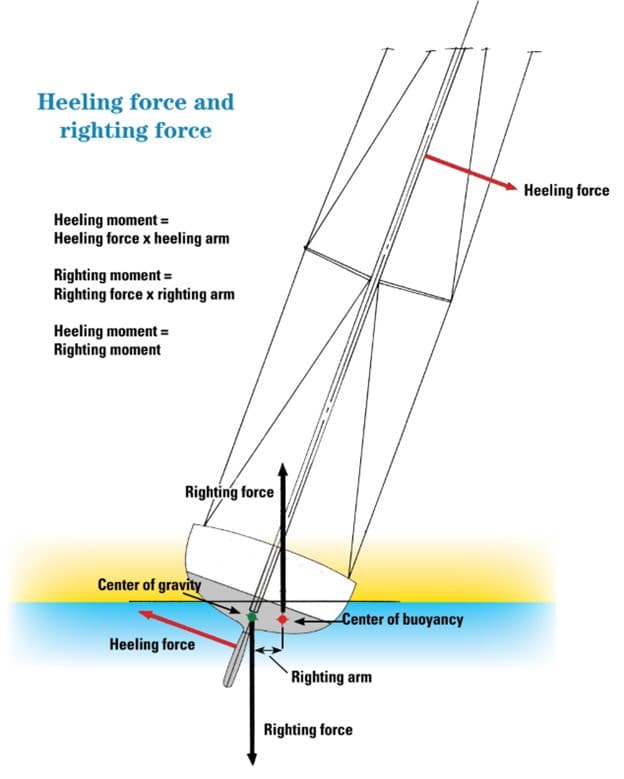
The physics are straightforward once you stop reducing them to ratios. Wind pushes on the sails and creates a heeling moment, which is a force acting at a distance. The boat answers with an equal and opposite righting moment, generated as the hull heels and the center of buoyancy shifts relative to the center of gravity.
The righting arm, or GZ, is the horizontal separation between the vertical lines through those two centers. Righting moment equals displacement multiplied by GZ. That matters because the shape of the righting-arm curve tells you far more than a ballast percentage ever will. A boat can feel stiff early, then lose authority later; another may feel softer at first but keep building a stronger reserve as heel increases.
The real red flag is the angle of vanishing stability, also called the limit of positive stability, or AVS and LPS. That is the point where the righting arm falls to zero and the boat can no longer stay upright on its own. Once you understand that, stability stops being a marketing word and becomes a question of safety margin.

Why beam and displacement are useful, but not decisive
Beam and displacement do influence stability, and in many cruising boats they also hint at structural robustness. A broader boat often has more initial stability, which is why modern production cruisers can feel more solid underfoot at small angles of heel. But that is not the same thing as ultimate offshore stability, and it is not a free pass for assuming the boat is safer.
That distinction matters because modern cruising sailboats are often wider and lighter than older designs. Practical Sailor has pointed out the core problem: these trends can increase initial stiffness while making the motion feel more abrupt. In other words, a boat may resist the first few degrees of heel well, then move into a seaway in a way that feels sharper and less forgiving. If you are shopping for a boat, planning a refit, or deciding how much sail to carry as weather builds, that difference is not academic. It is the margin between a boat that feels composed and one that becomes hard work.
What the offshore standards look at instead
This is why offshore rules and certification systems do not rely on ballast ratio alone. World Sailing’s Offshore Special Regulations set minimum equipment, accommodation, and training standards for offshore racing yachts, and the framework traces back to the experience of the 1979 Fastnet Race. The current regulations cover seven offshore race categories, which is a reminder that offshore sailing is judged by conditions and exposure, not by a single number on a brochure page.
The Offshore Racing Congress emphasizes the same point in its stability language: the important moment on the curve is where the righting arm reaches zero, the LPS or AVS. ISO 12217-1:2022 also evaluates stability and buoyancy for small craft and can assign a design category of A, B, C, or D based on the boat’s intended use and maximum total load. That gives you a useful framework, but not a magic shield. Compliance with an ISO stability standard provides assurance, yet it does not guarantee total safety or freedom from capsize or sinking.
The loading condition is where many owners get caught
This is the part DIY owners often miss when they start making changes. A boat that was drawn with one displacement and one load assumption can behave very differently once you add gear aloft, cruising stores, heavy anchors, extra batteries, dinghy davits, or a modified rig. Every pound raised above the waterline affects the center of gravity, and every change to the hull or rig alters how the boat develops heel and recovery.
That is why stability has to be judged in the condition the boat will actually sail in. If you are adding gear aloft, the question is not whether the upgrade looks neat or seems structurally strong enough. The real question is what it does to the righting-arm curve and whether it steals reserve when the boat is heeled hard in a seaway. The same applies if you are loading the boat for passage making. A boat that felt fine on a weekend sail may be a different machine once it is carrying cruising stores, extra water, and the clutter that offshore life always seems to create.
How to use stability data without misreading it
The practical trick is to stop asking, “What is the ballast ratio?” and start asking better questions about the whole boat. What happens to GZ as the boat heels? Where is the AVS? How broad is the beam, and how is that beam distributed in the hull form? What happens when the boat is loaded for the way you actually sail it, not just for the brochure displacement?
- Initial stiffness is not the same as offshore recovery.
- Higher displacement can help, but only in context.
- Beam can add stability, but it can also change the motion and the way the boat loads up.
- The righting moment curve tells you more than a single ratio ever will.
- Maximum righting moment often shows up somewhere around 40 to 80 degrees of heel, which is why a boat can feel reassuring early and still have very different behavior later.
A useful way to think about it is this:
For sailors who want to understand the why behind handling and seaworthiness, that is the key shift. Stability is not a brochure contest, and it is not solved by picking the boat with the prettiest ballast figure. It is the relationship between physics, hull shape, and load distribution, and the best question you can ask is how much safety margin is left when the boat is sailed the way you really use it.
This article was produced by Prism’s automated news system from verified source data, official records, and press releases, then run through automated quality and moderation checks before publishing. The system is built and supervised by the people who set the standards it runs under. Read our full AI policy.
Did this article answer your question?


