DIY Sailor Builds Portable 12-Volt Battery Baton for Mast Wiring Tests
A 14 1/8-inch PVC baton packed with eight AAA cells lets you prove mast lights and wiring before the mast goes back up.
Why this little baton matters
The expensive mistake is not the bad wire. It is discovering the bad wire after the mast is stepped, the crane is gone, and a simple test has turned into a climb or a haul-out problem. Tom Wells built a tiny 12-volt source to stop exactly that from happening on his Tartan 37, Higher Porpoise, while he and Sandy were deep into a refit and replacing every in-mast conductor before the stick went back up.
That is the real value of this tool. It gives you a portable, handheld way to check mast-mounted wiring while everything is still open, reachable, and cheap to fix. Wells did not want a permanent power setup or a big battery dragged around the yard. He wanted just enough voltage to prove the circuit, light the lamp, and move on before the mast became a crane-day headache.
The build is almost absurdly simple
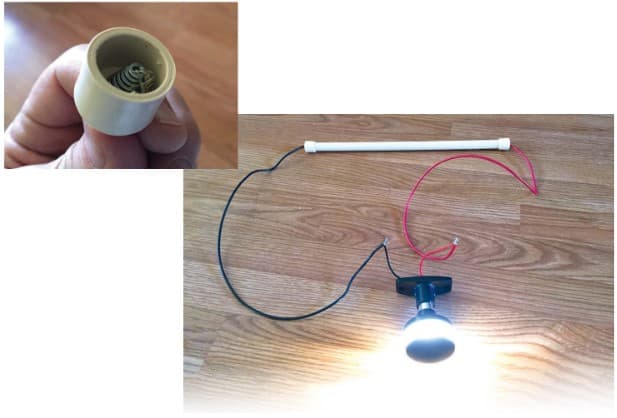
The parts list is refreshingly bare, which is part of the charm. Wells built the baton from:
- A 14 1/8-inch length of 1/2-inch PVC pipe
- Two 1/2-inch PVC end caps
- Eight AAA batteries arranged in series
- One red 16-inch #14 wire
- One black 16-inch #14 wire
- Two small coil springs scavenged from large wire nuts
The batteries sit inside the PVC tube like a skinny little cartridge. The red and black conductors pass through drilled holes in the pipe, and the springs serve as the contact pressure that keeps the stack alive. This is not a polished shop tool with machined terminals. It is a field fix, built from whatever was at hand, and that is exactly why it works for a sailor trying to finish a refit without overcomplicating the job.
The springs matter because they let the battery stack breathe a little. Wells notes that the device worked well, though he sometimes had to press the end caps inward to keep contact solid. That is the tradeoff with an improvised baton like this: it is light, cheap, and fast, but it depends on pressure to keep the circuit closed.
What it actually lets you test
This is not a substitute for a full house battery. It is a purpose-built test source for one job: proving mast wiring before the mast goes back up. In Wells’ case, that meant checking an LED anchor light while the rig was still on deck and the conductors were still accessible.
That kind of test catches the mistakes that become painful later. A light that does not come on. A circuit that is open somewhere in the mast. A connection that looks fine on the bench but fails when you want it overhead. When the mast is out of the boat, every one of those problems is still a wiring problem. Once the mast is stepped, the same problem becomes time, money, and access trouble.
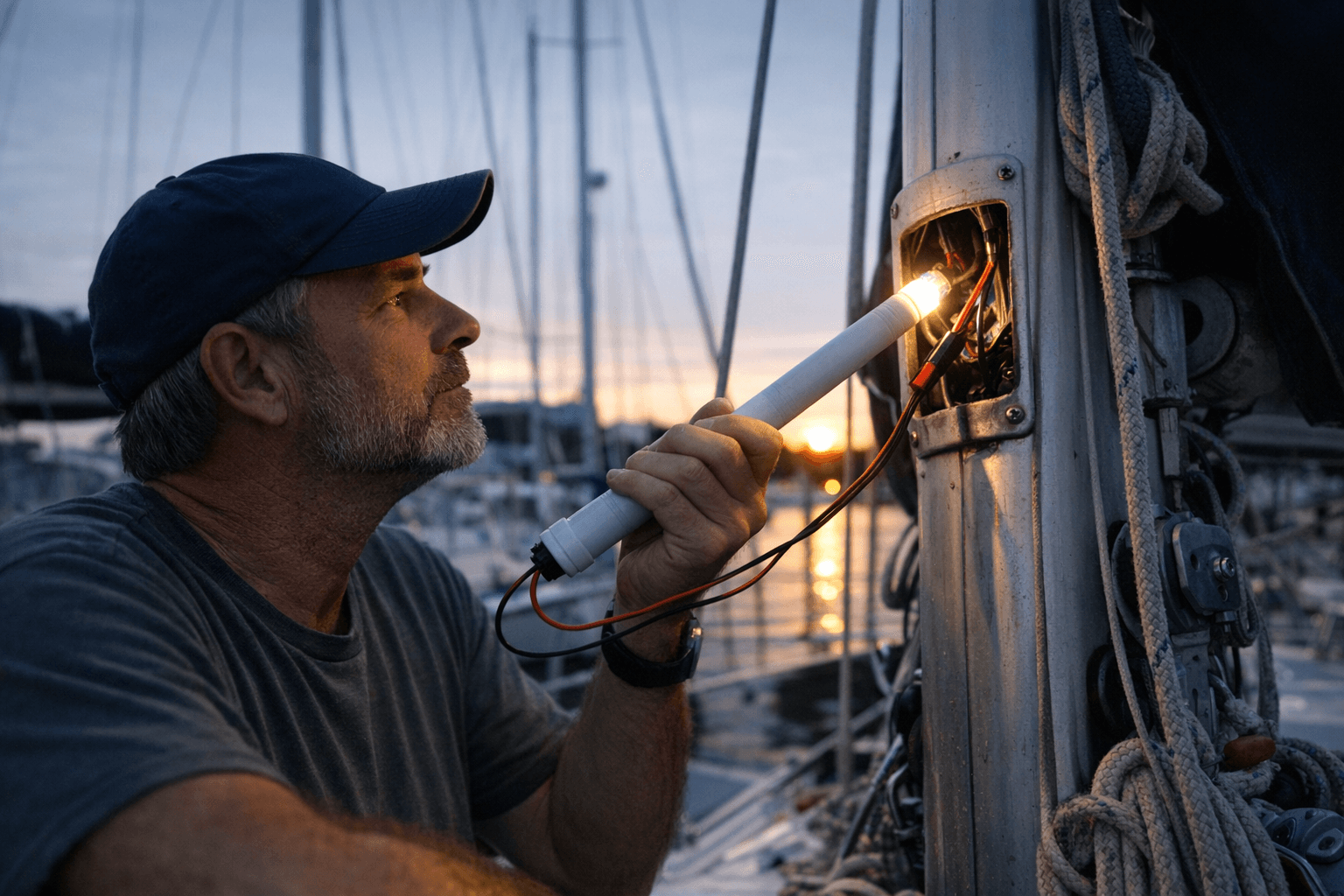
For a refit, that difference is huge. You are not trying to power the boat. You are trying to answer one question: does this mast circuit actually work before it becomes expensive to find out it does not?
Why a battery baton beats dragging a full battery around
A full battery has its place. This is not it. Lugging a big battery across the yard just to energize a mast light is clumsy, and it often solves more than the problem you actually have. Wells’ baton keeps the test portable and focused. It is light enough to hold in one hand, compact enough to bring right to the mast base, and simple enough that you do not need a cart, jumper leads, or a proper shop setup to make it useful.
That matters in the messy middle of a refit, when access is half the battle. The tool gives you a controlled 12-volt feed without turning the yard into a temporary battery farm. It also reduces the temptation to skip testing and hope the wiring will be fine after stepping. Hope is a lousy marine electrical strategy, especially when a failed mast circuit means going back up later to fix something that could have been caught on deck.
Why Wells’ version is worth copying
The best part of Wells’ build is that it is not clever for the sake of being clever. It is narrow, cheap, and easy to reproduce. The pipe length is specific, the battery count is specific, the wire lengths are specific, and the contact method is practical. If you are in the middle of a mast rewiring job, that kind of specificity is what you want.
He was not approaching this as a weekend dabble either. Good Old Boat describes Wells as a contributing editor and notes that he had a long career as a professional engineer. He and Sandy had been sailing together since the 1970s, retired in June 2016, and then set out from Waukegan, Illinois, in August 2016 on a 3,000-nautical-mile trip south via the Great Lakes, Erie Canal, Hudson River, and East Coast before settling aboard Higher Porpoise in Southwest Florida. That background shows in the tool. It is not flashy. It is the kind of practical fix you build when you know the cost of doing it twice.
The larger lesson for mast work
The baton is a reminder that marine troubleshooting does not always require a grand setup. Sometimes the right answer is a tiny 12-volt source, a PVC tube, eight AAA batteries, and enough contact pressure to prove a circuit before the mast goes back in the air. That small test can save a climb, save a crane reset, and save you from turning a simple wiring issue into a much bigger rigging problem.
On a boat refit, that is the kind of tool that earns its keep fast.
This article was produced by Prism’s automated news system from verified source data, official records, and press releases, then run through automated quality and moderation checks before publishing. The system is built and supervised by the people who set the standards it runs under. Read our full AI policy.
Did this article answer your question?