Anchor Holding Depends on Lead Angle, Not Just Scope
Short scope can work in a pinch, but only if the pull stays low. Once the rode climbs past a few degrees, holding drops fast and the shortcuts get expensive.
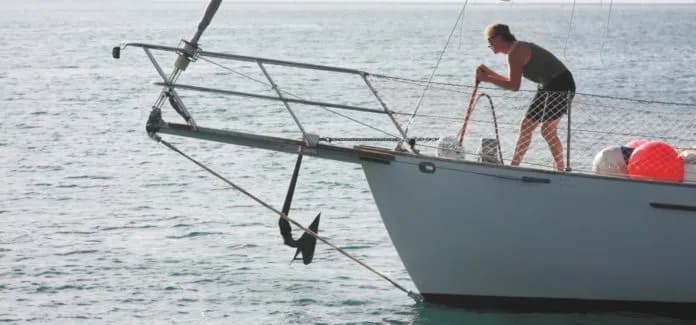
Lead angle is the real load test
The crowded anchorage tempts every skipper to cheat the rode. The trap is thinking scope alone tells the whole story. It does not. The real question is how high the pull climbs off the seabed when the wind and waves load the gear, because once that lead angle creeps past about 8 degrees, holding power for most anchors falls sharply.
That is the myth worth busting: short scope is not automatically failure, but it stops being a harmless compromise sooner than many crews expect. In practical terms, a snug berth in a jammed bay may be workable for a while, yet every extra degree in the pull angle eats into margin. By the time a small-boat anchor is seeing more than about 12 degrees, holding can be greatly reduced.
Why scope numbers can mislead
Scope is the familiar ratio of rode length to depth, and it still matters. But scope is only the setup on paper. Lead angle is the geometry under load, and that is where the anchor earns or loses its grip. Practical Sailor’s testing made that point plainly by pulling on six different anchors across a wide span of scope, from 3:1 to 20:1, instead of treating one anchor or one ratio as universal truth.
The useful takeaway is that different rode types can land in similar pull-angle territory even when the raw scope numbers are different. All-nylon, nylon-chain, and all-chain rodes can produce roughly similar angles in moderate conditions if the ratios are chosen well enough. That is why a skipper with chain on the bottom may get away with less scope than a pure nylon setup, while a lighter rode may need more length to keep the pull low.
Catenary helps, but it is not magic
Chain catenary is one of the most misunderstood pieces of anchoring gear. It helps because the hanging curve keeps the pull closer to horizontal, and a lower pull angle is what protects holding. But catenary is not a permanent shield. As the load rises, the chain straightens, the curve disappears, and the benefit fades.
That matters most in stronger conditions. Rocna’s guidance notes that at 8:1 scope the maximum angle of pull is already just over 7 degrees, which shows how quickly geometry can tighten even when the rode looks generous on paper. Rocna also notes that in 50-knot winds the chain can become nearly straight, leaving very little catenary benefit at all. The lesson is simple: chain buys you geometry and damping, but it cannot rescue a bad setup forever.
All-chain is efficient, not invincible
All-chain rode has a deserved reputation for efficiency, but it is easy to overstate what it can do. It is heavy, harder to retrieve, and once it goes bar-tight it loses much of the shock-absorbing value people assume they are getting. That is where the snubber becomes more than a nice add-on. In rougher conditions, a properly sized snubber helps manage the shock loads that a straightened chain cannot soften on its own.
That is also why all-chain should not be treated as a license to shorten scope recklessly. A chain-heavy rode can improve the numbers, but it does not eliminate the physics. If the boat is jerking the chain straight, the anchor still feels the load. The setup is only as good as the angle and elasticity it preserves when the gusts hit.
When you can cheat scope, and when you should not
Short scope is merely inconvenient when the weather is mild, the bottom is friendly, the boat has room to swing without trouble, and the rode still lies low enough to keep the pull near horizontal. In those conditions, a carefully managed all-chain or chain-assisted rode may produce a similar pull angle to a longer all-nylon setup. The mistake is to confuse “works right now” with “has margin.”
Short scope becomes dangerous when the load is rising, the chain is bar-tight, or the boat is in a place where a small change in set could put it on rocks, a neighbor’s bow, or a traffic lane. That is the crowded-anchorage problem in a nutshell. If your plan depends on an anchor brochure promise at extreme short scope, you are betting that the anchor alone will compensate for bad geometry. The test results say that is the wrong bet.
A practical rule of thumb emerges from the data:
- Keep the pull angle as close to horizontal as you can.
- Treat 8 degrees as a warning line, not a comfort zone.
- Treat anything above about 12 degrees on a small-boat anchor as serious loss of holding.
- Use chain and catenary to lower the angle, not to justify ignoring it.
- Add a snubber when the ride turns rough enough that chain stretch is no longer enough.
What the older rules still get right
The broader seamanship tradition was never wrong about the direction of the load. IACS guidance says the cable should be long enough that the pull on the shank remains practically horizontal, with a scope of 10 considered normal and not less than 6 sometimes accepted. That lines up with the modern angle-based view rather than contradicting it.
The point is not that every boat must always anchor at 10:1. It is that the old numbers were built around the same physics the newer testing highlights. Scope is a tool for controlling angle, and the angle is what the anchor feels. If you reduce scope too far, you are not just trimming rope. You are lifting the load path off the bottom and into the anchor’s weakest direction.
Why the new testing matters for real cruising decisions
Practical Sailor’s pull tests across six anchors and a 3:1 to 20:1 range are useful because they cut through marketing gloss. They ask whether certain designs truly do better at short scope, or whether the claims outrun reality. The answer for most cruisers is reassuring but disciplined: good anchors still matter, but geometry matters just as much. A better design cannot fully compensate for a bad lead angle, and the most polished product pitch does not change the physics under the keel.
That fits newer technical work as well. A 2024 paper in Marine Science and Engineering derived anchor holding-force equations by using catenary length and angle explicitly instead of pretending the seabed pull is always flat. That is the direction modern seamanship has been moving: less folklore, more geometry, and a clearer understanding of how chain length, wind, and load shape the actual holding power.
The final takeaway is not “always use more scope” and not “short scope is fine if the anchor is new.” It is this: if the rode can stay low, elastic, and close to horizontal, you have a system. If it cannot, you have a compromise that may still hold for a while, but with shrinking margin every time the wind pipes up.
This article was produced by Prism’s automated news system from verified source data, official records, and press releases, then run through automated quality and moderation checks before publishing. The system is built and supervised by the people who set the standards it runs under. Read our full AI policy.
Did this article answer your question?