Ben Zartman's poor man's vacuum bag simplifies fiberglass boat parts
Ben Zartman's garbage-bag vacuum trick gives small fiberglass parts tighter corners and cleaner surfaces, without paying for a full composite setup.

When you only need a hatch cover, a companionway-slide section, or a small trim piece with honest corners, a full vacuum-bagging setup can be expensive overkill. Ben Zartman’s answer was the kind of shop-floor improvisation sailors remember: a sacrificial plywood male mold, a black garbage bag, and a Shop-Vac doing just enough work to press fiberglass into shape. On the Cape George 31 Ganymede, that meant fewer bubbles, less bridging, and better fairing on parts he could actually build at home.
Why this cheap bag works
The basic idea is simple enough to respect. Vacuum bagging, in its proper form, uses atmospheric pressure to squeeze a laminate, drive out excess resin, and reduce voids. Zartman’s version borrows the same principle without pretending to be a full industrial process. For small fiberglass boat parts, that is often the whole battle: getting the cloth to stay put, pull into the corners, and cure as a compact piece instead of a lumpy hand layup.
That matters on one-off parts because hand layup tends to fight you exactly where boat parts are hardest to make. Outside corners want to lift. Cloth wants to bridge. Resin wants to pool where you do not need it and starve where you do. Zartman’s poor man’s bag presses the laminate against the mold instead of letting it float, which is why it is good enough for hatch covers, U-channel, and other small structural or trim pieces that benefit from a cleaner surface without demanding perfection from a full professional setup.
The setup is almost laughably simple
Zartman laid the part up over a sacrificial plywood male mold, slipped the whole assembly into a black plastic garbage bag, and pulled air with a Shop-Vac. The bag did the clamping, the vacuum helped compress the laminate, and the mold gave him a shape that a flat bench never could. That is a smart compromise for a DIY builder who wants repeatable results with common tools instead of paying for all the bells and whistles of a commercial composite shop.
The materials are all familiar boatyard stuff, just repurposed. You need fiberglass cloth, resin, a plywood form, a bag that can tolerate some abuse, tape, and a vacuum source if you want the full version. The trick is not the gear itself, it is understanding what each piece is doing: the mold gives shape, the bag applies pressure, and the vacuum helps the laminate settle instead of springing back.
Where the hack saves time, and where it saves money
Zartman’s method is especially useful when you are making small parts that would otherwise be awkward to fair by hand. A hatch cover, a short run of U-channel, or a companionway-slide section does not justify the cost or complexity of a professional vacuum system if the goal is simply to get a strong, clean piece off the bench. In that sense, the “poor man’s” part of the name is not an insult. It is the whole point.
The broader budget story around Ganymede makes the logic even sharper. Ben and Danielle Zartman built and cruised their 31-foot Cape George cutter from a bare hull. The hull came from Cape George Marine Works in Port Townsend, Washington, and they say it cost $23,000, while a factory-finished Cape George 31 was priced at $395,000 at the time. Their earlier 10-month Caribbean cruise ran on exactly $3,200, so a thrift-first fabrication method fits the same pattern of thinking that shaped the rest of their sailing life.
The failure point was not the fiberglass, it was the bag
The annoying part of the first version was sealing the bag. That is a very real shop problem, because a leaky bag can make the whole setup feel fussy for a relatively small payoff. Zartman simplified again by skipping the hard vacuum step and smoothing the plastic tightly over the part by hand, then gathering and taping down the loose ends to squeeze out excess resin.
That version is less glamorous, but it is often the version a sailor actually keeps using. You lose some of the neatness of a true vacuum pull, but you still gain pressure on the layup, a cleaner surface, and better control in the corners than a simple open-air hand layup usually delivers. If the job is a small part and the alternative is a sloppy laminate or no part at all, hand-tensioned plastic is a perfectly reasonable place to stop.
The mandrel trick is the real gem
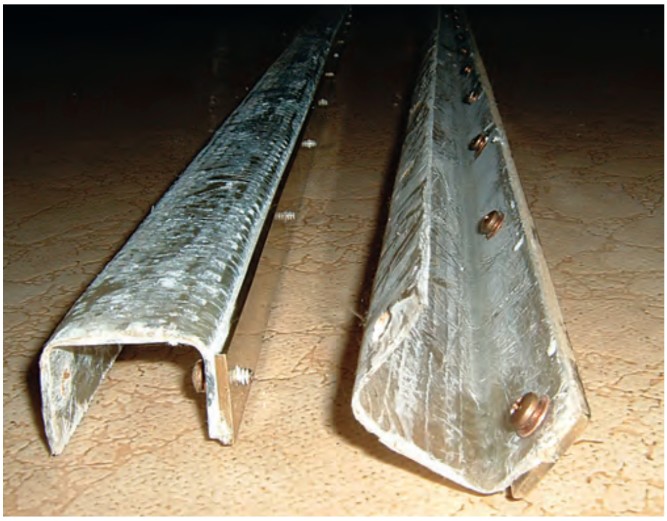
For the companionway-slide U-channel, Zartman refined the process again by wrapping the mandrel in Saran Wrap before laying up the fiberglass. Once cured, he could split the resulting box section and remove the wooden mandrel cleanly. He also made the companionway-hatch slides in one piece over a 2 x 4 as a mandrel, then cut them apart with a table saw.

That is a clever move because it solves two problems at once. First, the wrap acts like a release layer, which keeps the cured part from becoming permanently married to the wood. Second, the one-piece layup gives you a straighter, more consistent shape than trying to build a tiny channel in fragments. It is the same logic used in proper composite work, where release film keeps the laminate from bonding to the bag stack, only here the consumables come from the kitchen and the utility drawer.
Where to stop improvising
This is the part to take seriously: the poor man’s vacuum bag is for small, forgiving parts, not for every fiberglass job on the boat. Once a laminate needs highly controlled resin content, even consolidation across a larger surface, or the kind of repeatability you would expect from a true composite process, the bargain version starts looking like a compromise instead of a solution. That is when proper vacuum-bagging gear, with the right release film, bleeder ply, and breather ply, stops being luxury and starts being the sensible tool for the job.
Zartman’s example is valuable because it shows the exact edge of that line. He did not pretend a garbage bag was a professional system. He used it as a practical approximation, good enough to make useful parts in a real boatbuilding shop, on a budget that was already stretched by a bare-hull build, a family cruise, and years of living aboard. That is the lesson worth keeping: if the part is small and the goal is a better laminate, a little pressure and a lot of patience can beat expensive gear every time.
This article was produced by Prism’s automated news system from verified source data, official records, and press releases, then run through automated quality and moderation checks before publishing. The system is built and supervised by the people who set the standards it runs under. Read our full AI policy.
Did this article answer your question?