Boarding Ladders Can Turn Overboard Falls Into Self-Rescue
The right boarding ladder is the one you can reach, deploy, and climb when you are cold, alone, and half-stunned in foul-weather gear. At the dock is easy; in the water, everything changes.
The real question is whether you can get back aboard
A boarding ladder looks like convenience gear until the moment you are in the water, alone, tired, and trying to think through wet gloves and a pounding heartbeat. Don Launer’s framing is the right one: the ladder is not just for swimming off the boat or stepping aboard after a dockside errand, it is part of the boat’s self-rescue plan.
That changes how you judge it. A ladder that is comfortable from the dock but awkward from the water may be fine for day-to-day use and still fail the only test that matters in an overboard fall. The ladder has to be reachable, deployable, and climbable when you are not thinking clearly and are already spending strength on staying calm.
What a usable self-rescue ladder has to do
Launer’s basic standard is straightforward: a good ladder should extend well below the waterline, with at least two to three rungs below the surface. That gives a swimmer something to find quickly and enough depth to start the climb without having to muscle up to a first step that sits too high.
He also points to details that matter more when you are wet and exhausted than when you are standing in the cockpit. Rigid ladders should have standoffs so hands and feet are not pinched against the hull. Treads should be broad and nonskid, not narrow tubes that punish bare feet. Side rails should reach well above deck level so the last move back aboard is less of a heave and more of a controlled step.
That is the practical self-rescue test: can you find the ladder, get a foothold, and keep moving upward without needing perfect conditions? If the answer is no, the ladder may be hardware, but it is not rescue gear.
Comparing ladder types by the way they work in the water
A fixed rigid ladder usually offers the most confidence once you are on it. The shape is there, the rungs do not collapse under you, and a well-designed version can give you a stable path with better handholds and a clearer climb angle. The tradeoff is that rigid gear depends on careful mounting and enough room at the stern to keep the ladder from becoming a pinching point or a snag.
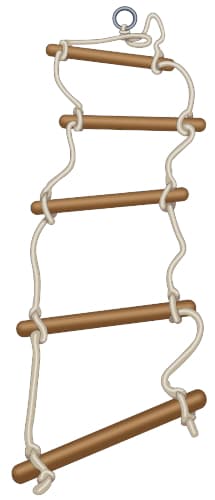
Rope-ladder style emergency solutions solve a different problem: storage and deployability. They can be stowed compactly, and on high-freeboard boats a line tied to the bottom rung can make the difference between a ladder that helps and one that stays out of reach. That small detail is huge, because a ladder you cannot reach from the water does not help you recover yourself.
The same logic applies to boarding angle. A ladder that hangs too steeply or starts too high off the water forces a tired swimmer to climb almost straight up. A better setup gives you a lower first step, a cleaner angle, and enough depth below the surface that you are not trying to hoist yourself the instant your hands find the rung.
Stowage matters, but only after rescue works
Sailing DIY often starts with the storage question because space on a stern rail or transom is precious. That matters, but only after the ladder passes the water test. A beautifully tucked-away ladder that takes two hands, a long reach, or a calm sea to deploy is a poor answer when cold water and surprise have already stolen your margin.
This is why the better emergency products in the safety-gear market are marketed as overboard-reentry tools. They are built around the reality that heavy wet clothing, shock, and exhaustion make climbing back aboard far harder than any calm, dry mockup suggests. The smartest stowage plan is the one that keeps the ladder secure at sea and instantly available the second you need it.
- Can a person in the water actually reach it?
- Does it deploy with one hand or under one simple motion?
- Will it still be usable if you are wearing foul-weather gear and boots?
For retrofit work, that usually means thinking through three questions before drilling anything:
If a new mount solves storage but makes the ladder harder to grab, the retrofit has missed the point.
The bigger safety system around the ladder
The Coast Guard treats boating safety as a loss-of-life issue, not a style choice. Its Boating Safety Division says its job is to reduce loss of life, injuries, and property damage on U.S. waterways, and the agency’s accident statistics track reported recreational boating accidents and incidents across all 50 states, five U.S. territories, and the District of Columbia. That broader picture is the reminder every sailor needs: overboard recovery is not a niche problem.
The Coast Guard’s person-overboard guidance drives the point home. Most people do not know they are going to fall overboard until it happens, which is why planning has to come before the accident. In fishing-vessel disasters from 2010 through 2014, 96% of fishermen reported wearing a PFD or immersion suit survived, compared with 73% of those not reported to be wearing one. That is a hard number, and it puts the ladder in context: flotation buys time, but a ladder can finish the job.
Ohio Department of Natural Resources boating-safety guidance says solo boaters should anticipate the need for self-rescue and prepare for it in advance. That advice fits sailboats perfectly. If you are sailing alone, or even just running with a small crew, you need to assume the recovery will start with you and the gear you can reach from the water.
The dock test is not enough
Launer’s home-water perspective makes the lesson feel close to the boatyard, not abstract. He lives off Barnegat Bay in New Jersey and sails his schooner Delphinus from home, which is exactly the sort of real-world setting where gear either earns trust or gets exposed. A ladder that works when you are calm at the dock may still fail the more honest test of a cold, panicked climb.
The best boarding ladder is not the prettiest one and not the one that folds away most neatly. It is the one that a tired swimmer can reach, deploy, and climb without help. In a real overboard fall, that is the difference between a hard day and a rescue plan that actually works.
This article was produced by Prism’s automated news system from verified source data, official records, and press releases, then run through automated quality and moderation checks before publishing. The system is built and supervised by the people who set the standards it runs under. Read our full AI policy.
Did this article answer your question?


