Wet Towel Tames a Loose Helm on Simple Sailboats
A wet towel can buy you a few hands-free moments at the helm, but only if you understand the friction it creates and the limits of the fix.
A loose helm is not a small annoyance when you are short-handed
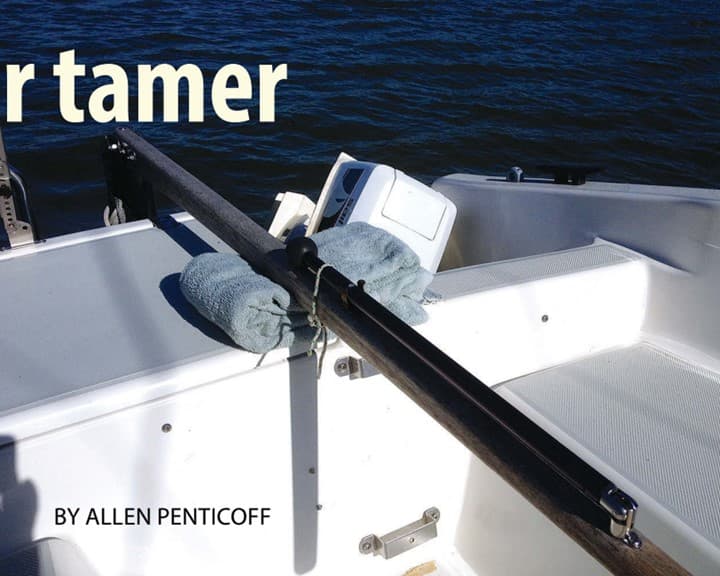
A loose tiller can turn a simple hands-free moment into a cockpit scramble. Allen Penticoff’s trick is appealing because it solves that problem with something already aboard, not with another piece of hardware you have to buy, mount, or remember to maintain. On a calm day at anchor, with the painter let go and the boat drifting under bare poles, the problem becomes easy to see: the tiller wanders when nobody is holding it, and a little extra resistance can keep it from flopping around.
That is the heart of the idea. A wet towel does not magically steer the boat, and it is not pretending to be an autopilot. It simply adds drag, enough to slow the tiller’s casual wandering and give you a short breather while you trim a sail, reef, stow gear, or sort out the cockpit without fighting the helm every second.
Why a wet towel works when a dry one fails
The key detail in Penticoff’s trick is dampness. A wet towel becomes a little tacky against fiberglass, which gives it grip; a dry towel slides too easily to hold the tiller in place. That small change in surface feel is what turns an ordinary piece of gear into a crude tiller tamer.
That matters because the fix depends on friction, not force. You are not locking the helm solid or asking the towel to do a job it cannot do. You are just creating enough resistance to tame the loose motion that makes singlehanded sailing or short-handed boat handling feel more frantic than it needs to be.
The best part is that the arrangement is reversible. When the moment passes, the towel comes off and the helm is free again. There is no permanent installation, no screw holes, and no device left on the boat after the need for it has gone.
Penticoff’s background makes the hack feel earned, not gimmicky
The story lands because Penticoff is not presenting a dockside brainstorm from someone who has only watched boats from shore. Good Old Boat identifies Allen Penticoff as a contributing editor, freelance writer, sailor, and longtime aviator. It also says he has trailer-sailed on every Great Lake and on many inland waters, with keelboat adventures on both fresh water and salt water.
That range matters. A sailor who has spent time on the Great Lakes, inland waters, and offshore-style keelboat sailing knows the difference between a clever trick and a useful one. This is not a magic fix for every situation; it is a practical answer from someone who understands that boat handling often comes down to small, immediate improvements that buy you time.
The real insight is not just that a towel can hold a tiller. It is that a good DIY sailor looks first for friction, leverage, and placement before reaching for a manufactured solution. That mindset is what makes low-dollar fixes worth studying, because sometimes the difference between calm control and a cockpit dance is just a little more resistance in the right place.
Use it for brief hands-free moments, not for a broken boat
The towel trick earns its keep during short pauses. It is useful when you need both hands for a few seconds or a few minutes, especially while trimming, reefing, organizing the cockpit, or making a quick adjustment forward. In that narrow window, the extra drag can keep the tiller from wandering far enough to become a nuisance.
It is even more attractive because it matches the way shorthanded sailors actually work. You may only need to release the helm long enough to eat a snack, take a drink, or move forward to make an adjustment. A properly set up tiller tamer and a balanced sail plan can keep a boat sailing itself long enough for exactly that kind of pause, according to the Swallow Yachts Association.
But the trick has a boundary. If you find yourself depending on the towel to hide a helm that will not behave, the issue is no longer temporary hands-free steering. That is when you stop improvising and start looking for the real cause, whether it is the tiller itself, the boat’s balance under sail, or a steering setup that needs proper attention.
How this homemade fix fits beside purpose-built tiller controls
Penticoff’s towel sits at the simplest end of a long line of tiller-holding ideas. Practical Sailor says it has reviewed several devices over the years, including the Davis Tiller-Tamer on October 1, 1992, the Tillerstay on April 15, 1997, the Tillermate on April 1, 2005, and the Steer-iT on April 1, 2008. The need is not new. Sailors have been looking for a way to let go of the helm for short periods for decades.
Davis Instruments describes its current Tiller-Tamer as a system that maintains cruising course with no hands, in any weather or wind condition, with tension that is smoothly adjustable from fully locked to fully free. Practical Boat Owner describes the same device as a line-based friction setup with an adjustable friction screw mounted on a spring, screwed to the top of the tiller. That is a very different solution from a towel, but the goal is the same: controlled resistance instead of a free-swinging helm.
Seen that way, the wet towel is not a rival to proper gear so much as the quickest version of the same idea. It uses friction without committing to hardware. It is useful when you want to test the concept, buy yourself a few minutes, or solve a problem right now with what you already have aboard.
Know when the hack has done its job
The wet towel trick is worth remembering because it is cheap, immediate, and reversible. It can steady a loose helm long enough to make the boat easier to live with during short-handed moments, and it does it without asking you to install anything permanent.
Just do not confuse a temporary friction fix with a cure for a boat that is out of tune. If the tiller still feels wrong, if the boat will not settle into a balanced sail plan, or if you need more and more improvised drag to keep the helm in check, the real answer is to address the underlying steering and balance problem. The towel is a smart helper, not a substitute for a boat that is properly set up to sail straight.
This article was produced by Prism’s automated news system from verified source data, official records, and press releases, then run through automated quality and moderation checks before publishing. The system is built and supervised by the people who set the standards it runs under. Read our full AI policy.
Did this article answer your question?