Soldered Boat Wiring, reliable electrical fixes for older sailboats
A shiny solder joint is not the goal offshore. The real win is a connection that stays alive through vibration, corrosion, and years of salt air.
When a dead light or weak bilge pump starts with one bad joint
On an older sailboat, electrical trouble rarely announces itself in a tidy way. A cabin light flickers, a windlass hesitates, a switch feels fine until it does nothing, and suddenly the problem is not the device at the end of the wire but the joint hidden in the run. That is why David Lynn’s approach matters so much: he treats soldering as a reliability decision, not a craft project, because one poor connection can turn into intermittent failures that are miserable to trace when you are underway or trying to leave the dock.
Lynn, a Good Old Boat contributing editor and former U.S. Navy electronics technician, writes from the kind of practical background that fits older sailboats perfectly. Those boats often carry original wiring, a few generations of owner-installed fixes, and terminals that have spent years in salt air. The lesson is simple but unforgiving: if the connection cannot survive moisture, vibration, and time, the circuit will eventually fail.
Where solder belongs aboard, and where it does not
Solder can be the right answer in marine wiring, but only in the right place and only when the work is done correctly. The broader marine rule set makes that clear. ABYC Standard E-11 is the main marine electrical standard in North America, and its focus is not just function but fire risk, shock hazard, and long-term reliability. The United States Coast Guard also requires electrical equipment and installations to be suitable for the vessel’s roll, pitch, and vibration underway, which is exactly the punishment a sailboat delivers.
That is why the argument is never simply solder versus crimp. The real issue is mechanical support. ABYC guidance says solder should not be the sole means of mechanical connection in a circuit, and if a connection is soldered, it needs support so flexing is minimized where the conductor changes from flexible to effectively solid. In plain sailing terms, a soldered joint that hangs in space and takes strain at the wire transition may look neat on the bench and still fail at sea.
What separates a durable marine connection from a pretty one
A durable marine connection is not defined by shine alone. It is defined by how well it resists vibration, how well it keeps moisture out, and whether the wire is supported so the joint is not forced to carry movement. That matters because the marine environment attacks connections from both sides: vibration works the metal loose, and moisture pushes corrosion into any gap it can find.
That is why recent boating coverage keeps circling back to the same theme. Practical Sailor has framed corrosion-proof electrical connections as a recurring refit task, and Practical Boat Owner has walked readers through soldering and de-soldering boat-wire joints. West Marine’s wiring guidance also emphasizes ABYC standards and secure connections. The common thread is unmistakable: on a boat, a connection has to be electrically sound, mechanically secure, and sealed against the environment.
One industry source citing BoatUS Marine Insurance claims data says corrosion accounts for roughly 40% of electrical failures on recreational and commercial vessels. Treat that as a reported industry estimate, not a universal law, but it still shows why marine wiring problems so often begin with a connection that looked acceptable until the first wet, vibrating passage exposed its weakness.
Preparation is what keeps the repair from becoming the failure
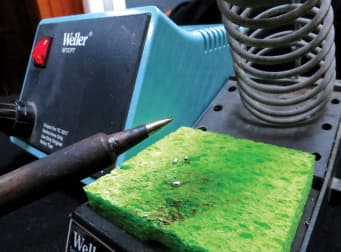
Lynn’s article puts real weight on preparation because boat electrical work is rarely clean or convenient. Before the iron ever touches the wire, you need a suitable work area, the right supplies laid out, a soldering iron with a properly tinned tip, and a damp sponge for cleaning the tip as you go. That may sound basic, but on a cramped older boat, bad setup is how bad joints happen.
Good preparation also means thinking through the repair before you start heating anything. If you are replacing a section of wire, updating a circuit, or repairing a terminal that has already been compromised, have the materials ready so you do not stop halfway through and leave the joint exposed longer than necessary. The more chaotic the jobsite, the more likely it is that heat, contamination, or movement will spoil the connection.
The practical sequence that matters
1. Strip and inspect the conductor so you know what shape the wire is really in.
2. Tin the iron tip properly and keep it clean with the damp sponge.
3. Make the splice or termination with the parts positioned so the joint does not have to carry bending load.
4. Support the finished connection so the wire cannot flex right at the solder transition.
5. Seal and secure the assembly so moisture and vibration do not undo the work later.
That sequence matters because soldering is not just about melting metal. It is about controlling heat, motion, and support so the finished joint behaves like part of the boat, not a fragile afterthought.
Why older sailboats need this skill more than new ones
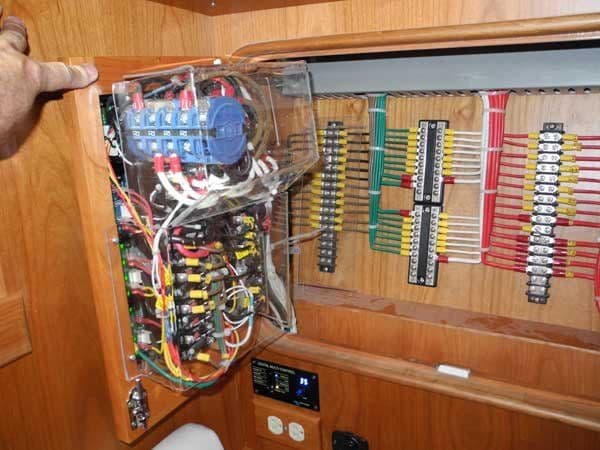
Older sailboats are where this topic becomes more than theory. Their electrical systems often reflect decades of repairs, upgrades, and improvisation. You may find original wire next to newer additions, old terminals beside fresh ones, and a few mystery splices that worked well enough until one wet season or one hard passage exposed the weak point.
Learning to solder well gives you a practical edge in that environment. It can reduce dependence on expensive service calls, make troubleshooting less intimidating, and help you restore reliability when a dead circuit appears at the worst possible moment. Just as important, it gives you a way to think about the system as a whole: every joint along the circuit matters, not only the device at the end.
The real payoff offshore and at the dock
The payoff for doing this right is not cosmetic. It is the confidence that a light will stay on, a bilge pump will keep working, a switch will respond when you need it, and a charging or control circuit will not fail because of a hidden weak link. David Lynn’s experience, shaped by years as a U.S. Navy electronics technician before he became an electrical engineer, gives the advice its shop-tested weight.
For older sailboats, soldering is part of a larger discipline: build for vibration, respect corrosion, and support every conductor so the joint is not asked to do a job it cannot survive. A connection that looks neat is nice. A connection that stays alive after a wet, rolling passage is the one that counts.
This article was produced by Prism’s automated news system from verified source data, official records, and press releases, then run through automated quality and moderation checks before publishing. The system is built and supervised by the people who set the standards it runs under. Read our full AI policy.
Did this article answer your question?