Cabinet latches that stay shut in rough seas
A hatch that looks tidy at the dock can turn into flying gear offshore. The best latches survive heel, pounding, and slam loads, and the safest swaps are often the simplest.
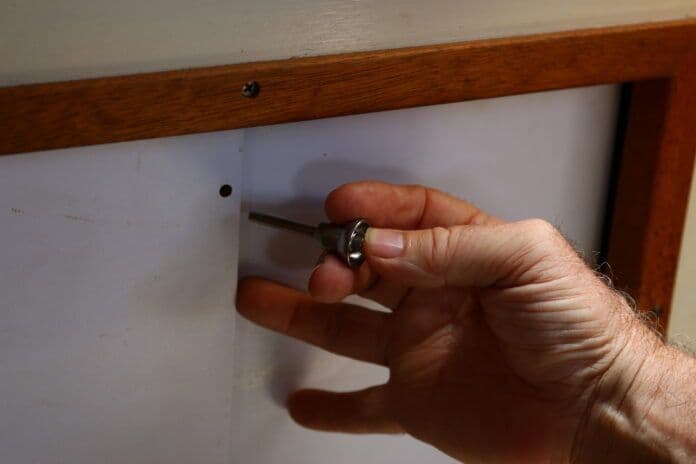
Drawers can fly open, locker lids can launch, and loose gear can turn a cabin into a hazard when a boat starts slamming, rolling, or getting knocked down. The latch that feels fine in the marina is not the one that matters offshore.
What actually fails at sea
The failure mode is brutally practical: a cabinet that opens on a calm day can dump heavy contents the first time the boat pounds hard on a reach or heels sharply on port tack. Nigel Calder says that once closed, cabinets, drawers, and hatches need to stay closed no matter the heel or the pounding. The wrong latch is not just annoying, it is a safety defect waiting for weather.
Calder’s warning is especially sharp for drawers that open athwartships. Pounding can work them loose and let them fly open, which is exactly the kind of failure that turns a tidy galley or nav station into a cleanup job with broken dishes and bruised shins. He also flags locker-access hatches in cabinsoles as dangerous if they come off in a knockdown, because a lid that flies free in rough conditions can do real damage belowdecks.
Loose objects make the problem worse. Unsecured items can endanger both crew and yacht in rough weather, and checking that the boat is secure before sea sailing should be a regular habit. That warning lands hard on cruising sailboats, liveaboards, and older boats, where original catches may be tired and lockers may now hold heavier gear than the builder ever imagined.
The hardware that earns trust
Not every latch deserves the same respect. Calder prefers spring-loaded button latches over finger latches, and the reason is more than convenience. A finger latch can become a finger-breaker if the boat lurches while someone is opening it, which is a painfully specific reminder that the best marine hardware has to work when the deck is moving underfoot.
For drawers that open athwartships, Calder recommends backup barrel bolts or similar locking hardware. That extra mechanical stop matters because a simple catch may hold fine in the slip and fail once the boat starts pounding. For locker-access hatches in cabinsoles, he goes further and says ocean-voyaging boats should lock them in place so they cannot pop free when the boat is thrown around.
That gives DIY owners a clear order of operations. Start with the closures that protect the heaviest or most dangerous contents. Then move to the latches that protect people, especially wherever a hand reaches for a handle while the boat is already in motion.
- Replace worn finger latches with spring-loaded button latches on high-use cabinets.
- Add barrel bolts or similar secondary locks to athwartships drawers.
- Secure locker-access hatches so they cannot fly off in a knockdown.
- Check hinges, catches, and strikes on any locker that carries heavy gear, dishes, tools, or spare parts.
A good shortlist usually looks like this:
How to test latches like you sail
The best test is not visual. It is physical. A latch should survive the same abuse the boat will deliver: load, vibration, and slam. Pack the locker with the heaviest items you normally carry, close it, and then try to make it fail with side loads, repeated opening and closing, and the kind of jolt that mimics a sharp heel or a hard landing.
What you are looking for is simple. Does the latch stay engaged when the door or drawer is jarred? Does it rattle loose after a few hard hits? Does the mechanism still operate cleanly when the boat is loaded, not just when it is empty on the bench? If the answer is no, it is not ready for rough water, no matter how neat it looks.
This is where a lot of older boats get exposed. Owners often inherit tired hardware and then add more weight, more gear, and more cruising ambition without changing the closures that hold it all shut. A latch that survived a bare-bones weekend boat may not survive a fully provisioned passage boat.
Why the safety world treats this seriously
The American Boat & Yacht Council develops globally recognized standards for boat design, construction, repair, and maintenance, and says its work has helped reduce boating accidents over the past seven decades. ABYC has existed since 1954.
The U.S. Coast Guard Auxiliary’s Vessel Safety Check program discusses required safety equipment and safety features specific to the boat in a check that typically takes 15 to 30 minutes.
United States Power Squadrons has nearly 20,000 members organized into more than 300 squadrons across the country.
This article was produced by Prism’s automated news system from verified source data, official records, and press releases, then run through automated quality and moderation checks before publishing. The system is built and supervised by the people who set the standards it runs under. Read our full AI policy.
Know something we missed? Have a correction or additional information?
Submit a Tip