Catamaran Rebuild Tests Epoxy Skills After Mangrove Sinking Disaster
After 52 days sinking in a Grenadian mangrove, Raff and Sasha’s catamaran showed how fast a DIY repair becomes a structural decision.
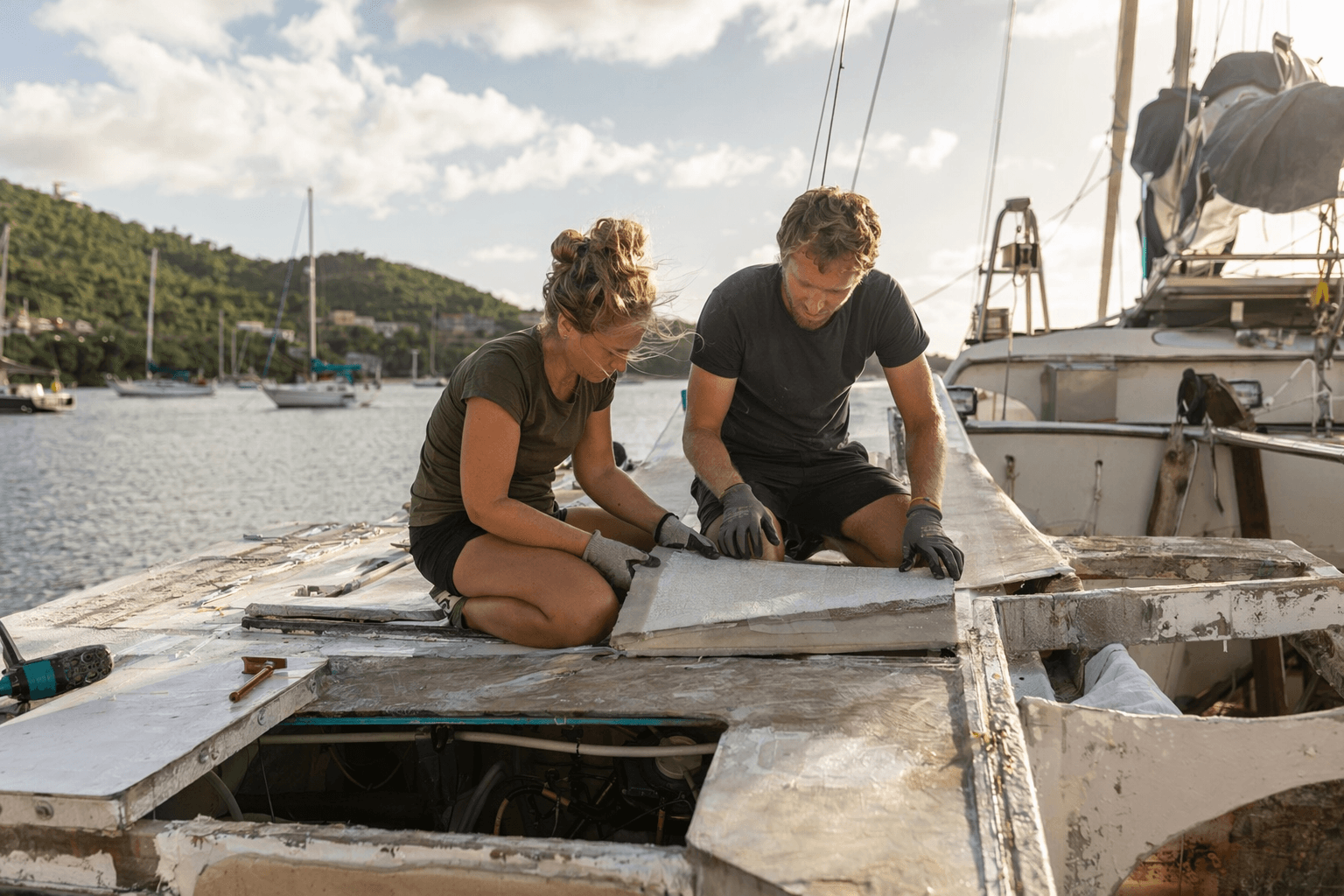
The hardest part of this catamaran rebuild was never the glass dust or the bad news. It was the moment a mangrove sinking turned into a judgment call: when a damaged boat is still a repair, and when it has become a structural project that can go wrong fast.
Raff and Sasha’s Spear It Animal spent 52 days sinking in a Grenadian mangrove before the boat was hauled 40 miles south to Spice Island Marine in Grenada. Episode 95 of the rebuild showed the work that follows a disaster like that, not in glossy before-and-after form, but in the awkward reality of overhead epoxy, grinding, and a broken crossbeam being lowered with ropes and ratchet straps. For owners staring at a soft deck or a hidden impact, the lesson is plain: once the structure starts talking, every step matters.
Outside, Darren and Jay from Fiberglass Pro Grenade Unlimited cut out rotted balsa core from bow to stern and replaced it with composite foam coring before laying glass back over the damage. That sequence matters as much as the materials. Rotten core is not cosmetic. It means the laminate has lost support, and on a multihull, that kind of loss can spread into the beam, deck, and load paths that keep the hulls working together. The boat, identified elsewhere as a Lagoon 450 SportTop catamaran, is large enough that a mistake in one area can echo through the whole platform.
Inside, Raff and Sasha ran into the part of repair work that punishes inexperience: overhead epoxy. Their first mixes of milled fiber and silica thickener sagged as the epoxy warmed up and exothermed, so they had to adjust the recipe and add longer milled glass fibers to give the fillet enough backbone to stay put. That is the practical dividing line for DIY sailors. If a repair is horizontal and forgiving, you have room. If it is overhead, structural, or heat-sensitive, the margin disappears quickly.
That is also why the story resonates beyond one wrecked catamaran. Spear It Animal says Raff and Sasha started with essentially zero sailing experience, bought their first catamaran in spring 2020, and headed into the Bahamas on Sept. 9 during hurricane season. The improvised, learn-as-you-go mindset that launched the channel is the same mindset now being tested against real structural damage, with help from a yard that has operated since 1984 in True Blue, St. George.
The backdrop explains why the repair is so severe. Hurricane Beryl hit Carriacou on July 1, 2024 as a Category 4 storm with sustained winds reported around 140 to 150 mph. Humanitarian assessments said 98 percent of infrastructure in Carriacou and Petite Martinique was destroyed, and NASA said practically all structures on Carriacou were damaged. Multihulls World also reported that looters had been aboard and both engines were missing. By the time the boat was ready to be flipped right-side up after seven weeks of preparation, the rebuild was already past the point of casual DIY and deep into the kind of work where sequencing, support, and outside expertise decide whether a boat sails again or stays in the yard.
This article was produced by Prism’s automated news system from verified source data, official records, and press releases, then run through automated quality and moderation checks before publishing. The system is built and supervised by the people who set the standards it runs under. Read our full AI policy.
Did this article answer your question?